New WoodChat!
Home Articles Forums Gallery Marketplace Videos

WoodCentral Forums

Knowledge You Can Build On — Est. 1998

Good Hope Hardwoods - Walnut Slabs & Specialty Hardwood Lumber

How do you start a mortise?

Posts

How do you start a mortise?

#1

How do you start a mortise?

Wiley Horne--So. Calif.

Hi All,

Am mortising this morning, and sorta compared a couple different approaches. I got curious how others like to start the mortise, and what your general strategy is.

Of course, there are different woods, different locations in that wood for mortises, and different shaped mortises. All of which complicate discussion. So, to simplify, can we talk first about a 1/4" wide mortise, 2" long say, and 1" deep, into the edge of a north American hardwood like maple, cherry, walnut, oak, beech, birch.

I tried two different methods.

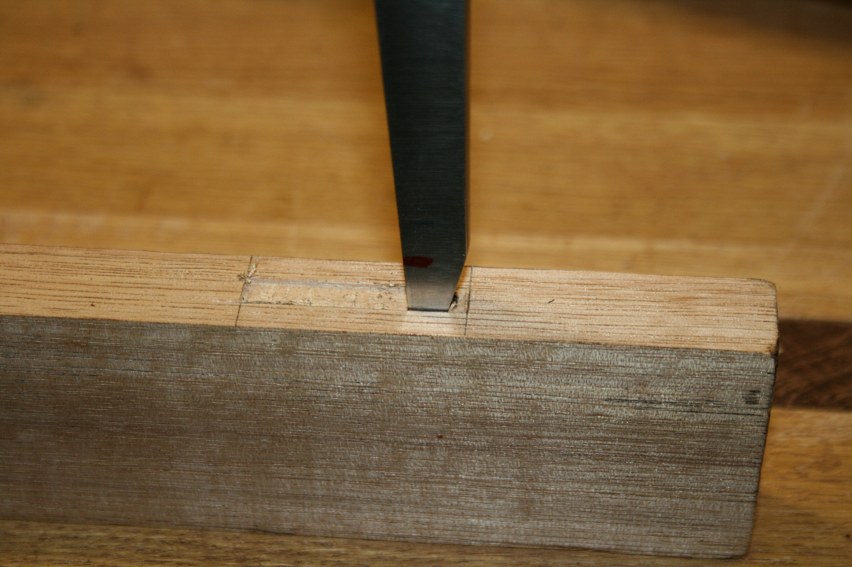
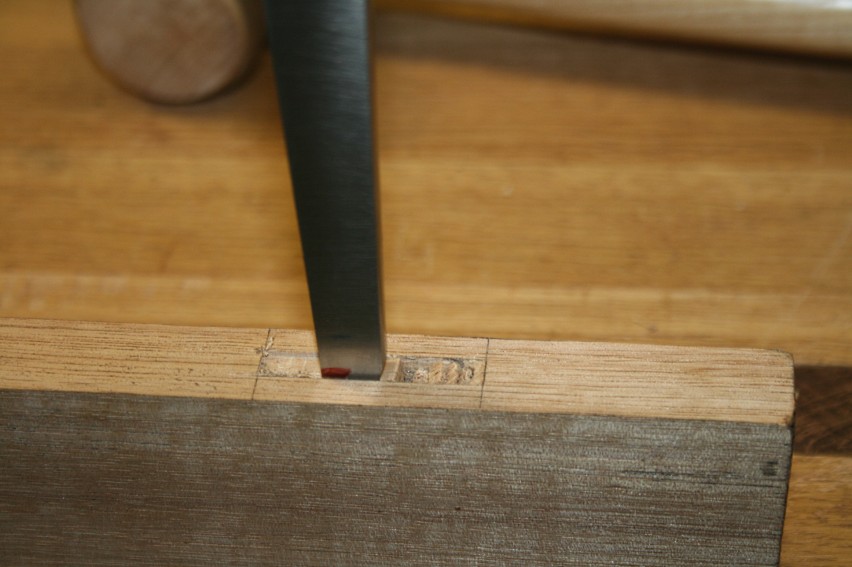
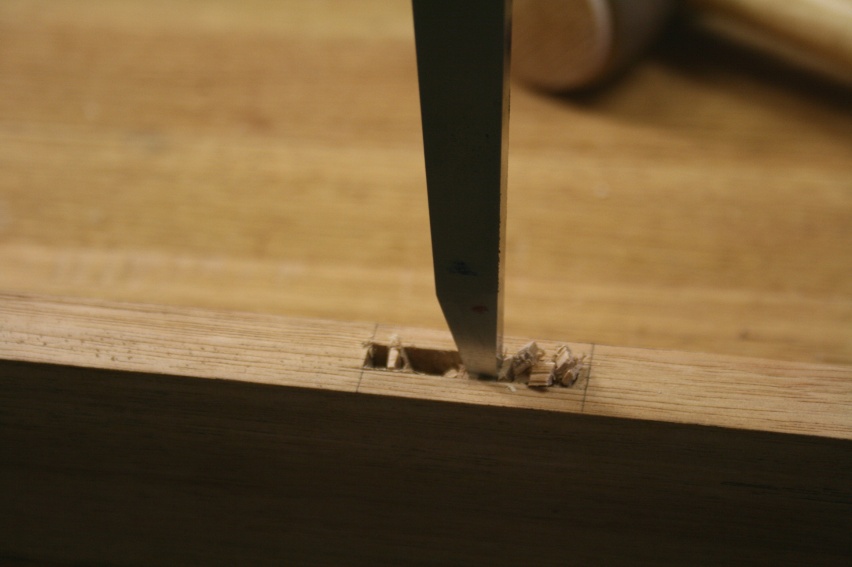
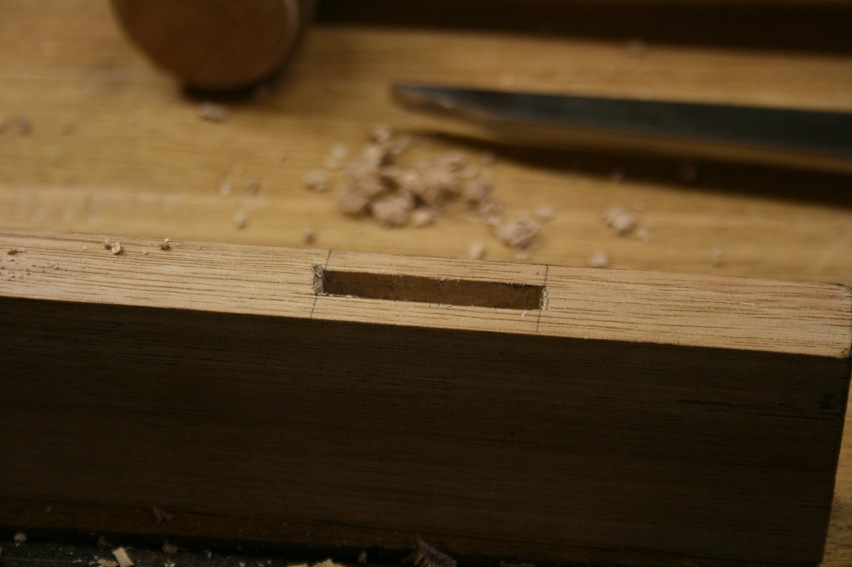
Method 1: Start with V in the middle. Make both arms of the V with bevel facing outward. First cut at fairly steep chisel angle, so the V that is removed initially is about 30 degree included angle, and maybe 1/2" deep in birdseye maple. Second pair of cuts extends and deepens the V, again with bevel facing outward on each pair of cuts. When bottom is reached, widen cut by sixteenths or eighths. Strategy: Get to the bottom of the hole as soon as possible, bust loose wood into the center cavity by action of the chisel strike, and minimize the amount of levering intact wood.

Method 2: 'Typewriter' method. Start with series of cuts directly down, spaced say 1/8" apart. With bevel out. Then come back the other way, with bevel out the other way, splitting the difference and making cuts straight down in between the first series of cuts. This created a pile of loose chips, no intact grain, about 1/4" deep in birdseye maple. To clear some waste, run the chisel laterally like a shovel, and scoop about 1/4" deep of this loose rubble. You're now down 1/4". Repeat til you get to bottom of hole.

Brief comparison of methods: In my hands, starting with the V and getting to the bottom fast minimized the amount of levering intact chips I needed to do. Most of the waste was cut clean and could be lifted out. The typewriter method, again in my hands, produced a cleaner mortise--the control was better--but there was more levering, especially after the first layer. As the cut got deeper, I was doing considerable scraping with the chisel to get the waste out.

What do you folks do?

Wiley

Re: How do you start a mortise?

#2

Jack Guzman from Maine

Re: How do you start a mortise?

Jack Guzman from Maine

Wiley,

When I chop a mortise I start chisel back toward me inside the line a bit and drive straight down.I then come back at an angle to chop out a "v" shaped chunk. Back to the fist cut and go deeper,go further out to remove more wood to enlarge the "v" opening. I repeat til I hit my bottom. Then I just keep enlarging til I get near the end then define the opposite end with a straight deep cut slightly away from the line and then clean it all up. I alter this somewhat for short mortises but it is my basic system.---Jack This was harder to put into words than it is to do.

Re: How do you start a mortise?

#3

Re: How do you start a mortise?

Patrick Gibbons

Usually the first thing I do is use the chisel bevel-down with hand power and make shallow cuts down the length of the mortise and then lay the chisel flat on the board and run it down the mortise to take those chips out. This defines the mortise and keeps the walls crisp. Then I define one end and lever out to almost final depth. Then I work my way to the other end. Finally I finish up by defining the opposite end. Adam Cherubini outlined a method I believe he got from Moxon using no mallet. I've tried it with success but find myself going back to my old method because of it's familiarity. To quote a line from the movie Orphe. "There's nothing more habit forming than habit."

Re: How do you start a mortise?

#4

Re: How do you start a mortise?

Warren in Lancaster, PA

I start with the chisel straight up and near the center of the mortise, bevel away from me. Then I continue with the bevel away, working toward the far end, chisel always straight up. The chisel rides on the bevel. At the far end, I turn the chisel around (bevel toward me) and work towards the near end, chisel straight up, riding on the bevel.

Re: How do you start a mortise?

#5

Re: How do you start a mortise?

John Pappas

I've done the "chop in the center to achieve depth" way, and also used the "chop a layer at a time" method. With the layer method I first make a deep cut in one end to create clearance for subsequent chips. (Some folks drill a hole to accomplish this.) This initial cut, a bit less than a quarter inch deep. Then I chop a layer at a time with the bevel forcing the chip into the clearance area, scooping out the chips as I go. Create a new clearance for the next row, and repeat.

Re: How do you start a mortise?

#6

Re: How do you start a mortise?

Wiley Horne--So. Calif.

Thanks for the description, Jack!

I like the V method also, starting somewhere near the middle. I like it because, once the V is dug out, you can 'ride the bevel' (as Warren says) down each slope of the V, taking 1/8" slices, and the slices come loose in blocks and fall into the center cavity.

Wiley

Re: How do you start a mortise?

#7

Re: How do you start a mortise?

Wiley Horne--So. Calif.

Patrick,

Thank you. In this approach, I take it you gauge the mortise first, so that the initial hand-power cuts are within the gauge lines. It sounds like after this first phase, you shift to the V method (starting at one end).

I sorta recall Adam talking about mortising by paring. I don't think he found the method in Moxon though--Moxon says "...with your Mallet knock hard upon it..." (Joinery, Section 17).

Wiley

Re: How do you start a mortise?

#8

"Riding on the bevel"

Wiley Horne--So. Calif.

I spent much of today's session mulling over exactly what it means to ride the bevel, and what the consequences are.

Here's what I came up with. It seems like that anytime the chisel is either straight up, or tilted in the bevel direction, then you're technically riding the bevel. But if the chisel is tilted away from the bevel, it's riding on the face (or back).

Consequences: If the chisel is riding on the bevel, then the face (which has sharp edges) will be driving chips before it, shearing them loose and shearing the sidewalls smooth at the same time. If the chisel is riding on the face, then the bevel side will be driving chips. This is less effective, because most mortise chisels are more or less trapezoidal in section, so that the bevel side will be slightly narrower than the face. Hence, if you're riding on the face, then you won't get the shearing action on the chips--the chisel is tending to wedge rather than shear. It'll wedge itself stuck, too.

That was my lesson for today. Hope it's partly right.

Wiley

Re: How do you start a mortise?

#9

Re: How do you start a mortise?

Wiley Horne--So. Calif.

Thanks John! How do you compare the two methods? Do you have a preference? I guess on short mortises, there isn't much practical difference, but on longer ones, there will be, I think.

Wiley

Re: How do you start a mortise?

#10

Re: "Riding on the bevel"

Warren in Lancaster, PA

1)If you ride on the back, you tend to jam the chips down into the mortise (because of the slanted bevel). So some of the effort goes into compacting chips. If you ride on the bevel the chips do not get as compacted.

2) If you ride on the bevel you are cutting at 60 degrees from the grain. If you chop straight down it is 90 degrees to the grain, tougher to cut and rougher on the edge.

3) If you ride the bevel the chisel moves horizontally through the area already cut, which will true up the sidewalls and helps jig the chisel for a straighter cut.

Re: How do you start a mortise?

#11

Re: How do you start a mortise?

John Pappas

Wiley, I tend to do layer, only because it was the first way I tried and found it worked for me. No strong preference. Must say that I am a casual woodworker....a fair woodworker, but no real credentials to validate my approach. However, since you raised the question I just might review both methods.

Re: How do you start a mortise?

#12

A fourth method

Derek Cohen (in Perth, Australia)

Hi Wylie

Thanks for the topic. It reminded me to update my website tutorial, which was last written 4 years ago. I changed the way I mortice about a year ago following some experimenting.

The following method is different from either of your methods, and also differs from Warrens'. I think it is the most efficient and easy strategy I have tried to date. I look forward to all comments.

There is a full step-by-step pictorial at this link: http://www.inthewoodshop.com/Furniture/MorticingByChisel.html

The wood here is Tasmanian Oak, which is a little harder than White Oak. The essence of the strategy is to first drill a hole at one end. This is space for waste chips ..


The second strategy is to only chop straight down, and to do so in 1/8" increments ..


You will be progressively able to reach the depth of the mortice ..


Once at the end, turn the chisel around and return ..


The waste is easy to remove. There is very little levering to do.


The final result is satisfactory ...


More details on the website.

Regards from Perth

Derek

Re: How do you start a mortise?

#13

Re: A fourth method

Wiley Horne--So. Calif.

Hi Derek,

A beautiful pictorial demo! A strong method. And fast.

I notice that the long slim bevel of the chisel fits well with the basic strategy, getting great depth right away.

The initial 'shouldering' of the mortise is also used by Patrick.

The one modification I would suggest for you and others to try out in conjunction with this method is Warren's advice to 'ride the bevel'. That is, keep the face of the chisel aimed toward the open area. You want the face of the chisel (not the bevel) driving the chips toward the open area. You get the shearing action of the face, which will be very sharp, and wider than the bevel if the chisel is trapezoidal. The exception being the last 1/16" at each end, where the ends are being defined.

In your picture, those sidewalls would be sheared clean after your initial passes getting to full depth. I really hate sounding like a know-it-all, and I certainly don't know it all, am still learning after many mortises :) , but was very impressed yesterday by the results when I adhered to Warren's advice. Something to try when an opportunity presents, and see what you think.

Great demo of what I predict will be a widely-used method! I seem to recall Bill Tindall drilling a hole at one end....

Wiley

Re: How do you start a mortise?

#14

Re: A fourth method

Derek Cohen (in Perth, Australia)

Hi Wiley

I am happy to experiment some more, but ...

The method I use is not new by any stretch of the imagination. I did some research today and discovered that Chris Schwarz has also advocated this strategy, referring to it as the Maynard Method. Here is a link: http://www.wkfinetools.com/contrib/cschwarz/z_art/mortchisel/mortChis3.asp

The interesting feature is that the chisel in his example is facing the same way as I use it. What got me going was watching a hand morticing machine in action, and a light bulb went on. All I did was do by hand what the machine did.

My understanding is this: if the chisel face (as you refer to it - I think of it as the back of the blade, and the other side the bevel face) .... to be clear, the long flat side :) ) is driven straight down, it self-registers against the wall it cuts. The bevel, being wedge shaped, begin to push away waste as it drives down. If you turn the chisel around, in order to achieve the same effect you would have to lean the blade over at 20 degrees, which is the angle of the primary bevel.

Regards from Perth

Derek

Re: How do you start a mortise?

#15

Support for your position--Link

Wiley Horne--So. Calif.

Hi Derek and all,

Below is a link to Jeff Gorman's commentary on the Maynard method. Apparently, Maynard originally presented the method with the chisel bevel facing away from the starting hole. In this link, Jeff Gorman tested both methods--bevel toward and bevel away--and determined that bevel toward the hole worked best. He explains why, and shows why. This is pretty definitive support for your's and Chris's method.

http://www.amgron.clara.net/maynard40.html

So I retract my recommendation to test 'bevel toward the hole' with respect to the 'drill a hole first' method--it's already been tested and found not as good. I apologize to Warren for invoking his name, since it was totally my recommendation, and he might well have disagreed.

Down toward the bottom of Jeff's page, he shows the central V method, and there illustrates all cuts (except end cuts) made with bevel facing away from central cavity. I still prefer this one, and for the reason he states (to get shearing action from the chisel face), but predict that your's and Chris's 'modified Maynard' method will gain more adherents :) .

Good discussion! Thank you.

Wiley

Re: How do you start a mortise?

#16

Re: Support for your position--Link

Derek Cohen (in Perth, Australia)

Hi Wiley

I should silently include Mr Maynard and Jeff Gorman in this greeting as the following illustration comes from Jeff's website. It reflects what I was trying to explain about the bevel face facing the hole, but it also explains why the flat face faces the central V in that method ...


In the Drilled Hole version, the aim is to move waste towards the hole. This is accomplished, as I wrote before, by the wedge of the bevel face forcing the waste away from it. The important structural issue here is that the flat face of the chisel is held perpendicular for the wedging action to occur. As the flat face is supported, it maintains its perpendicular cutting angle.

In the V version, the flat face of the chisel faces the hole (created by the V). It is now the bevel face that is supported, and the cut will proceed inline with the primary bevel angle. This cause the chisel to cut in a V shape. The V is widened as this is the only shape possible with the chisel orientated in that direction.

I can see some advantage for the V at the centre - basically, the "waste hole" gets larger (as long as you remove chips as you go). Theoretically, however, the waste hole remains the same size as the Drilled Hole version, where the advantage for those such as myself is that it looks less complicated :)

Regards from Perth

Derek

Re: How do you start a mortise?

#17

Re: A fourth method

Warren in Lancaster, PA

So how long does it take to make a mortise that is 5/16 inches wide, 1 1/2 inches long, and 1 1/2 inches deep using your "most efficient method"?

Re: How do you start a mortise?

#18

Re: A fourth method

Derek Cohen (in Perth, Australia)

No idea "how long", Warren. Never timed this.

For myself - and likely anyone else who is an amateur - the focus is less on time and more on effort. I would rather point to the number of chisel cuts required in making the mortice. This what I consider reflects the efficiency of his method. There appears to be less fiddle-faddling amount - no need to chop deeper, to remove waste before doing so, or to straighten anything.

It is a little more effort than the V method insofar as the Hole Method first needs a hole, and the V method creates its own. In that sense, the V method is more efficient.

I think it may just come down to personality, preferences and perceived performance. I cannot get more precise that that :)

Regards from Perth

Derek

Re: How do you start a mortise?

#19

Re: How do you start a mortise?

Patrick Gibbons

Wiley, you understand correctly. Usually I'll gauge only one side and let the chisel determine the other side. If the location of the mortise is critical, I'll gauge both sides.

Re: How do you start a mortise?

#20

Re: A fourth method

Patrick Gibbons

Speed is nice but my concern is always keeping the mortise square to the face.

Re: How do you start a mortise?

#21

Re: A fourth method

Derek Cohen (in Perth, Australia)

Speed is nice but my concern is always keeping the mortise square to the face.

Hi Patrick

I agree.

There are two items to help achieve vertical: the first is to have a visual aid. I use the end of a clamp (which is why I do not use a hold down for the stretcher on the benchtop).


The second strategy is to chop as deeply as possible. It is similar to using a fast cutting backsaw when cutting dovetails - the fewer strokes, the less likelihood of going off course.

Regards from Perth

Derek

Re: How do you start a mortise?

#22

a test

John Pappas

You said, "1)If you ride on the back, you tend to jam the chips down into the mortise (because of the slanted bevel). So some of the effort goes into compacting chips"

Easy to veryify that:

Hold chisel 1/4 inch from end of board, bevel toward edge....chisel verticle. Chip shows compression and some movement.

Hold chisel 1/4 inch from end of board, bevel in...chisel verticle. Chip has more movement, and no compression.

Re: How do you start a mortise?

#23

Nice Drive by

Ron Harper

The Spofford Brace

Re: How do you start a mortise?

#25

Re: How do you start a mortise?

Tom

Vs normally. I take that back to a japanese method I first learned, but when I got a western stationary pedal mortiser, I was interested to see the fixed chisel rotate 180 degrees. Control will come with practice, getting the right chip out helps, the specific size, which is feel developed over a while.