New WoodChat!
Home Articles Forums Gallery Marketplace Videos

WoodCentral Forums

Knowledge You Can Build On — Est. 1998

Find a woodworking club near you

Gramercy dovetail saw - a brief review

Posts

Gramercy dovetail saw - a brief review

#1

Gramercy dovetail saw - a brief review

Derek Cohen (in Perth, Australia)

Just after New Year I travelled to Brooklyn to meet Joel Moskowitz, who runs Tools for Working Wood. After a great day playing with planes and saws and talking tools modern and old, Joel made me a gift of one of his dovetail saws. Joel was not aware that I had earlier planned to buy this saw, and so instead purchased his sash saw (a review for another time). The tool day did not end there as that evening my wife and I joined Joel and his family for a wonderful dinner ... and more tool talk .. I also learned where the name Gramercy comes from - it is the park near Joel's home.


The Gramercy dovetail saw is unusual. It should not work on my local hardwoods - not the 3/4" Curly Marri I have been dovetailing into a blanket chest. Not only is the tooth count high for hardwood - 19 ppi - but the saw is light, very light.

I've been using the saw for a little while now and it has become a favourite. I enjoy joinery and have several excellent saws, so this is high praise. One of my interests lies with tool design, and so have found the design of this saw a little perplexing. Why does it work so well? This is what I came up with.

Let's look at the saw ...


A 9" long skinny canted saw plate, with a cutting depth of only 1 1/4". At the toe it is a tad less that that. Compare this with the LN, which has a plate depth of 1 5/8" and a Wenzloff & Sons at 2".

Top-to-bottom: Independent Tools, LN, Wenzloff & Sons, and Gramercy.


The Gramercy weighs the least at 200 gms. The LN is 325 gms and the Wenzloff & Sons a whopping 400 gms in a shorter 8 1/4" plate. In part this is due to the brass backs: 1/2" for the Gramercy, and 3/4" for the others.

Was it the thin 0.18" saw plate and "aggressive" zero rake rip teeth? Well the LN has the same teeth configuration in a 0.20" thick plate and 15 ppi, while the Wenzloff & Sons is also 0.18" thick but 20 ppi. All a little different but not so much that the Gramercy should feel so different.

It was not simply the light weight that stood out. There were two other features of significance: The handle was clearly skinnier than the others, and its hang was completely different.


I like the LN handle. It is thick and solid. The rounder Wenzloff is even nicer. I am used to these handles. The Gramercy simply could not be held in the same way. Its thinness forced one to hold the saw lightly. Where one would consciously have to loosen the grip with the LN or Wenzloff, as these encouraged a strong hand, I found that I did not hold the Gramercy tightly to begin with. The lighter weight added to this effect as there was less to stabilise.

Then there was the higher hang of the handle. Compared with the others, the Gramercy appeared to convert more effort into more downforce.

In the end all I could come up with was that the Gramercy more naturally allowed the saw to do more of the work.

All the saws were used side-by-side to cut several dovetails. They are all excellent saws, but the Gramercy was just more relaxing, less effortful to use.


Regards from Perth

Derek

Re: Gramercy dovetail saw - a brief review

#2

Re: Gramercy dovetail saw - a brief review

david weaver

All things equal, the saw with the smaller plate will have to have a higher hang to feel the same in a given piece of wood.

It will be lighter and the location of the handle vs. the teeth would make it so that with less hang, it would want to just be pushed into the cut, there is no leverage at the teeth.

I don't know how else to put it, but I'm not surprised it works well. The only reason I have half a clue about any of this is that I had at one point made a high 3" thin plate dovetail saw out of a wenzloff set of parts, and I also made a high hang angle on the handle. It is a bear to use unless the work is up high in a vise. It would be nice with less hang or with a smaller plate.

As george always says, if you are making your own stuff, if you don't know enough to design (as I don't, at least not until after screwup) or don't have the skill to design (I don't), it is best to make dead copies of excellent examples.

Joel and his folks either did a lot of trial or they did their homework to come up with that good combination of bits.

Re: Gramercy dovetail saw - a brief review

#3

Re: Gramercy dovetail saw - a brief review

Patrick Gibbons

I've had mine, which I made from a kit, for about a year and a half and have used it on several projects requiring dovetails. This has been in hard and soft woods from 3/8" to 1 1/8" thick. The quality of cut is excellent although the speed of cut is less than the Simonds 10" saw I had been using. The hang of the handle is something I have not gotten used to yet. I find my hand shifting in position in use. It feels to me that a bench height less than what I have now would be more effective with this saw. With that said, I have used, and continue to use this saw for all dovetailing. It has remained sharp and accurate. As I age my eyesight declines. Nothing unusual there. But because of this I prefer to dovetail wood that is positioned as high up- as close to- eye level as possible. The hang of the handle is contrary to this objective. It has been a round tuit of mine to make a new handle with a different hang to try out. If and when this occurs I'll report back.

Re: Gramercy dovetail saw - a brief review

#4

I am no saw expert...

david weaver

but if you want to use a saw at moxon vise height, and you want to have lower hang, you will probably prefer a heavier saw than the gramercy.

I probably didn't elaborate anything well in my post yesterday, and I doubt it will change today, but the high hang is necessary to get a lighter saw like the gramercy to dig.

That's not to say it won't work at all with less hang, but I do think with less hang, especially at a high height, it will be leaving you wishing the rest of the saw was more aggressive.

Re: Gramercy dovetail saw - a brief review

#5

Re: I am no saw expert...

Derek Cohen (in Perth, Australia)

.. if you want to use a saw at moxon vise height, and you want to have lower hang, you will probably prefer a heavier saw than the gramercy.

I probably didn't elaborate anything well in my post yesterday, and I doubt it will change today, but the high hang is necessary to get a lighter saw like the gramercy to dig.

That's not to say it won't work at all with less hang, but I do think with less hang, especially at a high height, it will be leaving you wishing the rest of the saw was more aggressive.

Hi David

I will partially agree with you.

The high hang does, I believe, increase the downforce of the saw, and this is desirable in a light saw, such as the Gramercy. I had some communication from Ron Bontz, who is making some of the best backsaws at this time, and he agreed with my observation. Conversely, a saw with a lower hang benefits from a heavier construction, such as the LN (in the middle range when looking at it from the 15 ppi tooth count) and the heavier still Wenzloff (at the upper range, with its smaller 20 ppi tooth count, plus fleam, which would be more work to push). At the extreme level is the dovetail saw of Rob Cosman, which is built extra heavy (more brass and a composite handle), no doubt to get the 22 ppi teeth going.

The point about hang and the Moxon I would - respectfully :) - disagree on. OK, partially disagree. :) Sawing height interacts with the rake of the teeth. The higher the angle at which one saws, the greater the effective rake angle. In other words, one can reduce the aggressiveness of a saw by angling it upward, and increase its aggressiveness by angling it downward.
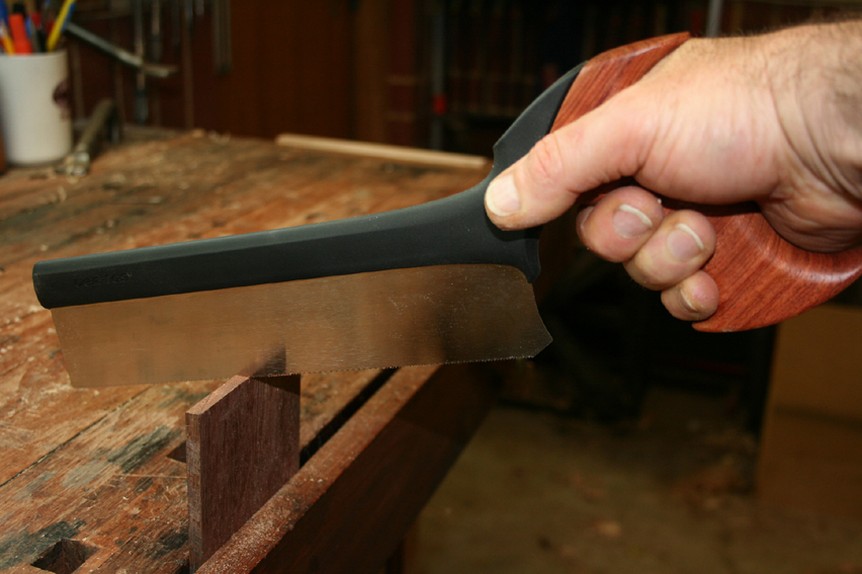
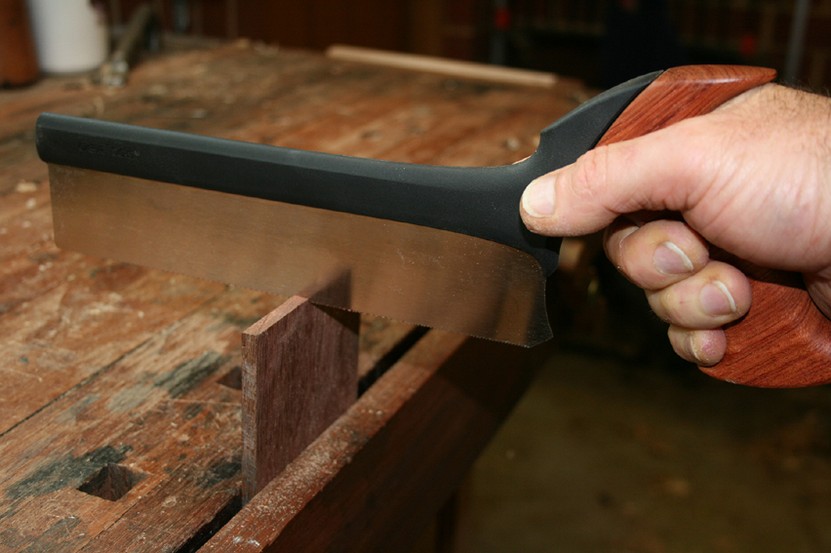
Based on comments made about preferred sawing methods by the following, I call this the "Rob Cosman" angle ...


... this the "Joel Moskowitz" angle ...


.. and this the "Adam Cherubini" ...


If you watch Rob in his videos he will talk about starting a saw cut with the gentlest of touches. In those videos he was using a LN saw with zero rake. No wonder the saw had a rep for being tricky to start. All one has to do is start it like Adam does, and it is a dream. Joel's saw is so light that it takes the weight off the teeth and it is the easiest of all to start on the level.

A Moxon makes it easier to reduce effective rake, and this makes sawing, especially starting, easier.

Regards from Perth

Derek

Re: Gramercy dovetail saw - a brief review

#6

Re: I am no saw expert...

david weaver

Derek, I agree with the last point, maybe I said it incorrectly. The high hang of the handle makes the saw easier for me to use on a moxon vise, when the saw started as one that's extremely difficult to start. It also gives you a tendency to saw "up the straws" instead of across or down them, which is nice of the saw has aggressive enough rake and hang to do that.

If it doesn't have the rake and hang combination, then weight is needed to make up for it, and I think the gramercy saw will lack weight enough that it won't be pleasant to use at with a low hang handle, even though the rake is there to make an aggressive cut, the ergonomics will have a user with a low rake handle pushing the saw across the wood rather than getting the digging stroke that you get with high rake.

I don't know, I could be wrong. I have made three saws that didn't cut like I expected, though, and know now what I'll do if I make a fourth. Until then, my high hang angle tall plated zero rake saw works fabulous in the moxon vise, but at bench height it would discourage anyone who is not experienced.

I do most of my sawing somewhere between your "joel" and "adam" pictures, it allows the use of an aggressive saw and one that doesn't have to be heavy to cut quickly. It also seems more "wood neutral".

Re: Gramercy dovetail saw - a brief review

#7

For clarification

Patrick Gibbons

It appears from the remarks made that if I change the hang of this saw it will alter its feel and how it cuts. This makes sense but I hadn't considered it prior to this. While this saw starts well, it does not start as easily as the Simonds does. My technique had been to cut across the full thickness of the board to start the cut. With this saw, starting at a corner is a better strategy.