New WoodChat!
Home Articles Forums Gallery Marketplace Videos

WoodCentral Forums

Knowledge You Can Build On — Est. 1998

200+ woodworking book reviews

shooting boards - flat or ramped

Posts

shooting boards - flat or ramped

#1

shooting boards - flat or ramped

Eric in Los Gatos

Well, it's time to take the plunge and build a shooting board (or two). My question is whether it's worth the trouble to do the inclined ramp scheme to get the shearing action. I'll be using a 5 or 7 for the time being but was thinking about a low angle jack plane as well.

I'd like to get your collective thoughts/experiences.

Thanks,

Eric in Los Gatos

Re: shooting boards - flat or ramped

#3

Re: shooting boards - flat or ramped

Derek Cohen (in Perth, Australia)

Hi Eric

The short answer is that they all work, a ramp works better, but the effort of building one depends on whether you have the time and inclination.

I have an article on my website that compares the LN #51 (skewed blade at 45 degree cutting angle), LN #9 (straight blade at 45 degree cutting angle) and the LV LA Jack (straight blade at 37 degree cutting angle, with and without a hotdog handle) on both flat and ramped shooting boards.

If you want the salient comments, here they are ...

Cutting angles and the effect of Skew

First and foremost there is a significant effect from the way that the cutting angle and the way in which the blade enters the wood.

In order of ease of the way that the blade cut end grain, the LN #51 was way out in the front of the pack. This was perceived to be due to a combination of factors: the mass of the plane (9 lbs for the #51, 4 ½ lbs for #9, and 6 lbs for the LAJ) and its 20 degree skew angle.

Second in this category was the LAJ. Again the mass is a likely factor, but so is the lower cutting angle (37 degrees versus the 45 degrees of the #9). Note that the cutting angle of the #51 is also 45 degrees, and this suggests that the (20 degree) blade skew plays a larger part than the (8 degrees of) cutting angle.

A similar factor was apparent with the shooting boards. The ramped boards were 5 degrees. While there is a much debate whether the ramped board can be said to impart a true slicing cut, there was no mistaking that any plane on the ramped board cut with less effort and less apparent impact than when used on a flat board.

The ramped board does appear to cause the blade to hit the edge of the board at an angle, which leads to it enter the board at a progressive angle. By contrast, a flat board will cause a plane with a square blade to strike it across its full width.

There is also an additive factor here: a ramped board with a square blade has less apparent impact than a flat board with a square blade, while a ramped board with a skewed blade is best of all (e.g. the #51 on a ramped board). Wouldn’t a ramped version of the #52 be nice!

The full text (article) is here: http://www.inthewoodshop.com/Furniture/ShootingPlanesCompared.html

Regards from Perth

Derek

Re: shooting boards - flat or ramped

#4

Start with flat

John in NM

Keep it simple, the easier it is to build, the sooner you will be using it. Once you've used it for a while, you'll know if you want something different or not.

I'm still kicking myself for tossing out my horrible MDF shooting board when I moved in 2005. The replacement I made out of baltic birch a couple years later just wasn't as good. Much as I hate MDF, it seems to make a great shooting board.

Re: shooting boards - flat or ramped

#5

Re: Start with flat

CStanford

What does 'not as good' mean? Is the newer one out of square?

Re: shooting boards - flat or ramped

#6

What is the claimed benefit of sloped?

Bill Tindall, E.TN.

When I am free-handing end grain I skew the plane but that is to get better registration on the edge of a narrow board end. I can't picture what the modest tilt of a shooting board would change, if anything, while cutting end grain. The fiber to blade edge orientation is the same at any angle.

Re: shooting boards - flat or ramped

#7

Re: shooting boards - flat or ramped

William Duffield

"Shearing action" is an old wives tale (or marketing gimmick). The only advantage of a ramped board is that the entry of the blade into the wood is at an angle, and even that trivial advantage is only applicable if the edge of the wood is square.

OTOH, a significant disadvantage is that the ramped shooting board effectively narrows the width of the blade, so you have to use a wider, heavier plane on wide or thick stock.

Some argue that by spreading the wear over a wider blade edge means you have to sharpen less often. I suggest that a more effective strategy is to use a narrower plane.

Re: shooting boards - flat or ramped

#8

Re: What is the claimed benefit of sloped?

Alex Y

In addition to better registration on the board, when you skew the plane as you describe, you are also lowering the effective angle of attack of the blade. Imagine a single fiber of wood as it is being met by the blade. If the blade is bedded at 45* and it is not skewed, the fiber of wood is lifted on the ramp that severs it at the same speed at the movement of the plane. Now skew the blade (whether in the same plane, with the whole body skewed, or in another plane that skews the blade), and with a little geometry and trig, you will find that the fiber is lifted at slower rate than the plane is moving--the mechanical advantage of a less steep angle of attack.

Another way to see this is to imagine cutting a 1" dowel. With the plane held square to the direction of motion, you will find that you move the plane 1" in making the cut. Skew the blade 30* from the direction of travel, and you will move the plane 2/sqrt(3) = 1.15" while making the cut--that is the mechanical advantage.

Now put that same dowel on a shooting board, and you will see that no amount of slope of the shooting board will affect how far the plane travels during the cut of that dowel. There is no mechanical advantage to the sloped shooting board. You can also examine how an individual fiber meets the edge, and see that there is no difference by virtue of the board being ramped.

There are only three advantages I see to a ramped shooting board.

1) We don't often cut dowels ;) When cutting squared stock, the ramped board allows the blade meet the board at a corner, thus making for a gentler entry into the wood. (This assumes that if a skewed blade is used, the ramp is in the opposite direction from the skew of the blade.)

2) When exiting the wood, we are trying to pull fibers at a slight angle, so they get a little more support from their neighbors in resisting tearout.

3) More of the width of the blade is used in making the cut, thus dulling the blade at a slower rate.

Re: shooting boards - flat or ramped

#9

Re: What is the claimed benefit of sloped?

John in NM

I would imagine there are several, whether they are actual benefits is a bit more dubious in my view.

Most obvious is that sloping the plane track downwards with the cut will make using the board seem like the plane is slightly heavier. I believe that advantage will disappear as one becomes accustomed to the board.

I suppose another is that the effective bed angle of the plane is slightly reduced - math is the same as an apparent dip problem (and that is where I found the graphic :D )


I would be willing to bet that a sloped board and a flat board, each using a heavy, sharp plane would be more or less indistinguishable side by side.

Re: shooting boards - flat or ramped

#10

Re: Start with flat

John in NM

The plywood warped and had a tendency to flex when used in a less than ideal location - such as installing fussy little moldings on a bath vanity after the unit had been installed.

It worked as intended, but it was annoying to use, much like the bulk of tools sold at Harbor Freight.

Re: shooting boards - flat or ramped

#12

Re: What is the claimed benefit of sloped?

Derek Cohen (in Perth, Australia)

Bill

The effect of a ramped board is real in action. I have reported on this for some years. My post above contains a link to a recent evaluation I completed using the opinion of other woodworkers on flat and ramped boards, as well as different shooing planes.

I find it amazing that some will argue their conclusions based upon theoretical and mathematical models without actually using anything.

Shooting is not the same as planing endgrain. Yes, they are both about the result you get on end grain - on one level. But not the level of relevance. You cannot replicate a skewed planing action with a plane on a ramped board. One involves an action where the focus is on the endgrain surface, while the other focusses on entry to the board, per se.

Regards from Perth

Derek

Re: shooting boards - flat or ramped

#13

Explain please

Bill Tindall, E.TN.

....you just repeated the claim. Those that are skeptical or unmotivated to make a complex shooting board could be convinced if the benefit(s) is described and it turns out it is relevant to their work. And who better to describe the benefit(s) than someone that has experienced it?

Re: shooting boards - flat or ramped

#14

"without actually using anything"????

John in NM

You sure missed something there.

The part you missed is that many users shoot with flat boards and find the results acceptable. So we do actually use one of the designs in question.

I don't doubt for a minute that you perceive there to be a measurable difference between the two styles, what I doubt is that this difference matters.

Re: shooting boards - flat or ramped

#15

Re: What is the claimed benefit of sloped?

Wiley Horne--So. Calif.

Hi Bill and all,

I thought Derek's comparison and physical results published at his website were convincing. And interesting in regards to skewed vs. ramped comparison.

As to claimed benefits, Jeff Gorman has had shooting board material online for decades. Here is a link to his ramped shooting board discussion:

http://www.amgron.clara.net/rampedboard68.html

To quote Jeff:

"The ramp has the advantage of extending the wear over a greater part of the cutting iron. Also the start and end of the cut is gradual. Instead of the whole (working) width of the blade entering and leaving the cut at the same moment, there a gradual engagement and disengagement. At the start of the stroke, this slightly reduces the bang and at the end of the stroke it can reduce breakout (called spelching).

The effective cutting angle is unchanged. The ramp gives the illusion of slewing, but is really only making a diagonal cut with the plane travelling in a straight line along its axis."

Wiley

Re: shooting boards - flat or ramped

#16

Re: I like them both

Bruce McCrory

Gravity seems to assist with using a ramp version. But I am sure that is only empirically the case.

Usually, I screw a block with cross piece into melamine particle board (work table-bench) and lean into it. 8)

Re: shooting boards - flat or ramped

#17

Derek and John can both be right

Ron Harper

Like some other topics ( honing is the most obvious). We can do things in the shop that will produce documentable differences in keenness, flatness, etc. But, some of those differences really do not have an impact on the things that we produce in the shop. I can visualize chisels that are sharper than mine. But. Mine are every bit as sharp as I need. See Bob Lang's recent blog

Re: shooting boards - flat or ramped

#18

Re: Better than good enough...

TomD

It's obvious the inclined board is better, biomechanically probably, shear wise, and the energy gain of descending a ramp (at least during the resistant part of the stroke).

I fall into the catagory where I am not having any problem making the level set-up work. The claimed advantages for the inclined board, are not unique to shooting, yet we do not see widespread adoption of the inclined plaining beam, or shear in cutters. Even though skewed blade versions of common planes have been available for centuries. In many cases these are more energetic and all day long plane uses than a few shots off the end of some boards.

There are other ways of increasing cutting power than inclining ramps, these include using wooden plane bodies, or otherwise lowering friction drag; sharpening to a higher level; or lowering bedding angles, and skewing blades. Often the guys advocating the complex set-up haven't first picked the low hanging fruit.

I don't buy the idea though, that setting up a test is so difficult, should be possible to place a few pieces of scrap on the bench to measure the effect in use. At least to the point of determining whether it matters to you. And that should probably be possible in far less time than I have spent in this thread.

Re: shooting boards - flat or ramped

#19

Re: shooting boards - flat or ramped

Eric in Los Gatos

Wow. Thanks for all the input.

Based on my experience shearing seems to have some benefit which is why I'm considering the inclined ramp. I also think that the initial contact being gradual is going to help. The question of course is how much.

Derek - I'm curious about where you got the 5 degree angle. Capacity? While a steeper angle is obviously better up to a point the limit is really determined by how wide and thick the boards you want to shoot are. I did a quick layout using a LV LAJ as a model. With an angle of 5 degrees a 1x12 (true dimensions) is easily accommodated. Increase the angle to 10 degrees and you're down to a 1x6. So the exercise is to determine what the maximum size board I will ever be dealing with and design around that. Or just pick a number like 1x8 and go with it. If I ever get something wider and can make a straight board.

Keep in mind that I'm a mechanical engineer and so have a natural tendency (which I fight) to over complicate things. At work I really struggle to simplify as much as possible as it adds cost to the products I design but, hey, this is for fun, so I can indulge my nature a bit. And it's not like a shooting board takes a great amount of time and materials.

So I think I'm going to take a stab at a ramp version. Maybe an 8 degree angle. Now I have(!) to go order me up one of them fancy LV LAJ's.

Thanks for all the input!

Eric in Los Gatos

Re: shooting boards - flat or ramped

#20

Re: "without actually using anything"????

Derek Cohen (in Perth, Australia)

The part you missed is that many users shoot with flat boards and find the results acceptable. So we do actually use one of the designs in question.

I don't doubt for a minute that you perceive there to be a measurable difference between the two styles, what I doubt is that this difference matters.

Hi John

I am not disagreeing with you. Indeed, I said the same in my first post on this subject.

In my experience, and in collating that of woodworkers who attended a woodshow a few years ago where I was able to get them to describe the experience for themselves, it is evident that there is a difference, and that the ramped board is responsible for making the cut smoother (as Wiley reported Jeff Gorman also found). Whether this difference is important is up to the individual. One finds a difference if the plane's blade is dull. It's a bit like that - the ramp offers a little less effort in the cut (all other factors held equal). It can be subtle until you have used both side-by-side.

Is this important enough to build a ramped board? It is not the be-all-to-end-all. For example, I like the idea that Chris Schwarz has of flipping his (flat) shooting board to use the reverse side as a chopping board. Use it up and make another. It's only when the jig becomes shop furniture that you stop to decide what you would most prefer.

Regards from Perth

Derek

Re: shooting boards - flat or ramped

#21

Re: shooting boards - flat or ramped

Derek Cohen (in Perth, Australia)

Derek - I'm curious about where you got the 5 degree angle. Capacity? While a steeper angle is obviously better up to a point the limit is really determined by how wide and thick the boards you want to shoot are. I did a quick layout using a LV LAJ as a model. With an angle of 5 degrees a 1x12 (true dimensions) is easily accommodated. Increase the angle to 10 degrees and you're down to a 1x6. So the exercise is to determine what the maximum size board I will ever be dealing with and design around that. Or just pick a number like 1x8 and go with it. If I ever get something wider and can make a straight board.


Hi Eric

There is nothing much original under the sun. My introduction to a ramped board came via Terry Gordon (HNT Gordon planes), when I used one of Michael Connor's ramped shooting boards about a decade ago. Was Michael's his own design? I do not know.

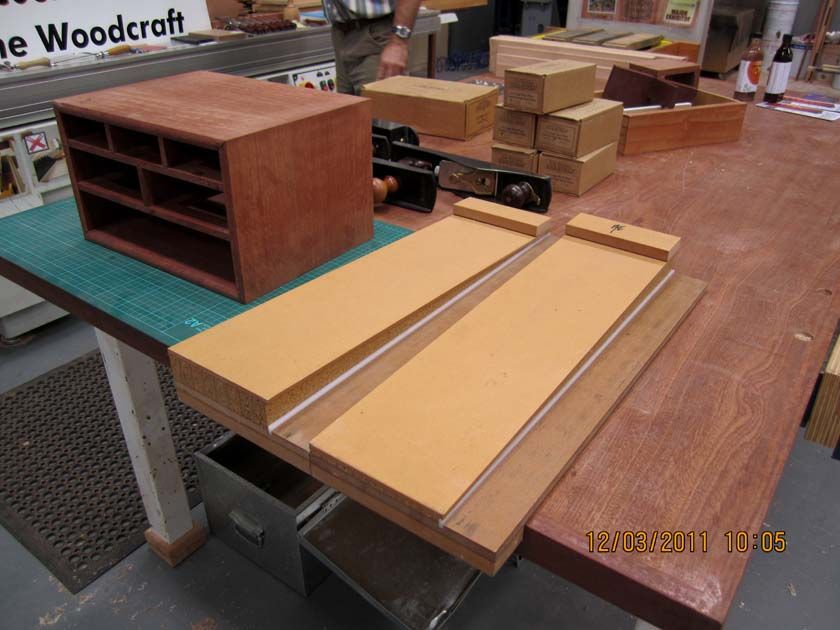
Michael built his with a 4 degree ramp. The boards are narrower and have a fixed fence. His board is on the left and one of mine on the right, (taken at a LN Tool Event about 4 years ago) ...


Michael still sells the same design, and it is very successful. Plain and simple. I added a slightly higher ramp - mainly because 5 degrees is easier to measure than 4 degrees! :) And added a micro adjustable fence (easier to set up and maintain), and later a fence that can switch between 90- and 45 degrees. Later I added a outside fence (ala Stanley #52). The latter item makes planing accurately much, much easier.
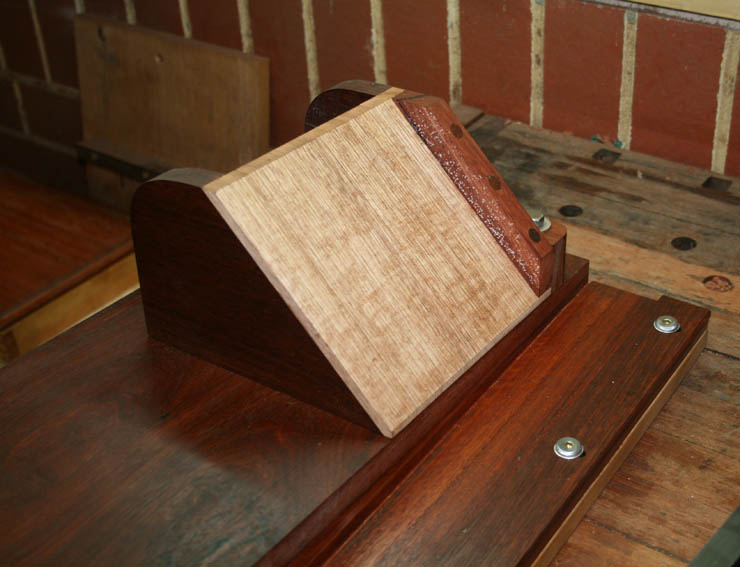
All the extras may suit someone, but the basic shooting board (straight fence) is good for 90% of the tasks we need it for.


Regards from Perth

Derek

Re: shooting boards - flat or ramped

#22

In fairness...

John in NM

That diagram I posted is wrong. Or rather it is right but for a different application - a skew blade or skewed plane. Took me a while to remember that with a ramp, the blade is still normal to the movement of the plane body, so only askew relative to the work. The way to skew a regular plane on a shooting board is to have the ramp move with the plane - then that diagram would apply.

I'm of the use it up school of jigging. Nothing wrong with improving the next one - say with a ramp - but first step is to make one and use it. Without that the discussion is academic.

Re: shooting boards - flat or ramped

#23

Re: shooting boards - flat or ramped

Eric in Los Gatos

Hi Derek,

Thanks for the reply. I think that, based on your much greater experience, I'm going to be guided by you. If your experience is that the 5 degree angle works I'll try that as it will provide more capacity. I've got some 45 degree chamfers to do so I think I'll just bite it all off at one time. Got to start some place.

Thanks again.

Eric

Re: shooting boards - flat or ramped

#24

Re: shooting boards - flat or ramped

TomD

I don't see the point of that kind of ramp Derek. Jeff's is more what I have in mind. I don't want to lift the board, if only slightly, and I do want the ramp to help the plane stroke. I can see yours would spread wear, which is never important to me, so far. The pieces I can get on a board are not ones that wear out my planes, but that could be a factor for some.

Interesting to imagine ramped designs discussed against the world of a few years back where every blade had to be a cambered one.

Re: shooting boards - flat or ramped

#25

Re: shooting boards - flat or ramped

Derek Cohen (in Perth, Australia)

I don't see the point of that kind of ramp Derek. Jeff's is more what I have in mind. I don't want to lift the board, if only slightly, and I do want the ramp to help the plane stroke.

Hi Tom

This is Jeff's board(s) to which you are referring ..


As I understand (this is in conversation with Neil Erasmus, who builds high end furniture in Perth), this style of shooting board excels for shooting veneer since it pulls the work piece down. Neil completed a traditional training with his father 40 years ago, and described using a similar design all those years ago. His (modern) version is built out of MDF. Notwithstanding the advantages of this design, Neil advises on the same style (direction) angle ramp as mine for more typical end grain shooting.

Here are his two boards - ramp up for veneer, and ramp down for all else ...


Two observations: The ramp up design is limited in the thickness that can be planed. I have never experienced a work piece lifting on my ramp down design - the thin veneer is probably more vulnerable to the slight pressure exerted ..

Regards from Perth

Derek