Building a Strike Block Plane
Derek Cohen (in Perth, Australia)
Over the past few weekends I have been busily building planes for the forthcoming Perth LN Tool Event. In past years I have demonstrated joint-making with handtools (OK, in the land of the blind ...). This year I shall be demonstrating plane building.
I thought it pertinent that I take along some new planes (some for demonstration and a few to sell). To this end I have so far completed 11 planes (it sounds grander than it really is - there are 5 router planes, 2 Krenov smoothers, and 3 Krenov block planes). I am just waiting on a few parts, plus have one more to complete (a solid body coffin smoother), and then I shall post pictures.
This is a solid body strike block plane. Why did I choose this particular plane to build? It is not as though I am low on planes for shooting. However I wanted one to dedicate to my ramped shooting board. Plus I enjoy using woodies, and my eventual plan is to fill a tool cabinet with planes I have made.
The strike block is a bevel down plane with a low cutting angle designed for shooting end grain. It is an alternative to a mitre plane, which achieves the same cutting angle from a bevel up orientation.
Were we discussing metal planes, there would be no question that the bevel up plane has the advantage of achieving a low cutting angle. Take for example both the Lee Valley and the Lie-Nielsen BU Jack. Built in strong and durable ductile iron, there is no difficulty in building in a 12-degree bed. Add a 25 degree bevel, and the result is a 37 degree cutting angle. This is great for planing end grain.
Wood is not a strong enough medium for low bevel planes. A 12-degree wooden bed is vulnerable. Building a 20 degree bed, while stronger, does not offer any advantage over a common angle (45 degree) bevel down plane. The strike block plane provides the low cutting angle by having a bed between 35 – 40 degrees.
Larry Williams (Old Street Tools) suggests that strike block planes fell out of favour in the 18th Century owing to the casual sharpening techniques of the day. His view is that it is imperative to maintain a clearance angle of a minimum of 10 degrees. Consequently, unless the bevel is maintained at about 25 degrees, a strike block plane may run out of clearance angle and stop cutting.
The plane build here is based on a bed of 38 degrees. This should provide the same performance as a low angle bevel up plane with a 12 degree bed. The overall dimensions are a 14” length (that comes from the Old Street version), with a 2 ½” wide x 2 1/8” high body. The blade is 2 1/8” wide, tapered and laminated high carbon steel.
I have used Jarrah for the strike block plane, mainly as it is a dense and heavy wood, and I have a good supply of dry, salvaged roofing trusses. The wedge is White Oak.

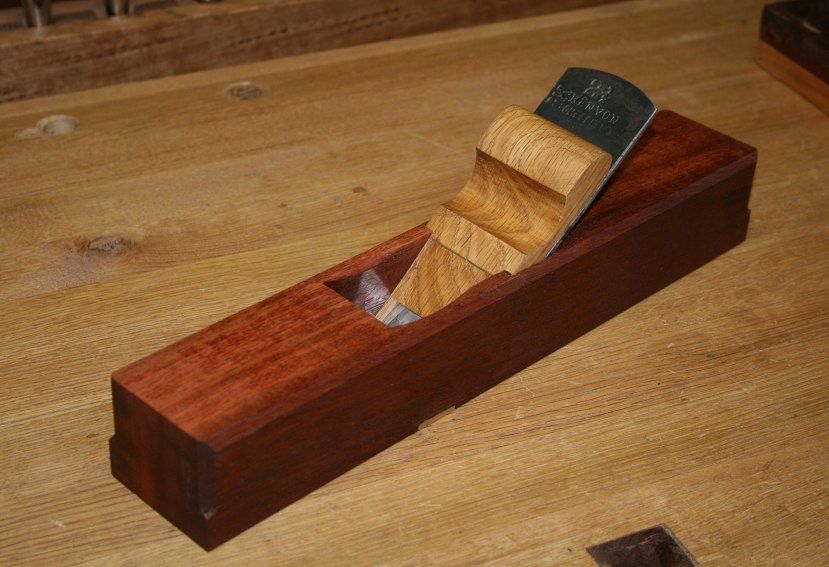
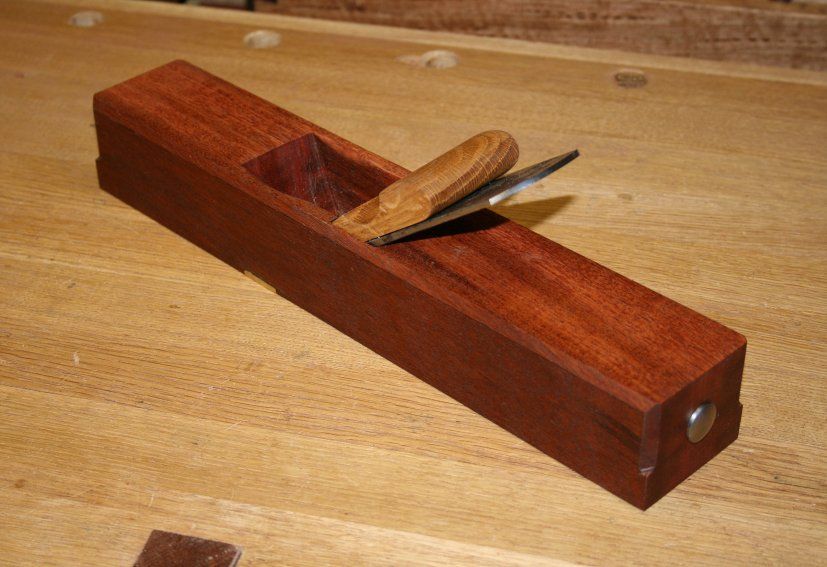
There is a steel strike button (more durable than wood) ...
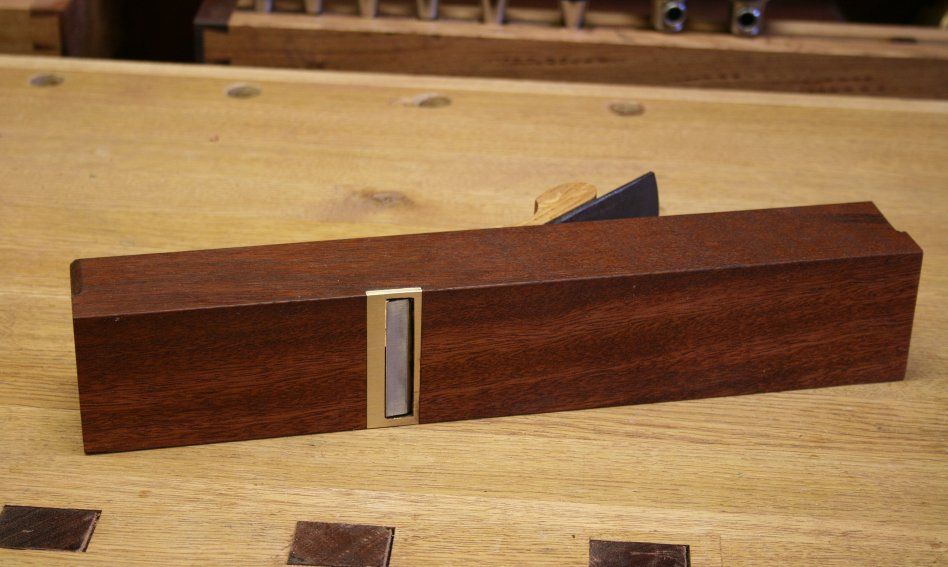
The underside shows the brass mouth ...
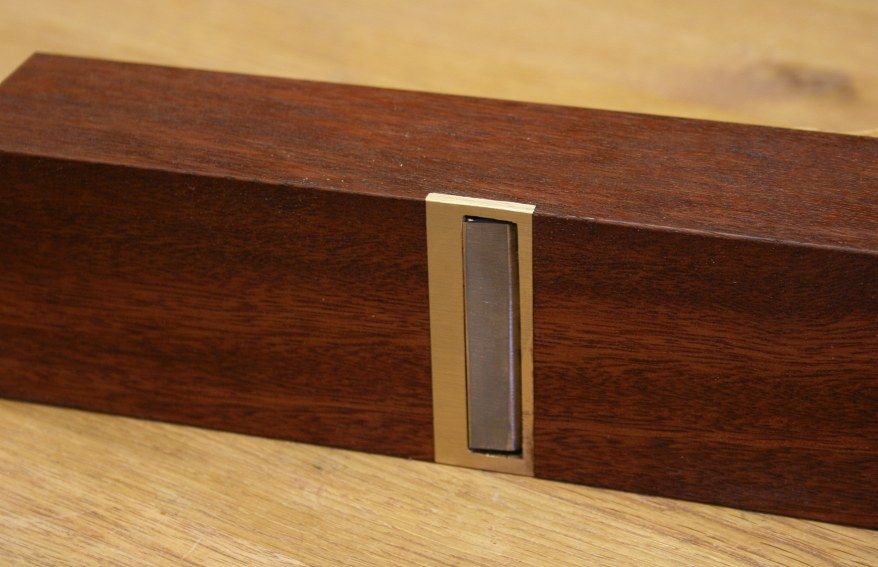
A close up (because someone will ask anyway  ) ...
This is where it will work (although it will also be useful for cross flattening panels) ...
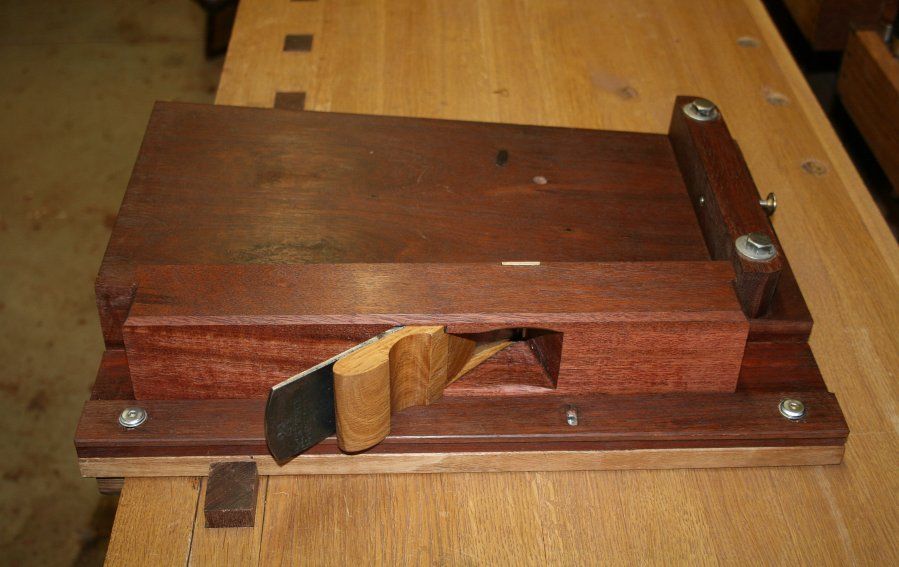
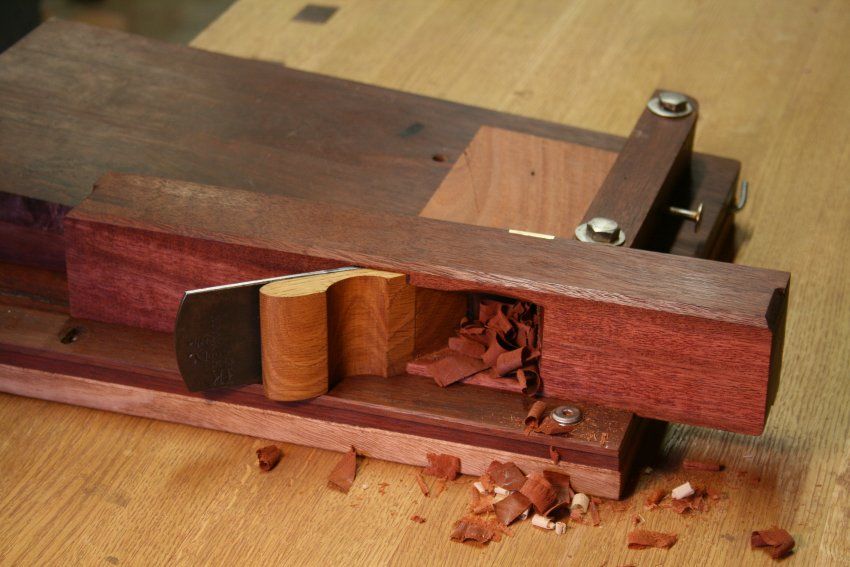
And .. yes .. it works very nicely. Easy shavings in 1/2" Jarrah endgrain ...
There is a step-by-step record of the build on my website: http://www.inthewoodshop.com/ShopMadeTools/BuildingaStrikeBlockPlane.html
Regards from Perth
Derek


