New WoodChat!
Home Articles Forums Gallery Marketplace Videos

WoodCentral Forums

Knowledge You Can Build On — Est. 1998

Urban Salvaged Hardwood Slabs, Milled In-House from Rare Trees. Shop Unique Walnut Stock.

Hometown joyner *LINK*

Posts

Hometown joyner *LINK*

#1

Hometown joyner *LINK*

Warren in Lancaster, PA

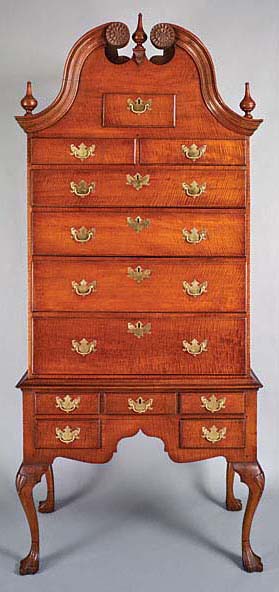
When I was a boy I knew a man named Seth Pancoast who lived in neighboring Marple Township. This Seth is no longer living. Many years later, when I read the Chester County cabinetmaker book, there was a listing for Seth Pancoast, Marple, joyner, and no other information. I remembered my father having said that there was always a Seth Pancoast in Marple Township since before the revolution.

I wondered what it meant to be listed in the 1766 tax rolls as a joyner. I wondered if he made the benches in the local Quaker meeting, which are of the right era. Then last year I found this example signed and dated by Pancoast in 1766 in an article by Wendy Cooper and Lisa Minardi. This is curly maple with poplar, chestnut and maple secondary. He may have made benches and sash for the rest of the year, we just don't know.


img

Cooper & Minardi

Re: Hometown joyner *LINK*

#2

Line and Berry

Warren in Lancaster, PA

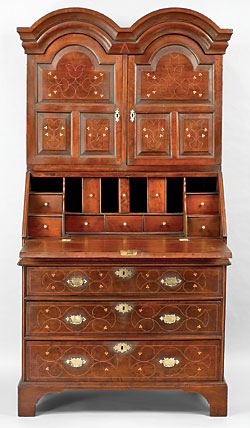
Here is a picture of a cherry desk from the same article. Chestnut, poplar, oak, white pine secondary woods. Walnut and holly inlay. Maker not known, apparently no Dremel.


img

Re: Hometown joyner *LINK*

#3

Where he would have used the Dremel

Bill Tindall, E.TN.

The Dremel excelled for long straight cuts. It was quick and made a perfect trough. One could string a whole drawer while I was plowing out one line of it. In my case I only have 6 drawers to do so it does not make any sense to buy the Dremel unless I contemplate doing lots more, and I don't. However, anyone earning a living at it would be using the Dremel for long straight cuts.

A compass cutter is faster for arcs and especially so for patterned arcs.

Re: Hometown joyner *LINK*

#4

Scratch stock

Warren in Lancaster, PA

If you are doing this for a living, the fastest way to make long straight cuts is with a scratch stock. Much faster than a dinky Dremel.

Re: Hometown joyner *LINK*

#5

David Barnett

(Message Deleted by Poster)


Re: Hometown joyner *LINK*

#6

Data

Bill Tindall, E.TN.

I just spent two full days making straight, curved, long grain, cross grain, etc. troughs in walnut and several days of practice before that. Additionally, I watched Steve Latta do Federal legs and help me on line and berry. Here are my conclusions for drawers and legs based on this experience and watching what Steve preferred for each task. (I have no opinions on guitars)

1. If I had one I would be stringing a drawer or leg edge with a properly set up Dremel. It is fast, easy to control and the cuts are crisp. Anybody that thinks there is a faster way just hasn't used one, or at least one optimally set up. That said, it can be done just fine with hand tools. For cross grain, the "saw" arrangement promoted by Steve is substantially superior to scratching in both speed and quality of the trough.

2. For line and berry the compass cutter sold by Lie Nielsen is the best tool for the task . These patterns are all arcs of a circle, a task ideally suited for a compass cutter. It takes but seconds to do a small one. Home made compass cutters are just as effective at cutting the trough but one will be making a lot of them to do a set of drawers, 12 in my case. In skilled hands the Dremel could be slightly faster for the larger arcs. However, because one would first have to lay out the pattern with a compass I doubt it would in fact be faster. I will never do enough line and berry that I will ever gain the confidence to use a Dremel for the line and berry arcs. While it cuts a bit faster it also can cut where it shouldn't very fast!

The slow part of line and berry is making the terminations and intersections crisp. Neither compass cutter nor Dremel avoids this tedious hand tool task. Hence, seconds saved on the trough making is irrelevant. The tool choice is made by cost, and reliability, or what is at hand.
Re: Hometown joyner *LINK*

#7

Re: Where he would have used the Dremel

Warren in Lancaster, PA


The Dremel excelled for long straight cuts. It was quick and made a perfect trough. One could string a whole drawer while I was plowing out one line of it. In my case I only have 6 drawers to do so it does not make any sense to buy the Dremel unless I contemplate doing lots more, and I don't. However, anyone earning a living at it would be using the Dremel for long straight cuts.

So how long does it take to set up a jig and make a 30 inch long trough with the Dremel tool?

Re: Hometown joyner *LINK*

#8

no jig is used

Bill Tindall, E.TN.

I was not intending to buy this tool for the few drawers I intend to string so I did not pay much attention to its details. But I gather that someone sells a slick fence for the Dremel. It looks to be trivial to set and use. Using it was certainly trivial. One pass down a leg and bam, done. End of it. But since I was going to do it all by hand I avoided being seduced by its quickness. Most everyone else however, preferred it and used it throughout the class. Apparently it took no effort to learn as they all made nice cuts.

Its advantage is the low torque of the Dremel. Coupled with modern bits it appeared trivial to control yet it cut fast. Not sure it cost less than the high priced LN stringing cutter which I found not easy to use. I do wish I had made this tool.

Re: Hometown joyner *LINK*

#9

David Barnett

(Message Deleted by Poster)


Re: Hometown joyner *LINK*

#10

So

Warren in Lancaster, PA

The Dremel excelled for long straight cuts. It was quick and made a perfect trough. One could string a whole drawer while I was plowing out one line of it. In my case I only have 6 drawers to do so it does not make any sense to buy the Dremel unless I contemplate doing lots more, and I don't. However, anyone earning a living at it would be using the Dremel for long straight cuts.

So how long does it take to make a 30 inch long trough with the Dremel tool?

Re: Hometown joyner *LINK*

#11

Well, thank you

Bill Tindall, E.TN.

I have a "Dremel" made by B&D. Never saw any means of attaching anything to it till your note. "Nose" you said...... Hmmm, mine has a knurreled nose. Tried to turn it and it came off with threads beneath. Whooo Hooo. I have a tap that size, and a half sheet of acrylic. I will be making a base shortly and cutting straight troughs with alacrity.

While the cross cut teeth for the LN cutter do ok on cross grain they mill long tooth clogging shavings on long grain. These have to be cleared or the cutter cuts a widened trough. Slow going, like in tedious.

Re: Hometown joyner *LINK*

#12

David Barnett

(Message Deleted by Poster)


Re: Hometown joyner *LINK*

#13

The bottom line of it

Bill Tindall, E.TN.

In class I toughed out cutting the many leg troughs with the LN device. By the time I finished my leg trough the other students had long since done theirs and were on to learning more advanced inlay techniques. While they were practicing their more advanced inlay techniques I was practicing, tediously, making a straight line that didn't get fat from shavings caught in the teeth.

My times on a small drawer were 3 minutes for long grain and 2 for the cross grain- 10 min total. The slowness is getting the shavings to eject from the trough. The LN does well on cross grain. For scratchers the opposite result is the case. I have watched Will Neptune scratch cross grain on walnut and it is not fast to avoid tear out. Tear out is a constant fear when scratching cross grain. The LN saws it nicely. Anybody more experienced than Will please raise your hand (and show your work).

So, for anyone not wedded to traditional technology that is contemplating buying stuff for stringing......For straight lines buy a Dremel instead of the LN device. The LN thingy for arcs works well. Given the way line and berry is constructed the Dremel would not add much, or any, productivity compared to the LN arc cutter.

For those that have not done it, one does not make all the troughs and then fill them in. For intersecting troughs there is a preferred strategy for which gets done first, filled and then the second is cut into or through the first. The result is to avoid blow out and end with crisp terminations and intersections. The trough cuts are short, followed by filling. I am not sure a Dremel would be of any advantage and it might be slower and/or riskier.

Re: Hometown joyner *LINK*

#14

Re: 11.40 seconds for 30 inches

Warren in Lancaster, PA

Thank you, David. I have never seen a Dremel tool in a professional shop, never seen one performing. It took me 37 seconds to set up my scratch stock and cut a 1/16 grove. Just a groove by itself took 9 seconds. It usually takes me longer to make a groove because I like to make them deeper than your 1/16", more like 1/8. You might be faster than I on a deeper groove. I think a deeper groove is a bit safer; some antiques are missing pieces.

One thing I like about the scratch stock is the ability to change the thickness of the groove to suit the scale of the work. Subtle changes in line thickness make a noticeable difference in the appearance.
