New WoodChat!
Home Articles Forums Gallery Marketplace Videos

WoodCentral Forums

Knowledge You Can Build On — Est. 1998

Build it. Rock it. Rockler has your woodworking tools.

Krenov saw horse construction details

Posts

Krenov saw horse construction details

#1

Krenov saw horse construction details

Bill Tindall, E.Tn.

Some seemed surprised that these frail looking horses would support 350 pounds. In fact I would not hesitate to put, and have put, over 500 pounds of lumber on them. Wood has huge compressive strength and the loading is all compression along the long fiber axis of the wood.

I have posted these details before, but will again since there was interest.


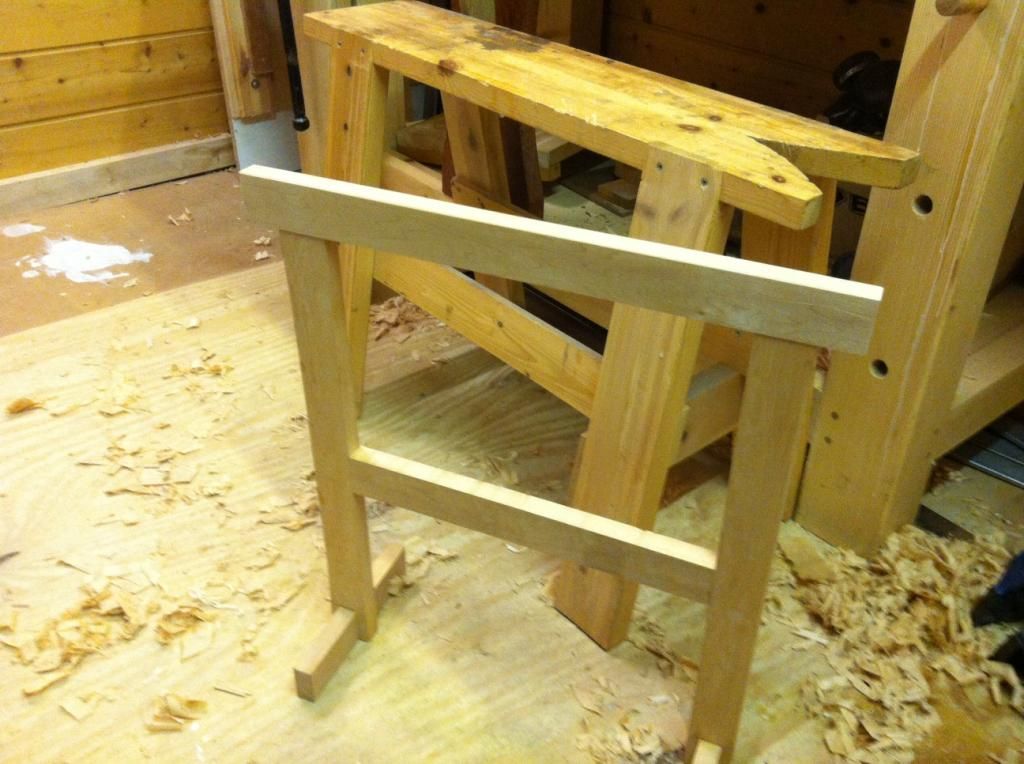
The lumber is 3/4" x 2 1/2" wormy red oak that was not useful for anything else but sheep pens. They are 30" tall, 20" wide and foot is arbitrarily 21" long. Verticals are joined to foot with M&T. Stretcher is M&T with wedged and glued tenon. Top rail sets in a slot and held in place with a screw. Didn't glue model #1 and it loosened out in the lumber shed where the humidity has huge swings.

Model 1 was made from 1" oak because I thought 3/4" was too frail. Big mistake. It is too heavy. A feature not apparent is the ease with which these two horses can be bundled and rested in the crook of the elbow to be easily moved about from shop to shed and thereabouts. Note in the picture how handily they stack. Conventional A-frame horses are miserable to carry around, and store.

Re: Krenov saw horse construction details

#2

Re: Krenov saw horse construction details

TomD

I do two minor things differently. One is I do not fully sink the top cross-piece. This ensures that the verticals do not bruise anything put across the top if the ground is not level, or if the object is not flat. I also place the mid, fixed, brace higher from the ground. Sometimes these horses are used without the top cross-piece, and the top piece is usually not fixed. So the mid brace is more stable. But if the top brace is fixed, probably the lower brace is better.

These suggestions are consistent with the original design.

Re: Krenov saw horse construction details

#3

comment on your points

Bill Tindall, E.Tn.

Yes indeed fit the top cross piece so that it is a bit higher than the verticals. This important point may not have been apparent in the picture.

While these horses are robust under vertical load their weakness is resisting lateral stress. If the top cross piece is fixed, the square formed by it and the shoulders of the stretcher provide substantial lateral rigidity. Without the top piece fixed only the wimpy M&T of the stretcher provides any lateral strength. Personally I have no application where I would want the top rail removed so I fixed it on my rendition of these horses. Your decision of what to do should depend on whether you need lateral strength. (don't set 300 pounds on them without it!)

Re: Krenov saw horse construction details

#4

Re: comment on your points

William Duffield

If you pinned the bridle joint with a tusk tenon (or a Domino) it would still be removable and replaceable with a differently shaped top rail, and the tenon, if fitted closely, would provide additional lateral strength.

An alternate strategy to counter lateral forces would be a diagonal wooden brace or a pair of crossing diagonal tension wires between the uprights. Of course, these would add complexity, cost and weight.

Re: Krenov saw horse construction details

#5

Re: comment on your points

Bill Tindall, E.Tn.

the screw I used seems trivial by comparison

Re: Krenov saw horse construction details

#6

Re: Post-and-foot joints

Bruce McCrory

Whew! I'll get that screwdriver, now.

Krenov liked to park boulders on tooth pick stilts and funky knife hinges.

Compression loads aren't my worry. It's wracking at a wimpy M&T joint 4 inches from ground. What's the cantilever force at 28 inches from a 4 inch joint at the fulcrum?

One problem: I work almost exclusively in softwoods, and timbers that are supposed to look massive. If my designs don't survive contact with the carriage a drunk is riding in--obviously, not controlling--I failed.

Re: Krenov saw horse construction details

#7

When building for strength instead of beauty

Bob Hackett

Why not look at what other trades are doing and have found useful as well?

Those of us who work on uneven floors or outside usually find that 3 legs are far more stable and strong than 4. Anvil stands come to mind here.

While I like the idea of cables used to tension and reinforce something a simple gusset placed in corners will many times do the job more effectively while taking up much less space and allowing more room for flexibility in application.

As proven in the fretsaw discussion recently, strength and rigidity couples with weight reduction usually works out better when we think in terms of triangles rather than squares or rectangles.

I`d also suggest looking outside the scale of where we normally see a "saw horse". Looking at how the trestles were made for the wood being supported in log form while initial hand powered sawing was taking place might be an informative place to start.

Another close relative of saw horses you see in everyday use around boatyards servicing wooden wooden boats is what`s called a "staging horse". These are what looks like overgrown, multi-level saw horses that have been adapted to the ideas of working as staging for a rather large crew of workmen, material storage, work stations and work support need to be considered yet the design must be easily adaptable to fit most anywhere around the anything but linear form of a ship`s hull. Both the examples I mentioned are also made from readily available materials. When I say readily available, I mean what is on hand and on site at the moment.

Re: Krenov saw horse construction details

#8

Re: Staging Horse?

William Duffield

Google isn't helping me with this one. Is there another term that is synonymous?

Re: Krenov saw horse construction details

#9

David Barnett

Also known as horse scaffolding 


img

Re: Krenov saw horse construction details

#10

Re: Also known as horse scaffolding

William Duffield

Aha! That looks familiar. A while back, I had to rebuild a dormer window. The guy who led the operation for me was very experienced with repairing and restoring wooden boats. He started with regular steel scaffolding and planks, and then we put horses on top and inside the bedroom with more planking through the window between them. It worked very well.

Re: Krenov saw horse construction details

#11

Re: When building for strength instead of beauty

TomD

I have seen the Krenov style made with one leg and one foot. I have used mine on somewhat uneven ground, but never a problem.

As I mentioned before, I made mine using biscuits, I had made all similar things before with tenons, and just needed a project to try the biscuits out on. Not something I would repeat, but even the weak biscuits have held up over the years. I used a pair of these to support my sailboat while it was being built. The design is super strong. Not that strength is their main advantage, but within reason they are fine.

Re: Krenov saw horse construction details

#12

Amen

Bill Tindall, E.Tn.

I have a pair of A-frame horses made from 8/4 poplar that I don't hesitate to put 1000 bd ft of lumber on. But I do hesitate to move them and they take up a lot of floor space with their splayed legs. The benefit of the Krenov horse is that it will hold up a 300 pound bench if you need to but it is easy to move about the shop and when necessary, to store.

Re: Krenov saw horse construction details

#13

Re: Amen

Bob Hackett

When you think about it a folding A frame horse in it`s folded state takes up less storage space footprint wise than the type of support you`re using when you go to store it Bill. As you mentioned, an A frame will bear more weight and is more safe when a heavy load has the chance of being bumped in certain directions.

I think your solution to this particular problem elegant, strong and exceptionally useful, as are most of your posts. I was just wanting to point out that this is probably much the same thing as the ongoing bench/chisel/plane iron/ sharpening medium discussions we have all the time here. I suspect there is no single "silver bullet" that will kill all beasts in a most effective manner.

I believe my point about uneven terrain and a 3 legged approach is a valid one as I suspect more of us work on uneven concrete or even outdoors in good weather than have shops with nicely finished, dead flat floors.

The strength thru triangulation thing has been proven and has several centuries of real world application to back it yet we keep making these things with all these 90 degree corners and wonder why they continue to fold on us.

I did like the tripod version that Thom posted a link to. I`d make it out of something other than PVC though as I am noted for my ability to pile stuff on any available nearly horizontal surface and suspect I am not alone in that regard. :D

Re: Krenov saw horse construction details

#14

A law of nature

Bill Tindall, E.Tn.

"Flat surfaces accumulate"

I even pile stuff on the project I am making if it has a flat surface to employ.

Re: Krenov saw horse construction details

#15

Re: Krenov saw horse construction details

Kees

Years ago when I started woodworking I made the sawbench design from Chris Schwarz. It's been a very helpfull tool, just a little small when working with long boards. I have helped myself with stacks of wooden blocks, which isn't very stable of course. So it was nice to see this design.

Now I look back at your photo's I see that my saw horse turned out a bit different. I made it from an old maple floor board. The feet joints are some kind of bridle joint. The middle is mortice and tennon and the top is attached with half laps. It seems sturdy enough as it is. All handtool work, took me about an afternoon.


img