Example
Wiley Horne--So. Calif.
Hi Tony,
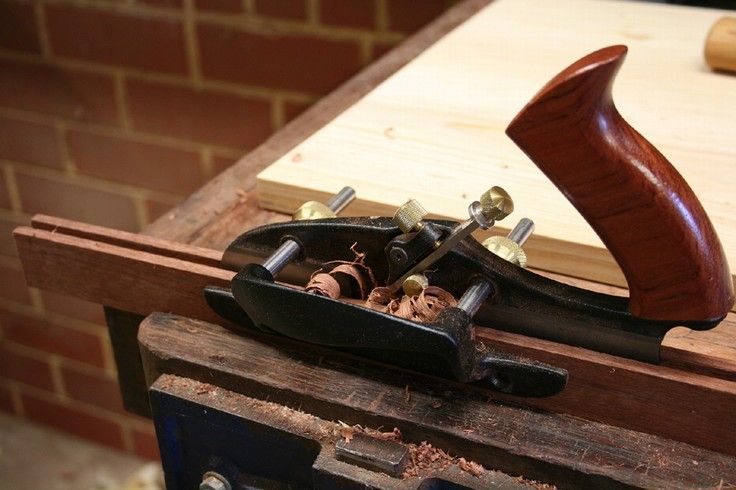
Shown below is a wooden plough I was using today to define the size and cut the wrap-around tongue on a slab of Baltic birch ply. This will be the core of a veneered desk. This core will be wrapped in a satinwood frame; the frame will be grooved to take the tongue. Plane is a Union Hardware No. 245 (all boxwood) screw-arm model; irons are John Moseley & Sons, London (more on irons below).
To your questions..... It's all personal preference, but there are some common attributes and some objective differences among woodie ploughs, and between woodie and metal ploughs. I am speaking of vintage woodies here, although Old Street (formerly Clark & Williams) make a wonderful plough:
1. Woodies are different from each other. The pictured woodie is screw-arm. These are heavier and bulkier than wedge-arm or the old 'Yankee' type. This plough has no handle--they also made them handled. There is a difference in use: I prefer the handleless, because I want my hands right over the cutting action. Better control, and easier to keep the plane plumb (in my experience). If plough is handled, then you're controlling at a distance, and indirectly (thru an engineering 'couple'). To me, weight doesn't matter--the plane is supported by the work--but bulk does. I prefer the lighter wedge-arm or Yankee in practice (the C&W is my favorite), but went for bulk and weight here because of cutting through the cross-plies and glue and crap you find in ply. Bulk just feels clumsier. On the other hand, I have found that screw-arms tend to be dead-sound in terms of no arm-slippage--150-year old plane will work like new, with no surgical intervention by you. With one exception, and that is the iron/wedge situation....
2. Irons and wedges. The plane shown was not shipped with the irons I'm using; who knows where the original irons are, they're almost never found with the plane. And the taper of the irons has to match the taper of the wedge--or the irons will rattle loose in the plane. So you can't just buy a vintage woodie and be in business--you need a set of irons that will match the wedge in the plane; or be ready to do some surgery on the wedge; or just be lucky. I was lucky here--the Moseley irons just needed a light scraping of the original wedge to fit. Also, a mixed, or 'harlequin' set of irons will not generally work--each iron would need its own wedge.
3. Irons and sizes. Vintage irons are numbered 1 thru 8, and nominally they are 1/8", 3/16", 1/4", 5/16", 3/8", 7/16", 1/2", and 5/8". But. These are nominal. The actual size range is usually + or - 1/32" from the nominal. In the plane shown, the No. 3 iron I'm using is pretty close to 1/4", but that's just happenstance. Similarly, you generally find the No. 1 iron larger than 1/8"; but this Moseley set's No. 1 iron is slightly smaller than 1/8". So if you're persnickety about metric vs. Imperial and into mic'ing irons and chisels, fuggedaboudit. Also the vintage irons as-found will generally be a mess at the business end--plan on machine-grinding them to a hollow grind. I've done a bunch of sets and never found a soft iron though--they've all been good steel as soon as I could unblunt and unconvex them.
4. Metal planes are predictable. If you buy an LV plough, it will work out of the box; the irons will be the size they say they are to a tight tolerance; don't have to go find irons and wonder how you're gonna get them to work with the plane.
Even a vintage Stanley 45 or equal will have irons that fit the plane--usually they're the correct nominal size, although sometimes you find a previous user has reground the exact iron you want to use, for some purpose or other.
But then, some people prefer wood. I do.
http://www.flickr.com/photos/78661951@N07/8214771970/
Wiley
 I just don't like the solutions so far.


