New WoodChat!
Home Articles Forums Gallery Marketplace Videos

WoodCentral Forums

Knowledge You Can Build On — Est. 1998

Identify and use hundreds of woods

Review of Lee Valley PMV11 Chisel Part 1

Posts

Review of Lee Valley PMV11 Chisel Part 1

#1

Review of Lee Valley PMV11 Chisel Part 1

Bill Tindall

Review of Lee Valley PMV11 Chisel Part 1

Background- I offer this background to help the reader better put into perspective this review. A bit over 10 years ago a friend and I set about to make a set of chisels. The knife building community and the technical staffs of the steel companies were valuable sources of information for choosing the best steel. I had access to a microscopy laboratory and pictures showing how chisel edges responded in use guided our steel choice. I learned some about steel and edge failure(dulling) for chisels. It became clear that a robust steel was required for a long lasting edge in operations where the chisel is struck with a mallet, for example dovetailing. Paring and carving were less demanding.

At something over $50 each for a premium chisel I am not going to buy a specialized chisel for all the tasks a chisel is called upon to perform. The chisel needs to be a multitasker, performing paring, carving and dovetailing satisfactorily. It is in this context that I am reviewing this chisel. In Part 1 I will discuss the steel and review the chisel for carving and paring, operations where ergonomics is paramount. Later in Part 2, I will review the chisel for chopping out dovetail waste, a task that will challenge the performance of the steel Lee Valley chose.

The Steel. What is PMV11. “PM” steels are steels manufactured using “powder/particle metallurgy”. (Some companies use “particle” and others “powder”, see http://www.crucible.com/eselector/general/generalpart3.html) In a nut shell this manufacturing process enables a steel to be alloyed with beneficial alloying elements to improve performance over simple carbon steel, yet maintain a very fine grain(crystal) structure essential to sharpening to a fine, long lasting edge.

To improve properties such as toughness and abrasion resistance elements such as vanadium, chromium, molybdenum, etc. are added to the iron and carbon found in simple carbon steels. When the melt containing these additives is cooled, slowly because a ton of steel cools slowly, these additives can segregate from the bulk iron melt and grow large crystals(gains) of these elements and their carbides. These elements “do more good” when there are dispersed as tiny crystals(grains).

In the particle process the molten steel is atomized to form a fine powder which cools instantly, precluding the growth of large grains of the alloying elements. The resulting powder is compacted and worked back into a solid bar or sheet of steel. The PM steel process produces steel that has better wear and toughness, superior sharpening and easier fabrication than traditional alloy steels.

Paring and Carving The benefits of the PM steel will be put to the test in Part 2 of this evaluation. However, for paring and carving it is the ergonomics of the chisel that are more critical. (To judge my hand size I wear a size large glove.)


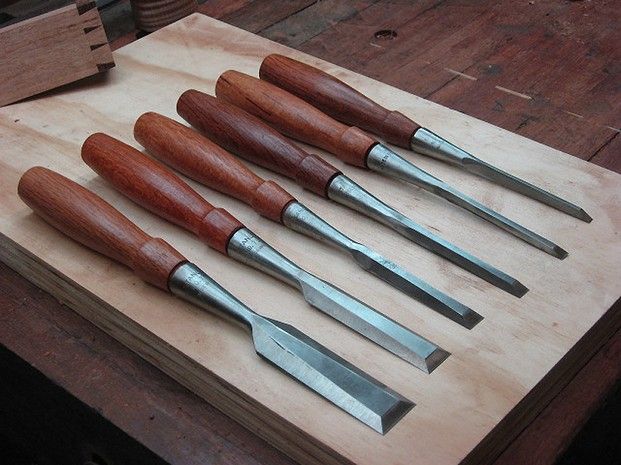
Picture 1 compares the shape of three common chisel types and the Lee Valley chisel. I want to draw your attention to the bolster area and compare this area among the four chisels. The smooth neck in the blade near the bolster and the smooth transition from handle, through the ferrule and then the blade naturally accommodate the shape of the hand in carving and paring as illustrated in Pictures 2 and 3.


Pictures 2 shows a typical hand position when the chisel is used for carving (right handed I must point out), as taught by Mary May, master carver. The left hand is the anchor and the thumb wraps that neck of the blade to provide a comfy pivot point. Everything about the chisel just fits the hand in this operation.


Picture 3 shows a typical hand position when paring. Note that the chisel provides a conforming location for the index finger to “point” the location of the working chisel tip. Alan Batty, master English craftsman, taught me the utility of using the index finger to “point” the direction of tools when paring or using lathe tools. Again the chisel comfortably and naturally conforms to the hand in this position.

For the way I use a chisel for carving and paring the Lee Valley chisel is superior to the other three chisel designs. The handle as received has an unnatural slick feeling compared to the unfinished dogwood handled chisels I am used to. I may eventually roughen the handle a bit. Shortly I will be preparing a set of drawers and I will then be evaluating the Lee Valley chisel for this dovetailing. Stay tuned for Part 2.

Re: Review of Lee Valley PMV11 Chisel Part 1

#2

Dimensions

Warren in Lancaster, PA

When I viewed the new chisel style at Cincinnati last October, I was critical of the handles for being short. I think there was only 4 1/2 inches of wood showing. I also criticised the chisel for being too heavy in thickness.

So I am curious. What is the thickness at the heel of the bevel? What is the length of wood exposed on the handle? And what is the overall length of your 1/2 inch chisel?

Re: Review of Lee Valley PMV11 Chisel Part 1

#3

Dimensions- answers and further comment

Bill Tindall

there will be three numbers comparing Lee Valley, a Witherby socket chisel and a Two Cherries........

What is the thickness at the heel of the bevel? .272, .302, .220" I will comment here that the ample thickness where the chisel necks down at the tang makes this part of the chisel comfy in the hand . I prefer this thickness to the more skinny Two Cherries. It makes the Lee Valley feel more like a socket chisel at this point.

What is the length of wood exposed on the handle?4.25, 4.25, 4" to ferrule and 4.6" overall.

And what is the overall length of your 1/2 inch chisel? 10, 12.5, 10.5"

A dimension you didn't ask for is thickness at the tip just before the tip bevel. .131, .110, .121. The Lee Valley chisel seems unnecessarily thick at the tip. We will see when I dovetail if this thick tip gets in the way. I would not be surprised to find myself grinding it thinner after others have had a chance to use it. I am not inclined to attempt modification at this point.

All these dimensions interact to affect balance which for the Lee Valley seems ideal. Balance factors will show up more when I commence. preparing dovetails. I will comment on balance in Part 2 as well as side bevel angle which seems not as acute as I may prefer.

Re: Review of Lee Valley PMV11 Chisel Part 1

#4

Re: Dimensions

Derek Cohen (in Perth, Australia)

When I viewed the new chisel style at Cincinnati last October, I was critical of the handles for being short. I think there was only 4 1/2 inches of wood showing. I also criticised the chisel for being too heavy in thickness.

So I am curious. What is the thickness at the heel of the bevel? What is the length of wood exposed on the handle? And what is the overall length of your 1/2 inch chisel?

Hi Warren

These are issues I had in mind and attempted to answer when I reviewed the LV chisels in their O1 guise. Review: http://www.inthewoodshop.com/ToolReviews/VeritasChiselReview.html

If you found the handles on the LV short, what would you say about the handles of the Stanley #750/LN, which have been considered a classic for so many years?

Here is the LV and LN alongside one another (there are other comparisons in the review):


As I pointed out in my review, I was predisposed (biased) to the LV handles as I had some time ago replaced those in my #750s with handles that were almost the same dimensions as the LVs. Similar minds at work?

Below is a Koyamaichi dovetail/bench chisel and Stanley #750 alongside one of these Stanley replacement handles.


I do struggle to agree with you that the LV handles are too short.

With regard the thickness of the blades, I can only speak of the O1 version at this stage. I do not know whether the PM-V11 version is the same (although I doubt it would be different). Keep in mind that these are bench chisels. And what other bench chisels would you like to compare them against? You do need to compare them for thickness at specific points. As I recall, while they look different as a result of the different should treatments, the LV and Stanley #750 were the same thickness size-for-size. I have not compared the thickness of the LNs, but suspect that they would be very similar.

Images of my Stanley #750s ..


I did measure the thickness of the LVs behind the bevel and at the socket end, and the details are in my review (I cannot copy and paste the data table).

I suspect that the blades "look" thicker than they really are owing to the shape of the side bevels.

Regards from Perth

Derek

Re: Review of Lee Valley PMV11 Chisel Part 1

#5

Re: handle ergonomic trade-offs

William Duffield

I find longer handles more accurate for paring, especially when used horizontally, while shorter handles are better for chopping, because the mallet need not be raised repeatedly to as great a height, and therefore can be controlled better, with less fatigue.

An advantage of the Stanley 750 and Lie-Nielsen socket chisels is that their handles can be easily swapped out. L-N even sells a second set of paring chisel handles that fit theirs. Of course, the more secure, more complicated attachment method used by the Veritas chisels doesn't make this nearly as easy as turning a taper of the proper size. The new Stanley 750s are notorious for their ill-fitting tapers, but I only had problems with my L-Ns when they were new, and have developed the security practice of dropping the handle vertically onto the bench whenever I remove one from its rack, so have never felt the need to glue the handles into the sockets. I may have needed to make a minor adjustment to the tapers of maybe one or two of my 9 L-Ns with a card scraper. Since L-N doesn't make a 7/8" chisel, I have filled in my set with an old Greenley 220 socket chisel in that width. I turned a handle for it to closely match the handle on the 1" L-N, which is a bit stouter than the other L-N handles.

I prefer the shape of the L-N handles, for several reasons. First, they are a bit larger in diameter than the Veritas handles. Second, the handle on the 1" L-N is substantially larger, which I think is an advantage for the larger, more robust chisel. For the third point, some arbitrary definitions are needed. These handles are vase shaped. There is a convex portion, nearest the butt, then a concave portion, and finally a lip or flange nearest the socket or tang and ferrule. To me, the shape of the flange is a wash. both are effective. The length of the convex section is shorter in the Vertitas, and I find that a disadvantage, because I find it more tiring to grip effectively with four fingers, because the weakest fingers have to work harder. Other people's hands may be different, which makes a difference on the optimal grip shape.

If you have separate paring and chopping (bench) handles, then you can choose a less dense wood for the paring handles, since you will only be pushing them, not punishing them. With a denser wood that will perform better for chopping handles, shortening the handle also decreases the weight and improves the balance of the chisel.

If you think you don't like the shape of the L-N handles, just turn some new experimental ones. If you don't like the shape of the Veritas handles, you are stuck with destroying the stock handles if you want to try something different.

If you examine the wood strength parameters measured by the USDA's Center for Wood Anatomy Research, I think it will be clear that Maine ironwood is a significantly better choice for bench chisel handles than rock maple. Maple is a good choice, too, and I can't really fault L-V for choosing it. My Greenley uses something else again*, and it has stood up to my hophornbeam, rock maple, purpleheart, and bitter orange mallets with no problems. Something that I find amusing is that here is a point where Stanley has copied L-N on their new 750s, but I doubt they appreciate why L-N chose ironwood. I think it has also been pointed out that Stanley's new chisels, unlike the Veritas, L-Ns and traditional 750s, are extremely inconsistent in the grind of their side bevels.

*JET 1442 lathe packing crate wood. Too bad that they have changed their packaging for that product, and no longer use whatever it is. I have a limited supply of it remaining, all of it with multiple staple holes.

Re: Review of Lee Valley PMV11 Chisel Part 1

#6

Re: handle ergonomic trade-offs

Derek Cohen (in Perth, Australia)

So William, how often do you trade out your LN handles?

I agree, this is a useful feature but, in my experience, few actually do this. David Charlesworth (who designed the Japanese-style handle for the LN chisel) is the only one I know of who may do so. Most tend to complain when the handles fall out the sockets (I am not pointing at LN specifically as this occurs across the board for socket chisels - but they did come up with the hairspray fix). I think that sockets are more vulnerable to changes in workshop climate.

Don't misunderstand me - I enjoy my Stanley #750s, which are socket chisels. However I believe that few if any avail themselves of the option (I did, insofar as replacing the handle with a design I prefer). Most, like myself, partly choose a new chisel for the ergonomics it offers, and may have different sets of chisels for different tasks. This is especially so with Japanese chisels. I've never heard anyone say that they wanted to change a handle on a Japanese chisel, or that the fixed handles of Blue Spruce were an issue (a major reason I purchased BS was that they are so comfortable and controllable in the hand).

I wonder what preferences others here have for chisel handles? This is not about LV or LN or BS specifically, although use them if you need to illustrate your points.

Regards from Perth

Derek

Re: Review of Lee Valley PMV11 Chisel Part 1

#7

Re: handle ergonomic trade-offs

Bruce, a MN Galoot

I like the general shape of the Stanley 750. I probably would like the Blue Spruce, but I've never fondled one.

In general, I don't particularly like socket chisels - they like to come apart and try to impale body parts, particularly feet. I have several socket chisels, and they are special use items, skew, long paring chisels, etc. When a socket chisel has needed a handle, it gets one of the general shape of a L-N or 750. I particularly don't like long handles. Or big ones, even on big chisels.

I really don't like the handles on my Hirsch firmers. They're going to be replaced as soon as I figure out specifically what shape that replacement will be, likely something close to a 750, or a cross between that and the Berg handles, which I also like. I also really, really don't like the handles on the Narex mortisers, either. But they get used so seldom that they're not likely to be replaced. Too many other things to do first.

Re: Review of Lee Valley PMV11 Chisel Part 1

#8

You folks make me smile

Bob Hackett

The only way to get a tool to fit you exactly is to make it yourself. We are woodworkers, after all.

Handles, grips and handholds made to be acceptable to a broad range of hands fit very few exactly. There will ALWAYS someone who will dissatisfied with the factory offerings.

If the only complaint you have is the wood handle then face it folks, you got nothing really to complain about except your own lack of skills and motivation.

Re: Review of Lee Valley PMV11 Chisel Part 1

#9

rehandling chisels

Warren in Lancaster, PA

Of the nine chisels on my bench right now, all are tang chisels. Six have handles made by me. Of the three with original handles, one was slightly crooked so I removed the handle to adjust it. Another I removed to show a blacksmith what a real tang looked like. So I have one handle that I cannot remember removing.

In contrast, the Lee Valley chisel does not have a traditional tang; the handle was not designed to be removed. The Lee Valley representatives I talked to had never heard of anybody removing a handle. They suggested destroying the handle to remove it. Because the tangs are not tapered, I would be difficult to rehandle the chisels with hand methods.

The problem with the Lee Valley handle is that when you put your left hand around the widest part of the handle, which is the most comfortable, your hand is in danger of being hit by the mallet. If you are going to hold the chisel at the ferrule or at the bevel, like a pencil, it doesn't matter about the handle.

Re: Review of Lee Valley PMV11 Chisel Part 1

#10

Dimensions

Warren in Lancaster, PA

Thanks, Bill. The thickness at the tip is what I was interested in. It appears they have slimmed down somewhat from the chisel I saw in Cincinnati, but still a lot thicker than necessary. This adds even more to sharpening time.

The length, at 10 inches is adequate. If the chisel gets appreciable use, a longer handle might be helpful. I think your hands would look pretty crowded if the chisel went down to nine inches.

Re: Review of Lee Valley PMV11 Chisel Part 1

#11

Re: handle ergonomic trade-offs *LINK*

William Duffield

I don't trade out my L-N chisel handles. I have a few other chisels with longer blades that I reach for first when paring. I don't have a full set of paring chisels, because a precise width is not so important for paring as it is for dovetailing, chopping mortises, etc., and I find I can get by with a shorter handle when necessary. I use some other paring chisels that are wider than 1", so comparing their handles to the L-N or Veritas is a moot point. I have rehab'd many chisels and fitted them with handles I made myself, most of them turned, and most of them done before I got my L-Ns. The older handles are experimental, to say the least, and none are as comfortable as the ones I made later that I modeled on the L-Ns. They are not so uncomfortable as to be annoying and in need of replacing with a better design, at least not until I finish a few projects a little higher on the to-do list. There must be lots of people out there who do swap out chisel handles, otherwise L-N would not sell paring chisel handles as a separate item. It certainly makes sense to me from an economic point of view to use wood instead of steel to lengthen a chisel, and some might find that such a repurposed bench chisel had a balance that they preferred to one made in a more traditional manner, with more steel and less wood.

I don't think the shape of the L-N long handle is particularly inspiring. If I needed a long handle for one (or several) of mine, I would turn my own, instead of buying it from L-N, at $22.50 each. Also, I don't think I would feel the need to turn it from Ostrya.

None of my L-N handles has fallen out in quite a while, not since I identified the individuals that did not fit perfectly and adjusted them with a card scraper (and maybe a rattail file). I will note that my shop is not subjected to large variations in humidity, as I live in a temperate climate, at sea level, and don't have either AC or heat in the shop. And, as I noted, whenever I take a socket chisel off the rack or out of a drawer, I tap the end of the handle on the bench, so I don't need to use the hair spray (or 3M 77) trick.

I've never turned down an old chisel whose steel was worth rehab'ing just because it had a socket, or because it had a tang. When I get a chance, I'll try to take some photos of my handles, both the ones I like and the ones I would redo (and why). Maybe I'll get the inspiration to turn a paring chisel handle to fit my L-Ns.


Long Handled Chisels

Re: Review of Lee Valley PMV11 Chisel Part 1

#12

Re: You folks make me smile

CStanford

True for the most part, but you can't just walk up to the lathe and turn the perfect handle for your own hand in one shot unless you are unusually anatomically aware. One would have to turn I'd say at least six to twelve prototypes in various configurations to come up with a winner. And then duplicate it several times. Sounds easy; it's not necessarily so.

Re: Review of Lee Valley PMV11 Chisel Part 1

#13

Re: rehandling chisels

Derek Cohen (in Perth, Australia)


Of the nine chisels on my bench right now, all are tang chisels. Six have handles made by me. Of the three with original handles, one was slightly crooked so I removed the handle to adjust it. Another I removed to show a blacksmith what a real tang looked like. So I have one handle that I cannot remember removing.

In contrast, the Lee Valley chisel does not have a traditional tang; the handle was not designed to be removed. The Lee Valley representatives I talked to had never heard of anybody removing a handle. They suggested destroying the handle to remove it. Because the tangs are not tapered, I would be difficult to rehandle the chisels with hand methods.

The problem with the Lee Valley handle is that when you put your left hand around the widest part of the handle, which is the most comfortable, your hand is in danger of being hit by the mallet. If you are going to hold the chisel at the ferrule or at the bevel, like a pencil, it doesn't matter about the handle.

Hi Warren

When you replace a tanged chisel handle is this because you are restoring a vintage chisel permanently or is this considered to be an exchangeable item?

I have replaced handles on quite a number of tanged chisels, one example being a set of Bergs. Yesterday I ground down a pre-production 1/4" LV chisel into a 1/8" (as there are none in the O1 steel). The handle was not epoxied to the tang, and came off easily. The point is, in my opinion, the construction is easier to work with than a vintage tanged chisel as all one need do is drill a (round) hole/mortice rather than create a tapered one.


I am not sure why on Earth anyone would wish to remove the handle from a new LV chisel - don't purchase it if the handle does not suit you. Get something else. However, if for argument sake the handle was damaged, a replacement would be as easy as any other tanged chisel. Probably easier, since you could get a decent grip from the round tang if you made the fit tight. And you could secure it with hairspray, which would make it removable with a little extra force. Can you remove the handles you made?

The other issue of where you hold a chisel tompare or when you use a hammer is a personal choice. Perhaps others here might chip in.

Regards from Perth

Derek

Re: Review of Lee Valley PMV11 Chisel Part 1

#14

Re: Dimensions

Derek Cohen (in Perth, Australia)


Thanks, Bill. The thickness at the tip is what I was interested in. It appears they have slimmed down somewhat from the chisel I saw in Cincinnati, but still a lot thicker than necessary. This adds even more to sharpening time.


Hi Warren

I suspect that you saw one of the very early pre-production chisels. The steel was quite thick early on, when the emphasis was on testing steel. At one time I had 10 different 1" chisels, and they all appeared over done. I recall seeing photos of WIA and recognised them.

This is the best I can do from my iPad. Prototype in the centre.


Extra sharpening time? How does that occur on a microbevel? A microbevel is a microbevel regardless of the thickness of the steel - it is still one edge, two if working a hollow grind.

Regards from Perth

Derek

Re: Review of Lee Valley PMV11 Chisel Part 1

#15

It is if you practice...

Bob Hackett

and have paid your dues. :)

An alternative for the less skillful among us would be to go visit with a turner friend who has the skills you lack and barter your skills for theirs. Gets you out of your own shop, into another`s (where you can see and learn new things) and you both end up with things you wouldn`t have if you hadn`t gone visiting.

Collaboration and the barter system are a wonderful things. :D

Re: Review of Lee Valley PMV11 Chisel Part 1

#16

Play-doh? *LINK*

Bill Houghton, Sebastopol, CA

It would seem like you could use Play-Doh (or the home-made version, which is cheaper) to mold a handle that felt good, then copy that. No need to construct your models out of the final material.

Me, I just use the handle that came with the tool.


http://fun.familyeducation.com/sculpting/recipes/37040.html

Re: Review of Lee Valley PMV11 Chisel Part 1

#17

Re: It is if you practice...

CStanford

I can turn tool handles, just speaking to the seeming 'ease' of it based on your first post - the 'you folks make me chuckle' part. I chuckled, frankly, when I read your post because it was a vast oversimplification of turning REALLY custom handles. Turning one, and psychologically liking it better just because you turned it, is way different than taking the time to figure out what it is you like (by turning a lot of differents styles and sizes) and then turning duplicates to a high degree of precision.

Re: Review of Lee Valley PMV11 Chisel Part 1

#18

Re: Play-doh?

CStanford

I too just use the one that came with the tool.

The problem with Play-Doh is you can't grip it without deforming it.

Re: Review of Lee Valley PMV11 Chisel Part 1

#19

I find it helps...

Bob Hackett

If you have access to a lot of old chisels (and OS handles) to handle and evaluate like I do.

Of course if you know and are friendly with a lot of WWers or belong to a guild or WWing club then you can always access other`s tools thru that route for real world evaluation as well. Any of these methods will both get you out into the wider world and talking about more than the ergonomics of chisels. I find having someone else to bounce ideas off of always speeds up the at least the preliminary steps of any project, be it steel, stone woods or otherwise.

I find if I warm up by doing a few simple projects like splitting out turning blanks or turning up a few chisel handles (or new prototypes) it helps me get my head right or undertaking larger more complicated processes. It`s almost a meditation for me before the real work begins.

Re: Review of Lee Valley PMV11 Chisel Part 1

#20

Re: handle ergonomic trade-offs

TomD

Hi Derek,

I did try to change a Japanese chisel handle on a bench chisel, because I foolishly wanted to replace it with a boxwood handle. Quite a process. I think that the perfect union between the ferule, and the lower shoulder is the result of some touch-up grinding which I was not prepared to do. I didn't miss by much, but it wasn't perfect either.

Re: Review of Lee Valley PMV11 Chisel Part 1

#21

Removing Handles

Warren in Lancaster, PA

Can you remove the handles you made?

Yes, that is the point. That is why it is nice to have a uniform taper tang. This evening I removed two handles. One took 8 seconds to remove and replace, the other 12 seconds.

Re: Review of Lee Valley PMV11 Chisel Part 1

#22

Re: Removing Handles

Derek Cohen (in Perth, Australia)

Yes, that is the point. That is why it is nice to have a uniform taper tang. This evening I removed two handles. One took 8 seconds to remove and replace, the other 12 seconds.

Hi Warren

I am curious why you needed to replace the handles?

Regards from Perth

Derek

Re: Review of Lee Valley PMV11 Chisel Part 1

#23

Replacing handles

Warren in Lancaster, PA

The handles are replaced for optimum length. These are older chisels. Some I have used for more than 40 years and they get shorter if you sharpen them.

If the chisel is too short one's hands get crowded when paring. With longer chisels there is more control for both paring and chopping.

Re: Review of Lee Valley PMV11 Chisel Part 1

#24

Re: Replacing handles

Derek Cohen (in Perth, Australia)

The handles are replaced for optimum length. These are older chisels. Some I have used for more than 40 years and they get shorter if you sharpen them.

If the chisel is too short one's hands get crowded when paring. With longer chisels there is more control for both paring and chopping.

Hi Warren

Yes, blades have a habit of growing shorter as they get older - like the rest of us! :)

I do prefer a chisel with a longer handle - which takes us back to our earlier posts here and why I replaced the shorter #750 handles with longer versions. I agree that there is more control as a result.

Regards from Perth

Derek

Re: Review of Lee Valley PMV11 Chisel Part 1

#25

Re: rehandling chisels

William Duffield

The handle was not epoxied to the tang, and came off easily.

Is that also true for the production chisels? How are they secured, and can they be removed without detroying the handle? If it is only epoxy (or hot hide glue, or even TiteBond) in addition to the attachment method used on the preproduction chisel, I see no reason that the handle would need to be destroyed to be removed. A heat gun should release the epoxy, and you wouldn't need to get the blade hot enough to take out the temper.

I agree, if it were a Veritas O1 chisel, why not get something else instead? But if it were one of the new PM-V11 chisels, that might be sufficient reason for some people to buy it anyway and replace the handle.