New WoodChat!
Home Articles Forums Gallery Marketplace Videos

WoodCentral Forums

Knowledge You Can Build On — Est. 1998

100+ Wood Species + Full-Shop Services: Lumber, Veneer, Tools & CNC. Everything in One Place.

No. 80 Scraper Blade Camber Question

Posts

No. 80 Scraper Blade Camber Question

#1

No. 80 Scraper Blade Camber Question

Dave (Arlington, VA)

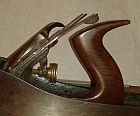
I picked up a No. 80 scraper at a flea market not too long ago. I've not used one before, and I am a cleaning it up and getting it ready for use. During this process I noticed that the blade has a small but definately noticeable camber on it. I haven't measured it precisely but it looks roughly to be somewhere between a 17-20 inch radius camber.

I don't believe I have ever noticed mention of cambering a No. 80 scraper blade in anything I've read on this topic. Before I grind it flat I thought I'd ask here if anyone knew of any benefits to a cambered blade like this. The blade is not original to the scraper as the scraper itself is a "Stanley" but the blade is marked "Geo H. Bishop".

I am wondering if the previous owner knew what he was doing and there is some benefit to cambering a scraper blade as such, or whether I should just flatten the blade (only relieving a bit off the edges).

Any advise would be be appreciated.

Thank you -

Dave
Re: No. 80 Scraper Blade Camber Question

#2

Re: No. 80 Scraper Blade Camber Question

Bruce, a MN Galoot

I don't have an original blade for my #80, so I can't tell from that. However, I don't see the need for a cambered blade because the #80 is adjusted turning the thumbscrew on the front of the scraper, thus introducing a bit of camber into it. My scraper blade is ground straight.

Re: No. 80 Scraper Blade Camber Question

#3

bridger

Re: No. 80 Scraper Blade Camber Question

bridger

I sharpen mine straight. no need to relieve the corners, either.

Re: No. 80 Scraper Blade Camber Question

#4

Re: No. 80 Scraper Blade Camber Question

David Charlesworth

When new the blade used to be supplied with one edge straight and one cambered quite significantly.

While never having found a use for the large camber I like to sharpen with a slight camber. I find it is much easier to set the blade in the tool.

David Charlesworth

Re: No. 80 Scraper Blade Camber Question

#5

Thank you!

Dave (Arlington, VA)

Thank you all for your responses. Maybe I'll do one side flat and one with a camber that's even smaller than what's on there now and just play with the two sides and see what turns up.

Again, I appreciate your replys.

Dave

Re: No. 80 Scraper Blade Camber Question

#6

Ellis Walentine

This may sound strange

Ellis Walentine

... but I used to sharpen my #80 blades with a *reverse* camber so that when I applied pressure with the thumbscrew, it pushed the cutting edge flush to the surface of the wood I was scraping. Otherwise, a conventionally cambered edge tends to cut slight concave depressions instead of a nice flat scrape. This was particularly important to me when scraping veneers.

YMMV,

Ellis

Re: No. 80 Scraper Blade Camber Question

#7

Re: This may sound strange

Dave (Arlington, VA)

Thanks, Ellis. That is interesting, and makes sense.

On the subject of a traditional camber for these scraper planes and with no hands-on experience with them I was wondering if a cambered blade would be good at flattening burl or areas of complicated grain such that you could remove more material but cause less tear out. Then you could move to a flat blade to finish the job. Dunno.

Dave

Re: No. 80 Scraper Blade Camber Question

#8

Ellis Walentine

Removing tearout

Ellis Walentine

A convex cutting edge on a scraper, whether the result of a thumbscrew (or two thumbs, for that matter) or a cambered blade, concentrates the scraping action in the center of the cutter, sparing surrounding areas as it works on localized tearout. The flip side is that it takes noticeable divots in the surface, which you can see in oblique light.

Ellis

Re: No. 80 Scraper Blade Camber Question

#9

Re: This may sound strange

CStan

Tage Frid said you always pull a card scraper, never push it which makes it bow and removes too much material and leaves scallops.

Tage was right IMO.

If you need to remove as much material as a bowed (and cambered) card scraper will remove when pushed you need to go back to a plane.

A pulled scraper keeps the surface flat. A slightly cambered scraper flattens out when pulled and keeps the corners from digging. Pushing a cambered scraper is sure to leave scallops.