New WoodChat!
Home Articles Forums Gallery Marketplace Videos

WoodCentral Forums

Knowledge You Can Build On — Est. 1998

Premium Live Edge Slabs, Hand-Selected in the Berkshires. Shop Unique Hardwood Pieces.

fettled a really old #2

Posts

fettled a really old #2

#1

bridger

fettled a really old #2

bridger

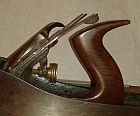
...that I inherited from my grandfather. lapped the sole, stoned the mating faces between the frog and base castings, lapped the top of the frog. relieved the top front of the mouth away from the frog a bit with a file. sharpened the blade with something on the order of .020 crown, stropped that 'till it shaved cleanly, fitted the chipbreaker so no light gets through, set it really close to the edge. adjusted the frog forward till just a tight gap remained. the old #2 planes never had a frog adjusting screw, and nothing holding alignment between the frog and base- makes for a lot of trial and error to get the mouth close and parallel.

on a piece of nasty, curly, crotch grain hard maple it leaves a glowing smooth surface with no hint of tear out.

Bridger

Re: fettled a really old #2

#2

Ellis Walentine

Camber?

Ellis Walentine

Hi Bridger,

After all the talk here lately about chipbreakers, including some discussion about how they relate to cambered irons, I was struck by your mention of a .020" camber (crown?) on the plane iron. That seems pretty large to me, and I am wondering about the rationale? Also, if the ideal chipbreaker setback is on the order of .004", I'm guessing that you crowned the chipbreaker, too?

Inquiring minds and all that....

Ellis Walentine, Host

Re: fettled a really old #2

#3

". . . ideal chipbreaker setback . . ."

Steve Elliott

I don't want to hijack this thread, but just yesterday I was working with a chipbreaker setback of .008" and found that it caused an accordion shaving when my blade was set for a very thick cut and but had just the right effect when the shaving thickness was reduced to 3 thousandths. That's still a pretty heavy cut for smooth planing but it produced an excellent surface on curly soft maple. The blade was less than optimally sharp, in fact I considered it "working dull" rather than "working sharp."

Setting a chipbreaker close enough to get the beneficial effect isn't nearly as difficult as it might seem if you just read descriptions of "so many thousandths of an inch." If you set it pretty close and watch what kind of wood surface and shaving are produced it's easy to get it right.

Re: fettled a really old #2

#4

bridger

Re: Camber?

bridger

I didn't measure that camber/ crown/ whatever. .020 is strictly a guess. it may be more than I need for that plane, and will likely work out to be less as further sharpening happens. certainly at the moment it's not pulling full width shavings, but remember, this is a #2 smoother- it's for small detail areas. not having corners below the sole is a good thing here. the cb has a little camber, less than the blade, and it's set to the corners. OK, went and looked again. it's a lot less than .020, maybe half that, most of that being at the corners. the center 2/3 is pretty straight, and the cb setback is pretty consistent in that area. they meet at the corners, no big deal as no cutting happens there anyway.

Re: fettled a really old #2

#5

Re: ". . . ideal chipbreaker setback . . ."

TomD

Paper is 4 thou, playing card, probably 8. I have several sets of feeler gauges, one of the cheaper measuring tools you can have.

I posted the thing from the archive where the guy mentioned leaving the breaker looser than crammed down, so you can adjust it on the fly. Adjustable on the fly breakers would be an excellent upgrade for breakers that would be far more useful than just bulking them up. BU versions all right reserved.

Re: fettled a really old #2

#6

Re: ". . . ideal chipbreaker setback . . ."

CStan

But in the context of actually building something, where presumably the planing can't continue unabated until the exact sweetspot is found (i.e. one is planing to the 'finish line' or finished thickness) what is one to do? I guess you have to lay in a supply of test boards for tweaking. I think in the fullness of time, the exact, perfect setting will be too elusive and we'll all still scrape and sand from time to time if for no other reason than to actually finish a project.... gasp!

Re: fettled a really old #2

#7

Re: ". . . ideal chipbreaker setback . . ."

david weaver

There isn't a great reason to search like you're describing. If you have a panel or trying plane with the iron set reasonably close, and your smoother is set properly, there is no search, there is no tearout that can't be removed with two smoother swipes. You run the try plane almost to your knife line and take two swipes of straight through shavings with a smoother. That's it.

I remember warren saying a long time ago if you can't smooth a board with normal through shavings, then you're in the weeds. That contrasts with other folks describing all manner of gyrations to turn planes around, spin them around knots, and all kinds of other ballet. In the end, warren is right.

The "searching for an optimal setting" stuff is only during the first week or two of use, until you figure out the plane you're using. I still have not seen tearout in anything other than absolutely dead QS dried cocobolo where the earlywood is very soft and crumbles and the late wood is hard (it's something you'd never use, anyway, and no plane I have will plane it).

The only reason I can think of to scrape and sand is if you have something assembled and can't get a plane to it (or possibly if you're going to stain something and want to sand the surface to get it to be uniform and lifeless just before you cover it up with stain...barf...).