New WoodChat!
Home Articles Forums Gallery Marketplace Videos

WoodCentral Forums

Knowledge You Can Build On — Est. 1998

Precision you can feel — woodworking perfected with Lee Valley

bubinga for a hand plane

Posts

bubinga for a hand plane

#1

bubinga for a hand plane

eliot d

I came across about five pieces of what I believe is bubinga in 4 x4 x4 inches blocks. Do you think there's a good way to make a wood plane from say two of these somehow? I know I could do it in the Krenov laminated style even though the side slabs would have to come from somewhere else.

Re: bubinga for a hand plane

#2

Re: bubinga for a hand plane

TomD

Yeah, you could do it that way. I like my K planes to be longer, I like to get both hands on them fully. To some extent I don't see a lot of benefit to overly short planes. But he did make some of them short. One thing though is that I don't particularly hunger after planes made of tropical woods. When I first got head over heels with hand planes it was from reading his books back when they were published. I therefore felt a good plane should be solid rosewood, or something of the sort. I made Andaman Padauk planes. Even later when I got into Japanese planes in the early 80s, at that time, quite a few people were pushing Macassar Ebony versions as the best. So it was a year or two before I got into more normal woods, and I really didn't want to let go. But since then my favorite woods have been white oak, or maple, or when I could get them the Japanese oaks. So I wouldn't let a few small pieces of wood drive my plane design unless I really wanted that size of plane.

Re: bubinga for a hand plane

#3

Re: bubinga for a hand plane

eliot d

Thanks for what appears to me to be a very reasoned response. The plane I made with David Fink, years ago, an excellent plane, is indeed maple. And the last one I made,which ( after much adjusting and tuning works very well now) is ( I think) tulip wood with a very hard rosewood sole laminated to it. So I suppose I do know that these planes don't have to be exotic woods. Still, this bubinga is pretty and is just sitting around. And I didn't see you say that it was a POOR choice; so I'll think some more about it. (Look at how much influence you could have on me: had you said that bubinga is the best possible wood for this application, I would probably rush to get started with it!)

Re: bubinga for a hand plane

#4

Re: bubinga for a hand plane

TomD

Moreso, you can pretty much use anything that will take the wedging loads so feel free. Many people like the waxy glossiness of tropical woods, or the weight. If you really know your way around, these are mostly design issues and not necessarily wood specific.

Now that you are solid on how to get these planes to perform, you pretty much only need a few hours to make one, if that, so you can do your own experiments, and you will be able to tell us what's what soon enough.

There are disadvantages to tropical woods, and I will just throw these out for your consideration, amusement, and rapid rejection...

- There is the whole enviro thing, I think Krenov was sorry he featured his jewel like planes in tropical woods. They subsequently pioneered the use of pointless but thin, soles to save wood. I never let this kind of thing bother me, if people who care don't use these woods, they will just end up sliced into veneer and wrapped around dollar store lighters...

- It is slightly difficult to tell what one has with tropical woods, grain wise. As it is always important to have some kind of snobbery even more far fetched than the next guy's mine is all related to the grain and cut, and obscure benefits of local woods. I don't really know what I am getting with tropical woods that have no visible early and late wood (or that is my story). Certainly the musical instrument field is full of charming stories of 2000 dollar sides that blew up when bent. Stuff looks nice but really belongs in a pallet. My pal who is about a 20% more powerful archer than I, is on his 5th extremely expensive custom recurve. The risers about the size of a 2x3 keep breaking on them. Meanwhile, my simple domestic wood longbow risers 16 times less strong in form never break at all. Things that make you go Hmmm.

- Also, now that the law governing tropical woods is firmly in that netherworld normally reserved for guns of "Johns". I try to avoid using tropicals for anything I might be inclined to import to the US.

- There is the whole toxicity thing...

Anyway, bubinga is pretty easy going on most of these fronts.

Re: bubinga for a hand plane

#5

Re: bubinga for a hand plane

eliot d

Interesting post! Thanks. I can respond with direct knowledge only to the grain issue: the grain on the bubinga I happen to have is really obvious; it's really easy to read in my case.

Re: bubinga for a hand plane

#6

Re: bubinga for a hand plane

Bill Tindall

David Finck lives nearby and I have been in his shop several times. His stable of planes appear to be made from common woods of various sorts. It seems to me that it would be desirable to have all the wood in the plane be the same species so that it all expands and contracts in harmony.

One of the most stable woods and abrasion resistant to boot is IPE. It makes a great plane but must be glued with special epoxy available from LV.

Re: bubinga for a hand plane

#7

Krenov planes by Jim Krenov

Derek Cohen (in Perth, Australia)

- There is the whole enviro thing, I think Krenov was sorry he featured his jewel like planes in tropical woods.

Several years ago I wrote a tribute to JK after receiving one of the planes he built. The story (and review) is here: http://www.inthewoodshop.com/ToolReviews/The%20James%20Krenov%20Smoother.html


Regards from Perth

Derek

Re: bubinga for a hand plane

#8

Re: bubinga for a hand plane

eliot d

I have made the grand total of two wood planes in the Krenov style -- learned it in David Fink's workshop years ago. They are fine planes and seem stable and strong. But here's my question : the side lamination slabs are pretty thin-- about 1/8 in. Why wouldn't such thin lamination lend itself to bending and twisting under the various forces and torques that occur when planing?

Re: bubinga for a hand plane

#9

Way wrong on side thickness

Bill Tindall

I just measured a plane built by Finck and the sides are 5/16". In the book David specifies 5/16 to 3/8".

Re: bubinga for a hand plane

#10

Re: Way wrong on side thickness

eliot d

Ups! But don't some makers specify thinner? If so, my question remains.

Re: bubinga for a hand plane

#11

Re: Way wrong on side thickness

TomD

If you were talking about the downward load, which is the major one, if you make the cheeks half the thickness they are half as stiff. That would be the equivalent to dropping the height around 25%. Japanese planes use similar thickness cheeks, in the thinner range of standard, and are at least 25% lower in height. So your plane would not be all that crazy.

A racking or twisting load would be a bigger problem, but that would be of more concern to me with very rough, or uneven surfaces, not finishing. Also it depends on the materials, if you had 3/16" but ebony, that would make up for some of the lost thickness. I have some jack planes that are only about 1/4 in beech.

Re: bubinga for a hand plane

#12

Re: Way wrong on side thickness

eliot d

Thanks. What I was actually wondering about was the question of laminated vs non-laminated wood plane construction. Is it possible that the extra work in making the non-laminated type pays off in a "stiffer" plane? Otherwise, aside from the possible satisfaction from following an older tradition, I would have trouble seeing the benefit from all the work in making a traditional plane.

Re: bubinga for a hand plane

#13

Re: Way wrong on side thickness *LINK*

Kees

Because making a wooden plane is more time efficient? Of course there is a bit of a learning curve. But when you have mastered the art (after a couple of years), there are a lot less steps to perform, so it would be quicker to make a traditional plane.

And did you read the article from Larry Williams on his site old street tools?


http://www.planemaker.com/articles_beech.html

Re: bubinga for a hand plane

#14

Re: Laminate vs mortised planes

TomD

"Thanks. What I was actually wondering about was the question of laminated vs non-laminated wood plane construction. Is it possible that the extra work in making the non-laminated type pays off in a "stiffer" plane?"

No, it isn't possible. There shouldn't really be any difference. Laminated would allow one to undertake a composite construction which could give superior structural properties, or even stability properties, it is also possible to build bad characteristics in. On stiffness, presumably adding a sole, something I don't prefer, makes the plane stiffer. You can also make a Krenov plane out of Diamondwood, I have a lurid one somewhere.

" Otherwise, aside from the possible satisfaction from following an older tradition, I would have trouble seeing the benefit from all the work in making a traditional plane."

It is actually a lot faster making a traditional style plane both in net time to make, and time to get the project in the shop. This obviously depends on the tools one has. Assuming you have a proper way to hold the block, proper chisels and hammers, and floats, you can get a trad plane out faster than glue-up. I am talking functional planes, finish time can be a variable, or say a complex tote vs a toteless. Some of my Krenov planes have the bandsaw marks left for grip, if they turn out nicely enough.

As for the laminated, if one has planer, jointer, bandsaw, drill press, lathe, they can be pretty quick, but the killer is you have to prep the block, then resaw two sides, redress, redress center block, drill pin, glue up, etc... Wait for glue to dry, all to get to where mortising out a golf ball's worth of wood would take you. Plus, there are power tools that work with the mortised plane method.

Also, as a newbie, I remember trying to make the Krenov plane on a table saw, with a bad blade, and poor alignment. I had to learn how to rebuild the saw to get rid of the chocking smoke. And it isn't a safe method. As a newbie Japanese plane maker, I slapped a block up against the garage wall with the sole on the concrete patio, and had at it with my 1/2 mortise chisel. Back then it did take me a while to learn how to perfect a chisel, but that is part of the trick for the plane also.

I started making traditional western planes mostly because I came to believe they were better. And also for the usual, something new to me type reasons. This took me a while, like 30 years to come around to. I was pretty set on traditional Japanese planes, and Krenov planes, those where the nostagia for me. Ultimately a plane with an escapement free of obstructions is the best option. I like both the Japanese, and World approach to that. They both have their own advantages. I made at least one of these resaw style, but it really isn't all that good a method, for those planes.
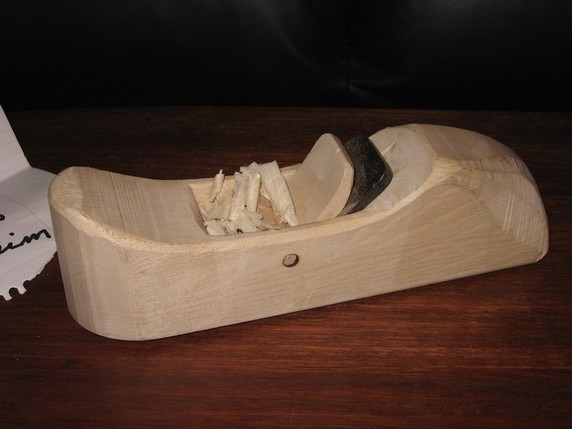
Re: bubinga for a hand plane

#15

Re: Ah, yes!  BEECH!

TomD

I'm not sure I buy the idea it is superior. You can almost always make a superior product with composites. As the old guys knew when the laminated wear strips, but a lot of planing doesn't really cause that much wear. Speaking of C&W, I wonder what material that dark coloured jack plane is from the molding plane video.

My beech is almost ready:


Re: bubinga for a hand plane

#16

depends on tooling available

Chris Friesen

For someone who is coming from a power-tool environment, it's quite possible that they have a jointer/tablesaw/bandsaw but no chisels/floats.

It's also the whole "workmanship of risk" thing. When preparing a laminated plane on power tools it's straightforward to obtain a flat bed and mouth perpendicular to the sole. With a traditional plane this requires hand tool skills.

Re: bubinga for a hand plane

#17

Re: depends on tooling available

TomD

Yeah, it depends on skills also. Workmanship of risk is really not that different. The worst was that tablesaw deal. :) In both senses of the word. Making a ramp flat with hand tools is pretty easy, if you know how, it really shouldn't be in doubt. The worst part is that one can get sorta off kilter the first few times, and try to use the wrong tool, or a particular tool for too long. In my case, the majority of my planes, well basically all of them, were made without floats. I still only have the ones I made. That Swiss video from a while back, shows that the plane maker did not use a float. And the Japanese don't either. You can actually make a pretty good plane without the ramp fitting well at all. At least with the cutters in Japanese planes. I don't like to admit it, but I know that from experience. So don't hold of if it seems like something one would want to try.

As mentioned, if you have every tool in town you can set up stuff like mortising machines to get the balance of speed with power tools and risk where you want it. Just seems to me that a plane is a hand tool, and if a person is planing on going in that direction they might take the opportunity to learn a few hand skills, but that isn't always the way it goes.

A good thing to do is cut a piece of wood to 45 degrees, and then cut it perfectly flat with a chisel, or a float if you have one. Working on the end of a piece of wood is a lot less intimidating than working within a plane. There are a few things that can be done without the clutter of the sides, but it is a good way to learn if you stick with the exercise.

Re: bubinga for a hand plane

#18

Re: depends on tooling available

eliot d

I think I'll try one of the traditional ones after I go though Charelsworth's Vol I, so that I have some of the hand tool skills under my belt. I would even try it now; but I'm intimidated by cutting the side 'V'-shaped ramps that hold the wedge. I think I could do the rest of it. I do have one good morticing chisel and lots of mediocre chisels.(Craftsman and Marples) And two really good rasps. And I'm learning to sharpen well!

Re: bubinga for a hand plane

#19

Re: Cutting abutments

TomD

It should be fun? Sounds like a good plan. Actually the abutments are one of the easier things, and faster things to do. I happen to cut them with Japanese tools because I had them, but anything would probably work pretty well. I have used bow saws. If you don't have the floats, I didn't have them, then it is sorta important to get the cut in on the first go. I just mark the top point on the plane, and then index the lower end off the mouth. I just pinch it against the mouth. I start cutting, and angle the saw to the mark on the top of the plane. I use a flush cut saw to make the cut from the ramp. That is pretty much a gimme. If you want to have the same certainty for the top cut, you can make a wedge, and just rest the flush cut saw on it. That way the cut is pretty much automatic. Flush cut saws are clever that way. But they cut nicely enough I just eyeball the cut. I got a specialized abutment saw from Harelson, and I don't regret spending the money. But for quite a while, I used one of two LV saws.

http://www.leevalley.com/en/wood/page.aspx?p=32933&cat=1,42884,50321

My favourite, the double cut is great for lots of stuff:

http://www.leevalley.com/en/wood/page.aspx?p=32928&cat=1,42884

Once you have the two kerf cuts, the waste comes out easily with a chisel.