New WoodChat!
Home Articles Forums Gallery Marketplace Videos

WoodCentral Forums

Knowledge You Can Build On — Est. 1998

Need a tree taken down or milled?

A handy way to lay out dovetailed drawers

Posts

A handy way to lay out dovetailed drawers

#1

A handy way to lay out dovetailed drawers

Bill Tindall

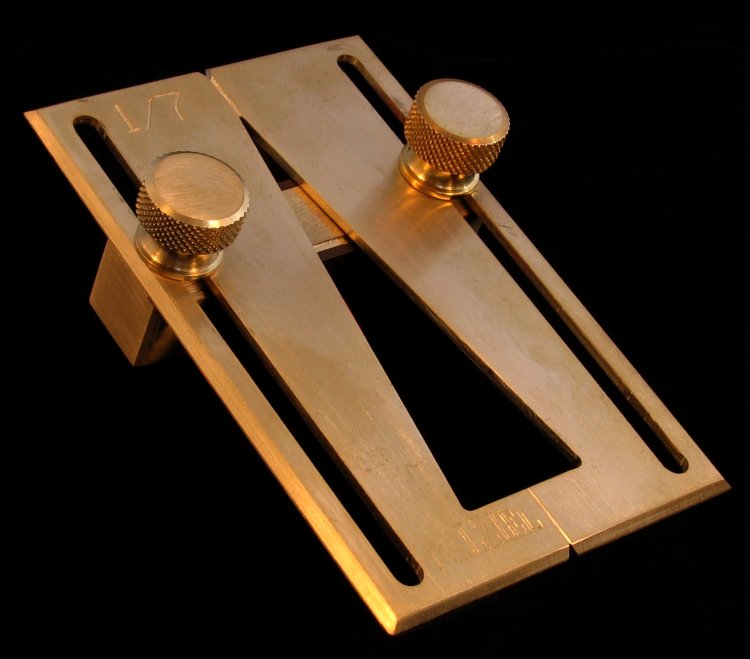
Let me state up front that someone on Woodcentral sent me a picture of this device; it is not my invention.

The task: There are more than 6 dozen individual dovetails to be laid out for the front of the drawers in the chest I am making and about 5 dozen for the rear. All the pins for the front are the same size and all the pins for the back are the same size, but a bit larger ( and fewer). Furthermore, the spacing of the pins can be something less than perfect and still look fine. However, the size of the pins needs to be similar or the layout looks sloppy. That is a bunch of marking that can be made easy and result in perfectly sized pins. It is done by focusing on the pins, not the tails. To that end I name this thing an "Adjustable Pin Marking Gauge", even though I gang the drawer sides and saw tails first.

The device:

This example board has been marked as it would be for a drawer side, but the marks have been darkened so they show up better. The half pins are marked, then either by eye or by dividers the center of the pins are located. The gauge is centered, more or less, over the pin marks and the pin/tail marked with what ever you use for marking. I use a 0.5 mm drafting pencil or a 0.5mm gel pen on dark wood. This device not only makes short work of marking, but every pin will be the same size.
Re: A handy way to lay out dovetailed drawers

#2

Re: A handy way to lay out dovetailed drawers

John Pappas

Bill, rather than working with the center of the pins, try this. Mark the half pin on the left side. Then using a metric ruler divide the space from the right edge of that half pin to the right edge of the board by the number of pins desired. Those marks (and the right edge of the board) represent the right edge of each pin. Use the right edge of the guide to mark the remaining pins. No centering necessary.

Re: A handy way to lay out dovetailed drawers

#3

Re: A handy way to lay out dovetailed drawers

Derek Cohen (in Perth, Australia)

Hi Bill

Robert Wearing designed a dovetail guide along those lines. Ian Danziel, plane maker in the UK, build the most superb version for Bugbear, who will no doubt be along soon to tell us all about its construction and what it is like in use ..


Back to yours ... question: can you run a line from the vertical/angle straight back and onto the horizontal, or must this require a second tool, such as a square?

The weakness with the Wearing gauge is, I feel, that it only marks one side of the board. Compare with those from LN/Cosman and Lee Valley, which wrap around the edge.

Regards from Perth

Derek

Re: A handy way to lay out dovetailed drawers

#4

Re: A handy way to lay out dovetailed drawers

Pam Niedermayer

I don't understand why you use a compass to make pencil marks. Also, seems the compass would get in the way of the gauge.

Pam

Re: A handy way to lay out dovetailed drawers

#5

Re: A handy way to lay out dovetailed drawers

Bob Hackett

My guess is that he`s using the compass like dividers to lay out the spacing,then just using the pencil on the compass to mark with.

Speaking as a master at misplacing pencils the compass is harder for me to hide from myself. :)

Re: A handy way to lay out dovetailed drawers

#6

Your question indicates I didn't make......

Bill Tindall

something clear. But I am not sure what. First, the half pin marks are made on each side of the board (I just eye-ball their size considering that the pin on the drawer bottom can't be so big that the drawer bottom dado shows).

Next is the task of dividing up the space in between with more pins. There are many ways to do this part but an important consideration is that the one's eye doesn't pick up variation in the spacing unless it is extreme. Hence, many professionals just look at the space and divide it up by eye. To use my marker one would just make a pencil mark to indicate these pin locations, more or less center the gauge on these marks and mark the lines to be sawed.

Alternatively, one can "walk" across the space with dividers as advocated by Cossman and when the divider is adjusted about right, make pricks with the divider to locate the center of each pin. I often use this technique. Again, the spacing does not have to be precisely uniform so after two "walks" with the divider I estimate the spacing and make pencil marks to locate the center of the the saw kerfs that will define the tails(center of the pins).

Re: A handy way to lay out dovetailed drawers

#7

The main advantage......

Bill Tindall

Using this thing ensures each pin is the same size, something I struggle with when using a one sided dovetail marker. In terms of layout, this size is the most critical factor and the skinnier the pins are the more precise their size needs to be.

Re: A handy way to lay out dovetailed drawers

#8

Compass?

Bill Tindall

Ok that's two of you that have said compass. What have I done to confuse the situation? The picture shows a divider, not a compass, used as described below. No compasses involved.

Re: A handy way to lay out dovetailed drawers

#9

OK, I stand corrected. Thanks.


Re: A handy way to lay out dovetailed drawers

#10

Re: Your question indicates I didn't make......

Pam Niedermayer

Yeah, I assumed that the dividers were superfluous, which in the case of my using such a marker they would be, even in the case of no marker at all. So, Gilda to the rescue: Never mind. :)

Pam

Re: A handy way to lay out dovetailed drawers

#11

Stephen Shepherd

Re: Compasses=Dividers


Re: A handy way to lay out dovetailed drawers

#12

Maybe not quite

Bill Houghton, Sebastopol, CA

I've always* thought that "divider" referred to an instrument with two pointed ends, while "compass" referred to an instrument in which one of the legs ended in a pencil or pen. This seems to be common usage in referring to drafting equipment; in fact, I found an online ad that talked about one of the company's offerings as a "compass and divider," and talked about the interchangeable points and pencil holder. Britannica online supports the same distinction.

Graham Blackburn, in his "Illustrated Encyclopedia of Woodworking Handtools, Instruments, & Devices," shows two compasses: one with a pencil holder and one with two steel points; so woodworkers historically may have used the words interchangeably. On t'other hand, machinists seem pretty well established in referring to the two-steel-points instrument as dividers (in fact, Starrett, in the catalog I inherited from my uncle, called them dividers even when they have pencil points).

So this may be a traditional vs. current usage distinction, or differences among different trades. I do think using two different terms, depending on the points on the instrument, is clearer, as dividers (two steel points) have very different uses in woodworking than compasses (one pencil point).

Shall we talk about how many different objects can be called protractors?

*"always" here refers back to the late 50s...

Re: A handy way to lay out dovetailed drawers

#13

Re: A handy way to lay out dovetailed drawers

TomD

"even though I gang the drawer sides and saw tails first."

I have always wanted to gang them, but don't bother since with the pins I can saw to the finished joint anyway. I don't know if this could be part of the reason you are struggling with a lot of paring, though people like Beckworst seem fine with it. Didn't he say he only did it that way because someone told him it couldn't be done. Great premis for shifting the focus of a generation of woodworkers.

Also, for the backs, I would just go all KLaus on it. It is faster by far, and the results are good, and certainly good enough for backs even if one didn't get them good enough for fronts. I remember the first time I did it on a keeper piece of furniture, I got all screwed up and had full tail width half tails, and very coarse joint overall, though great fit. It's just a way to get a lot of practice fast and relly on one's skill not a lot of layout gages made by infill makers.

Re: A handy way to lay out dovetailed drawers

#14

Re: A handy way to lay out dovetailed drawers

bugbear

Bugbear, who will no doubt be along soon to tell us all about its construction and what it is like in use ...

Job's already done!

BugBear