Peening dovetails in wood
Derek Cohen (in Perth, Australia)
I was planing and scraping the outside of the military chest carcases, happy with the joinery so far, when it occurred to me to show the underside of the cabinet - the part that will not be seen - and in particular the dovetails there.
Obtaining a tight fit for dovetails is not a big test if the wood combination used is sympathetic. For example, one hard and one soft wood. The soft wood will compress inside the harder wood and create a gap-free join. Well .. most times. 
Joining a carcase that is built of medium hard wood is similar. As long as the woods involved have a little elasticity, they will compress. However, when one uses hard wood against hardwood, particularly woods that do not compress, such as the Jarrah of these carcases, then you had better take care to saw accurately. There is minimal compression with such woods.
For this reason I am extra careful with carcases in Jarrah. I saw to the line, but if I err I would rather that the fit is oversize - then test for fit and pare away any excess wood.
The result here was as good as I could have wished ...
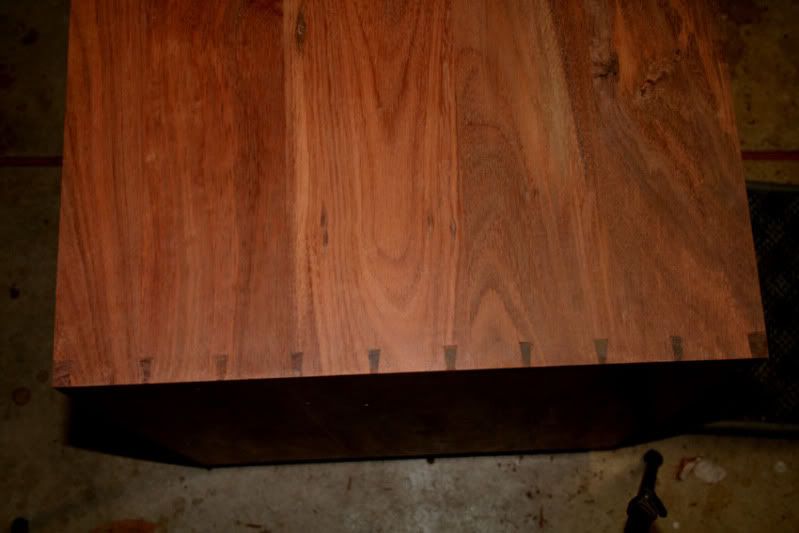
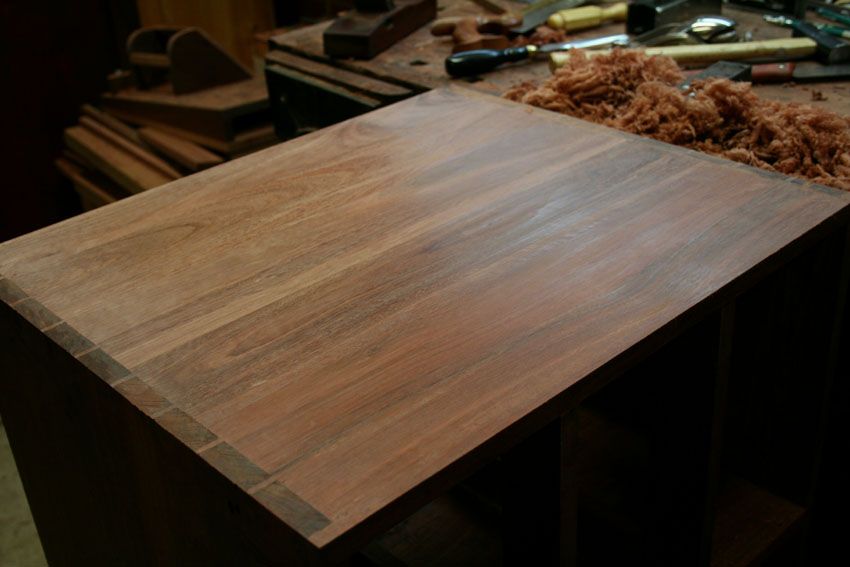
Now the underside of both cabinets was another matter altogether. The dovetail fit was not bad, but I did not aim for a perfect fit, just a good join. If I needed to pare away a tad more than usual to make the sides fit easily, well so be it. As a result there were gaps. No one would know.
We all know about filling gaps with thin wood wedges or slivers of wood. This can make gaps disappear.
There is another method - peening or sometimes called Bishoping - and this is particularly easy if the tails are slightly raised above the pins (in other words, the end grain is raised above the face grain).
Here is the underside of one end. There is one tail that split away as I pared it, and I did not both with a repair at the time ..
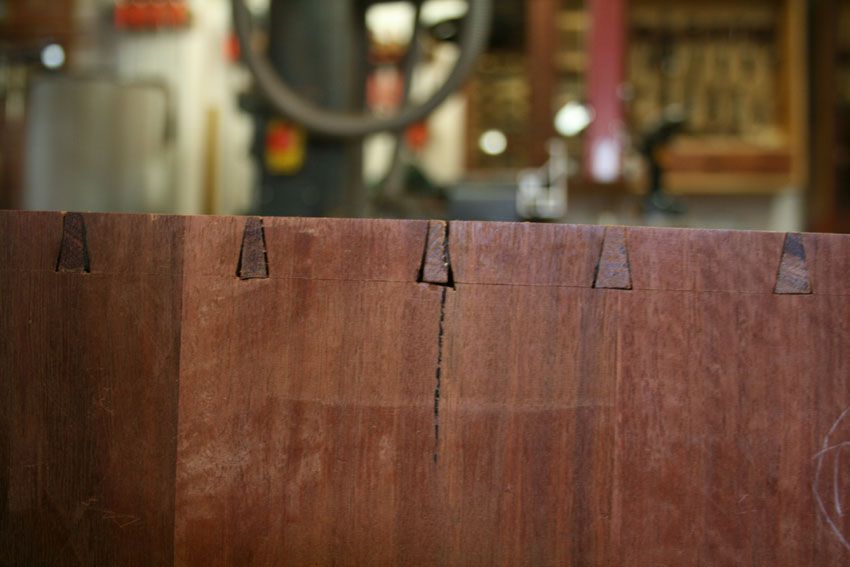
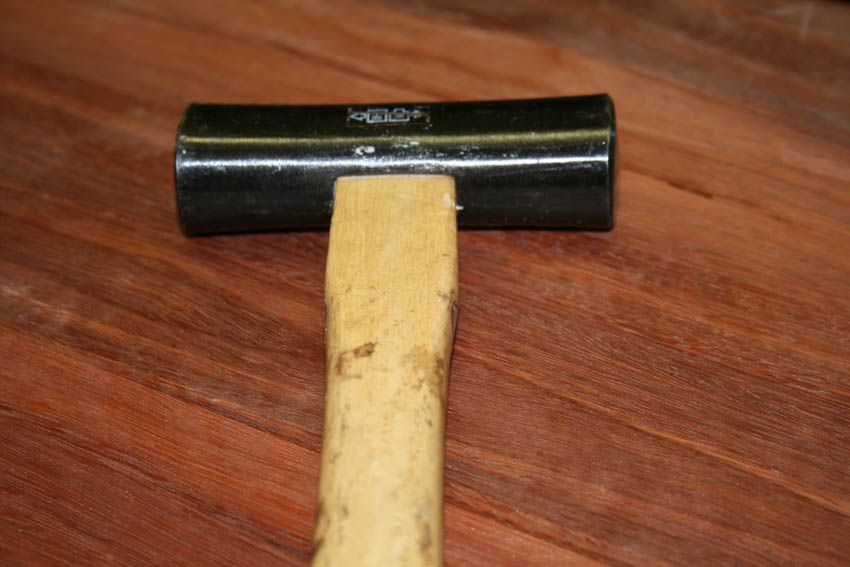
Peening is the process of working the surface - in this case wood - and moving excess into gaps. To do this we need a hammer with a domed head - the traditional Japanese gennou is perfect (these have a domed end on on side and a flat end on the other side).
Step one is to squeeze a little glue into the gaps. I place a little on my fingertip and then push it in ..
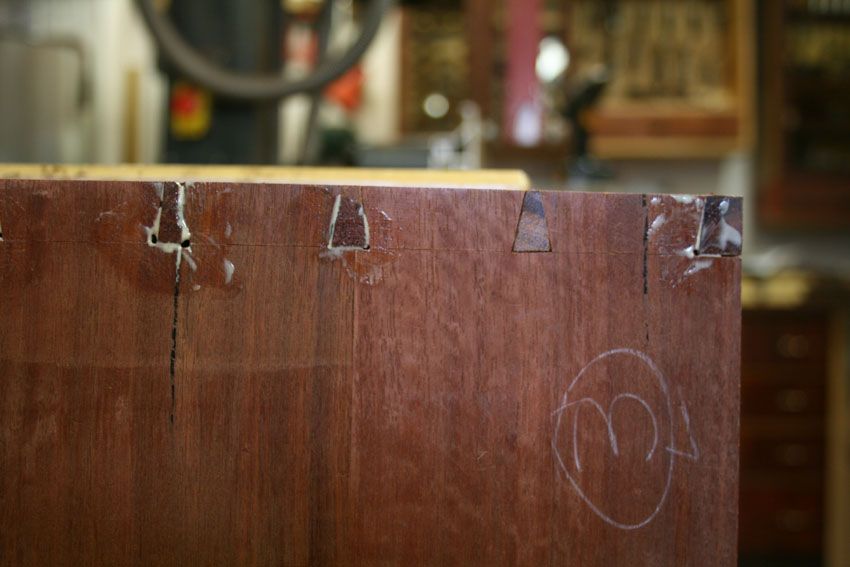
To peen one does not hammer downwards. Instead you need to hammer at an oblique angle and similtaneously drag the hammer head across the surface, as if you were pulling the wood into the gap. Several controled gentle taps are better a single heavy-handed slam.
You should achieve something like this ...
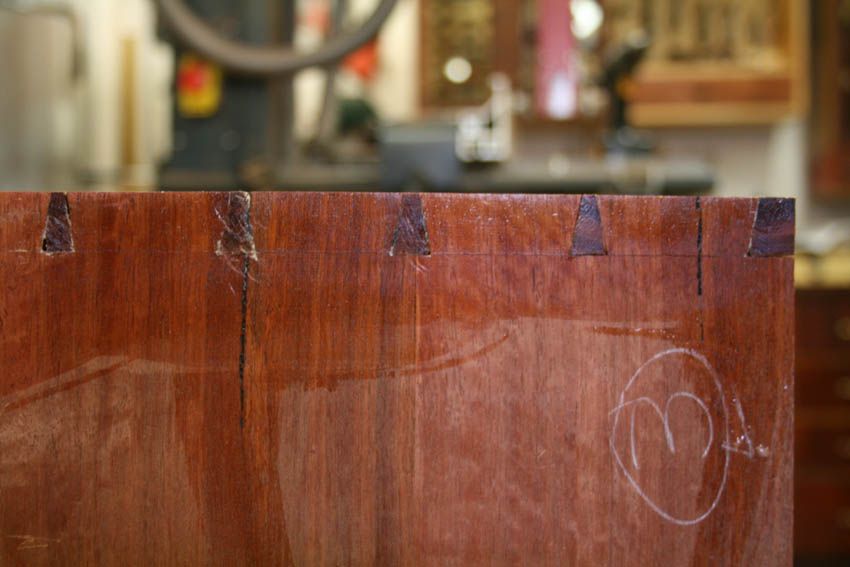
Now clean up the dovetail with a plane and see the result ...
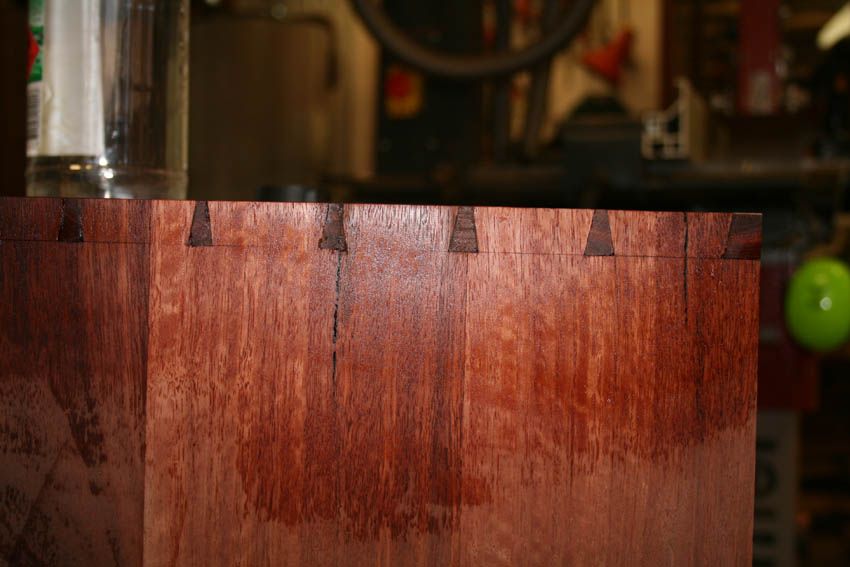
Not perfect but not bad.
Update: 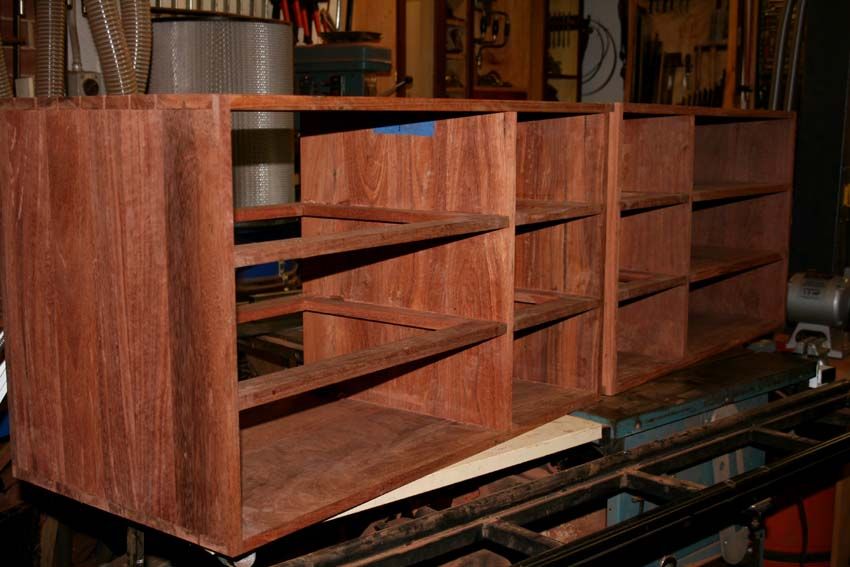
Regards from Perth
Derek


