New WoodChat!
Home Articles Forums Gallery Marketplace Videos

WoodCentral Forums

Knowledge You Can Build On — Est. 1998

A55 Smoothing Plane

Taper grinding a dovetail saw - a grand failure

Posts

Taper grinding a dovetail saw - a grand failure

#1

Taper grinding a dovetail saw - a grand failure

Derek Cohen (in Perth, Australia)

I've had this on my mind for about a year, ever since I removed the set from a LN dovetail saw and used it sans set. I had filed off a little to reduce the rough kerf .. and just couldn't get the saw to cut in a straight line no matter how much I tweeked the remaining set. So I filed it all all .. and the saw cut straight as a die, and cleanly as one could wish. However ... there is always a "however" ... the saw was hard to push. It would bind in the kerf (are we surprised?). This was easily fixed with a little wax to lubricate the steel, which is how I used it. What I find so appealing about this saw is that it will create a kerf just where the saw is placed .. you do not also have to account for the extra amount of wood removed by the set.

So I began to wonder about a dovetail saw that did not need any set. In other words a saw plate that was taper ground to avoid binding. A few months ago I read about Mike Wenzloff producing a tenon saw that was taper ground. Chris Schwarz was raving about it. Still, I have not read about a dovetail saw created this way.

The problem is that I am not a sawmaker. I have made a few saws, but that does not qualify me. Making a handle is the easy part. I can do a reasonable job of filing teeth (although you wouldn't believe this when you see the teeth that I filed in the saw to come!). The tough part is preparing a saw plate that is tapered. I do not have machining equipment. All I have is a beltsander!

Now I must warn all in advance that this was a failure. It was an experiment. I am hoping that we get some discussion going with the aim of improving the method. There is enough success here to see the benefits that may be gained.

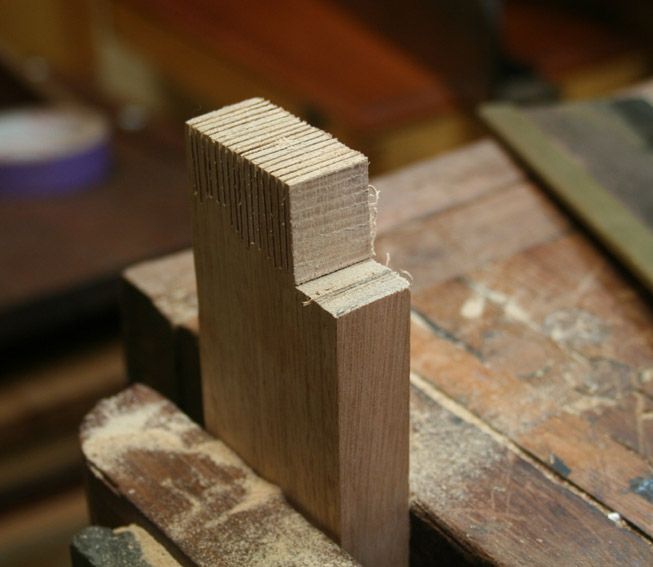
First some "before" pictures. The Guinea Pig was a Crown Gent Saw with an 8" long plate that was filed 18 tpi rip. I have had this saw about 10 years. It has not been used in half a dozen, but the teeth were reasonable. So I sawed these lines in 3/4" thick Tasmanian Oak ...
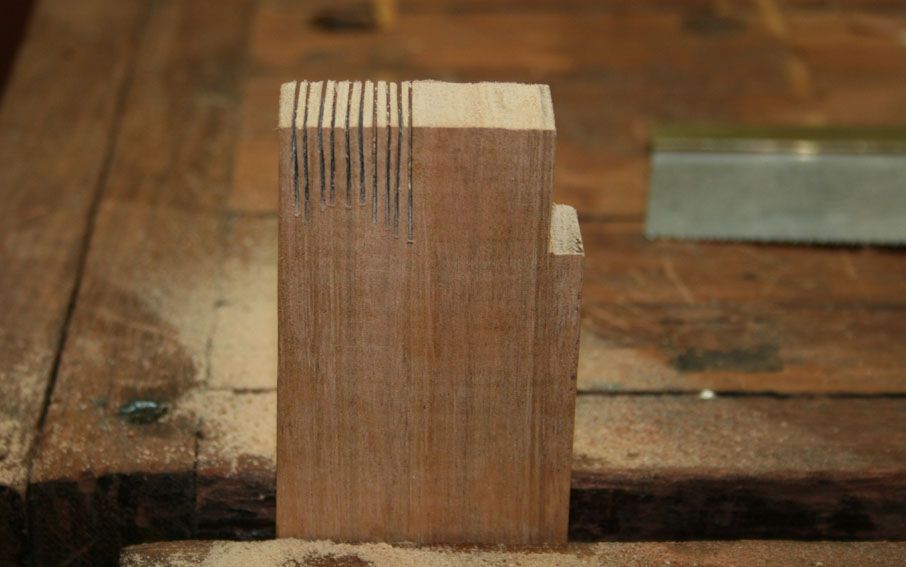

I sliced off a section at the end to reveal the kerf ..
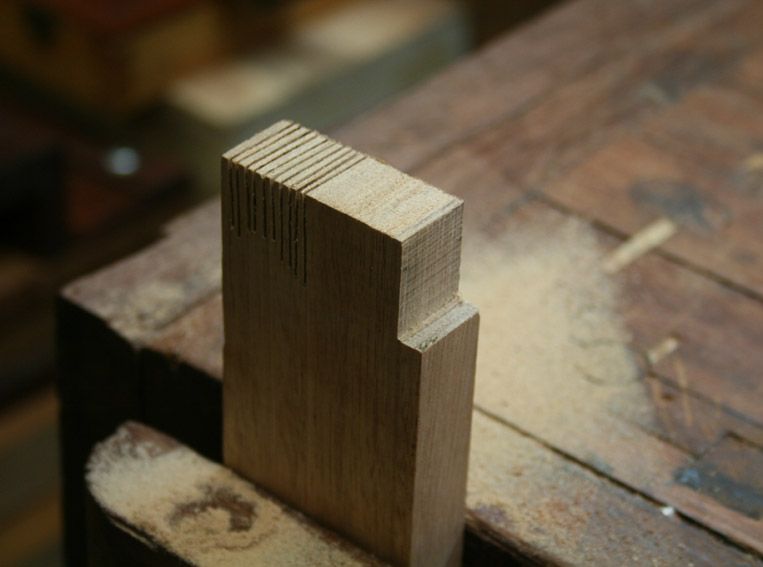

Next I carefully flattened the teeth with a gennou. Carefully tapped them down on the sawtable...


And then cut some more lines in the Tassie Oak ..
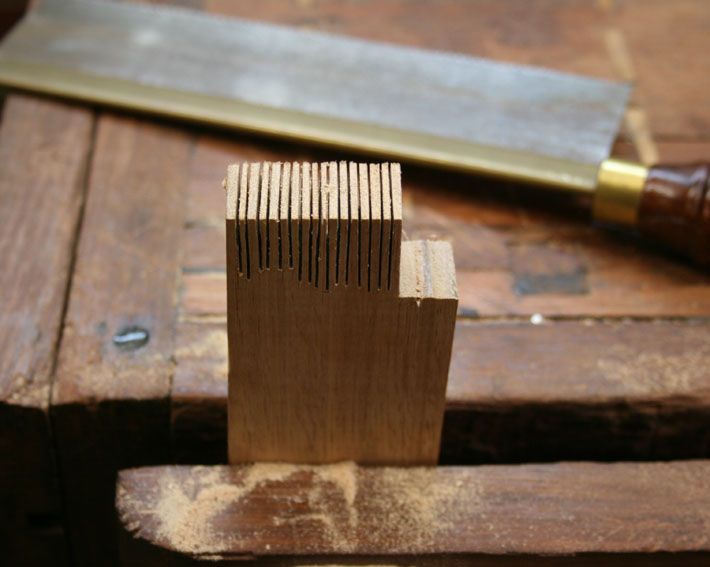


The kerfs are noticeably straighter and the kerf face is a little smoother.

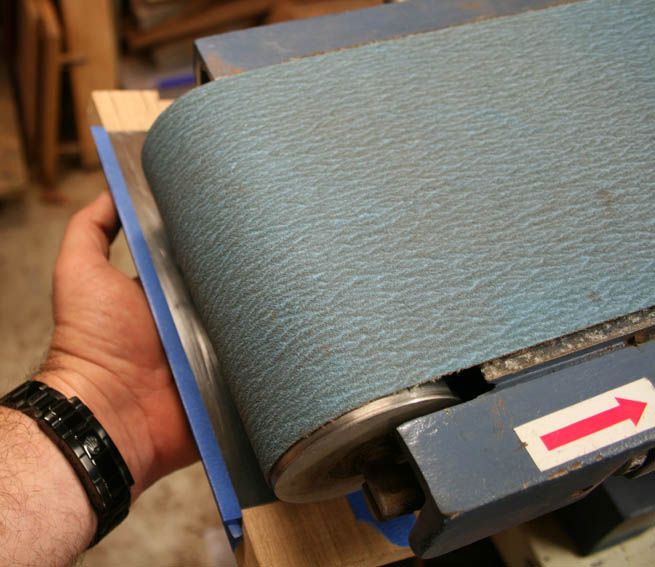
The next stage was to taper grind the saw plate. What I did was to tape up a 1/4" from the teeth, then use my belt sander to grind back the steel for about 2". The belts I had are Zirconion Oxide in 120 grit and then 3M trizact belts to 600 grit. The plates were painted blue to monitor the grinding, cooled with a wet sponge if they became warm, and checked for thickness as we proceeded.

In the first picture (left) if the original thickness. On the right I am checking for progress - .001� is barely a start ..
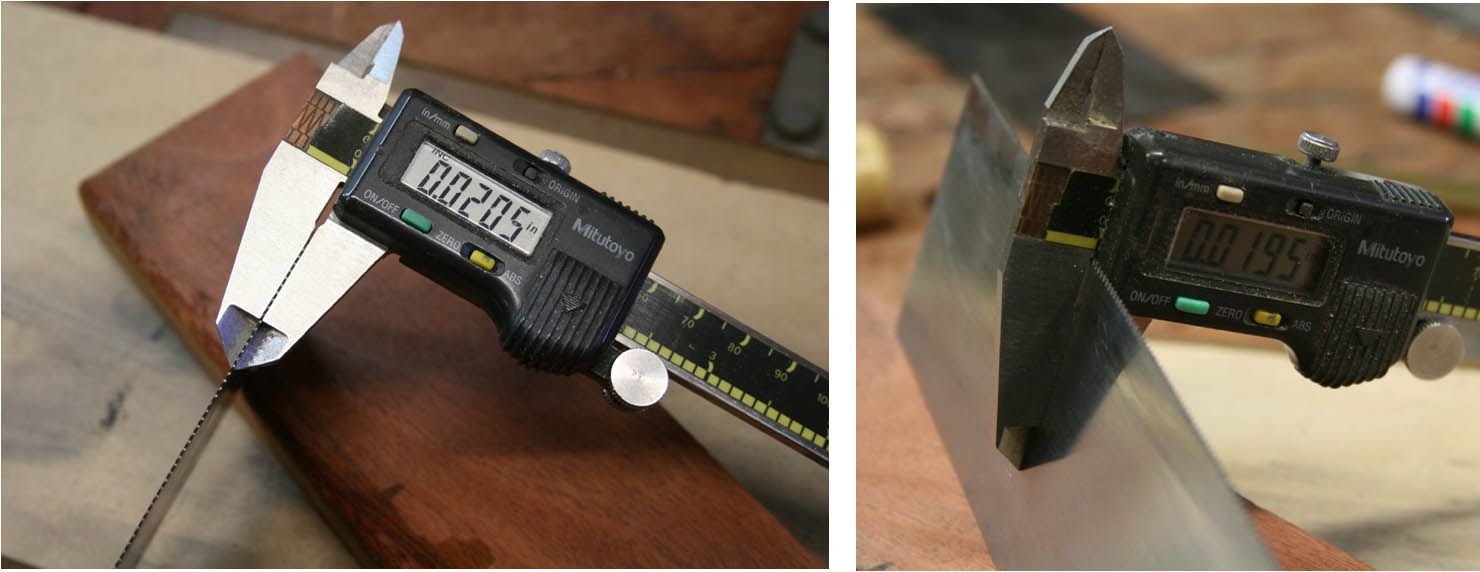

I ended up with a taper of .005� that started �� in from the teeth.

Promise not to wince at the teeth (I did warn you). I did them fast. There is a 10 degree rake. 18 tpi is hard on the eyes ...
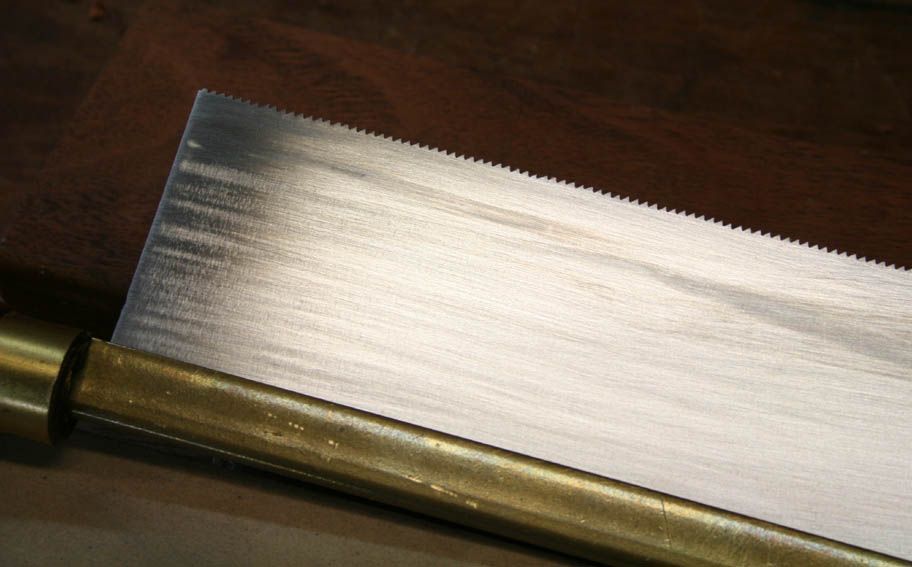

But they worked. Jointed, sharpened .. they cut well ..

At first it was a struggle. I thought that the wood was too thick. I resawed it to 3/8", which would be more typical for a saw with this configuration.

It cut really straight and with so much control that I was taking slices 1mm and under ...
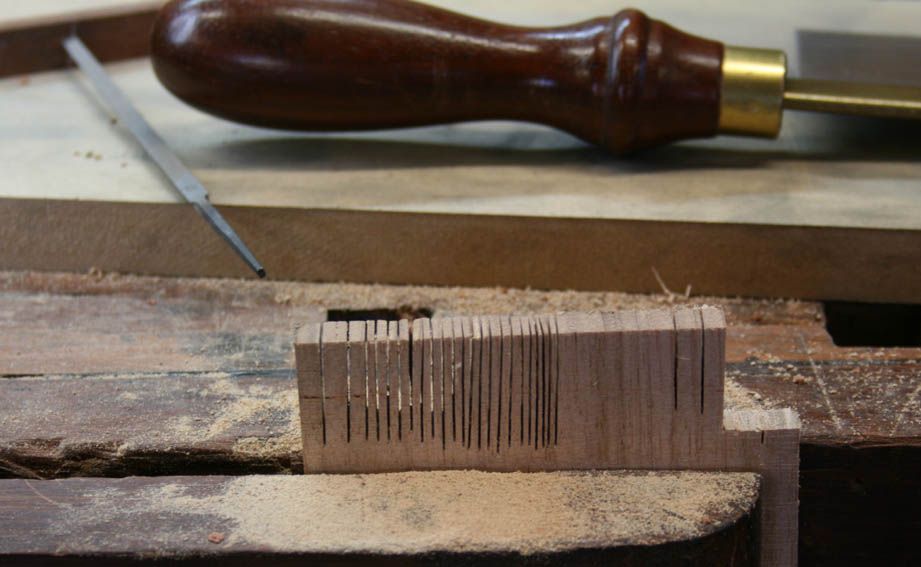

And the kerf was as smooth as a baby's watsit .. at least as good as a tablesaw with it high toothed blade ...
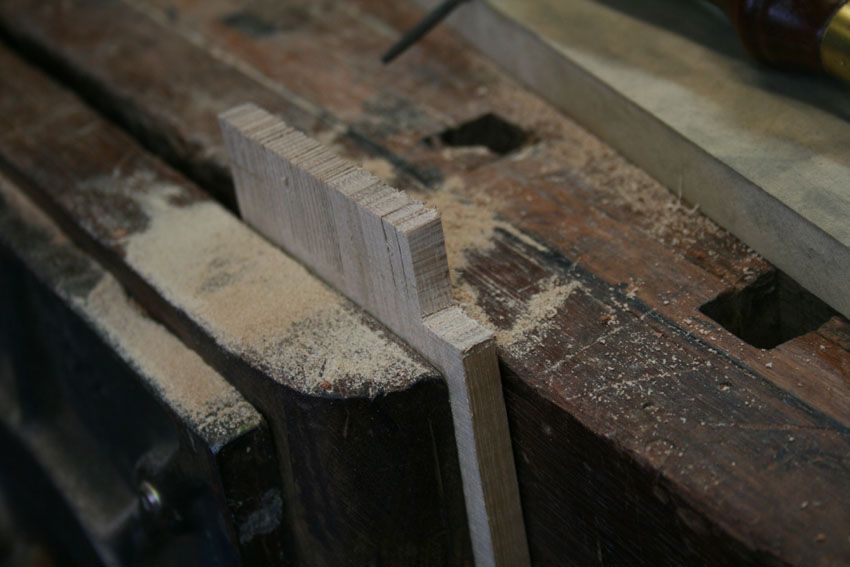

I sawed a practice dovetail. The kerf was like from a japanese dozuki ..
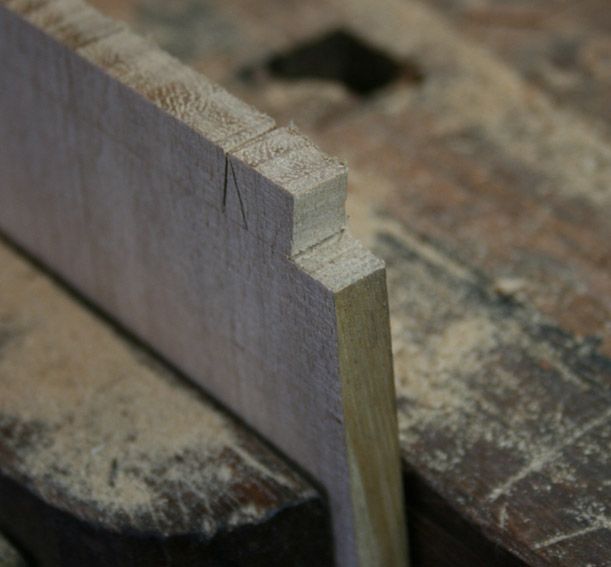

At the end of time I had to say it was a failure - the saw just did not cut smoothly. It felt like it was binding on the 1/4" around the tooth area. The effort started immediately and did not increase or decrease as the blade bit deeper. I will have to find a way to taper grind to the end of the plate.

Any ideas? Comments?

Regards from Perth

Derek

Re: Taper grinding a dovetail saw - a grand failure

#2

Experiments are failures only if badly designed

Bill Houghton, Sebastopol, CA

One of our physics faculty used to say that a properly designed experiment cannot fail: it can support or fail to support the hypothesis. Neither answer is a failure, because each answer advances understanding.

I have to say, I doubt I'll ever try taper grinding a sawplate on a belt sander. This may be a product of bad early experience with the belt sander in the shop of one of my early mentors, with which I ruined a lap joint I was trying to make (I also learned that time that wood putty is not a structural gap filler). I picture myself looking through holes in the sawplate after I pull it off the sander, or finding the sawplate turning blue.

But you found a way successfully to remove very slight amounts. That's great, and useful information. Maybe it'll inspire me to be a little gutsier if I ever own a belt sander.

Weren't sawplate tapers traditionally scraped in? If so, could you do your highwire act with the belt sander for all but the very edge and then scrape a taper on that last 1/4"?

Re: Taper grinding a dovetail saw - a grand failure

#3

Getting back to a flat surface . . .

Steve Elliott

There are two issues involved in tapering the saw plate: stock removal and achieving flatness. The belt sander method worked in removing stock but left high areas (particularly near the teeth) that needed a little more taken off to get that flat surface you want.

My first thought would be to use some sort of "hard sanding block" technique to work on the high areas. Maybe a coarse oilstone, maybe draw filing, but some method that would work on the high parts and eventually let you achieve a flat, polished surface.

Can someone who owns a tapered saw measure its thickness and post the amount of taper traditionally used? That would be useful information.

Re: Taper grinding a dovetail saw - a grand failure

#4

You need a Sen.

Bob Hackett

Known in the West as a saw scraper.

As with most projects involving a power vs hand tools balance, for the final finesse you would be better off with a scraper IMO.

Just think of the saw plate as a bit of REALLY hard wood, will you get more control and be able to reach close up into details (the saw teeth) with a belt sander or a hand scraper?

Re: Taper grinding a dovetail saw - a grand failure

#5

Scraping Metal

Steve Elliott

My experiments with scraping cast iron weren't very successful but I'm sure a proper scraper for the task and some instruction would help a lot.

Instead of scraping around the teeth I'd get the saw plate tapered and polished to my satisfaction and then file the teeth and set them.

Do you know of any good information on saw scrapers?

Re: Taper grinding a dovetail saw - a grand failure

#6

same experience

Bill Tindall

Various people have suggested scraping this or that like anyone could just pick up a scraper and shavings would be readily produced. I must be scraper challenged because I have never had any success on metal. However, I suspect that much like wood, the scraper must be of the proper type and properly sharpened and properly presented to the surface. These details have always been lacking in the description of the task and I have never seen it demonstrated.

So, will someone provide the missing details?

Re: Taper grinding a dovetail saw - a grand failure

#7

Re: Taper grinding a dovetail saw - a grand failur

David Weaver

Taper it all the way to the teeth, don't worry about the teeth, and file them to the depth that they need to be undamaged when you're done. That would be my bet at it. I would also create a block (with handles) with sandpaper to count strokes and do the sanding by hand. I know that sounds ridiculous, but you don't have to have a perfect look on the plate when you're done, so you can do the grinding with a low grit like 80 or something, and then just remove some of the scratches with 220 or something like that, to make it run smooth in the kerf.

I think using a belt sander will be too hard to get an even taper.

Re: Taper grinding a dovetail saw - a grand failure

#8

craigd

Re: same experience *LINK*

craigd

Scraping got a lot of coverage in one of the cast iron threads, good info, including this post by David Barnett.

I've seen videos of Japanese saw makers using sen's (looks kinda like a spoke shave) to thin the center of saws, pretty impressive; looks simple but I bet it takes lots of practice and a good feel.


So you've got a slab or iron. Now what?

Re: Taper grinding a dovetail saw - a grand failure

#9

Re: same experience *LINK*

Pam Niedermayer - Austin, TX

You may want to take a look at one of 330mate's ebay pages, near the bottom of the page are two fairly blurry videos of saw tapering, one with a sen.

Pam


two saw videos

Re: Taper grinding a dovetail saw - a grand failure

#10

Leo Cuellar

Re: Taper grinding a dovetail saw - a grand failur

Leo Cuellar

Derek, if you haven't already considered this, might I suggest using a flap disk mounted on a hand held angle grinder. A light touch should allow you to taper that last 1/4" or so without over heating it. A small disk sander would accomplish the same if a bit slower.

If you own a drill press you could mount a cup wheel and attach the saw to a sled at a suitable angle. While this would be more work, it would give you consistency & repeatability.

Enjoy your posts even though I'm more of an electron smasher. :)

Leo

Re: Taper grinding a dovetail saw - a grand failure

#11

Re: Taper grinding a dovetail saw - a grand failur

Marv

Derek,

No doubt an interesting experiment, however, I see no practical reason to taper grind a saw plate that will be sawing kerfs only about 3/4" deep for the most part.

All of your cutting problems involve the teeth and how they are filed and set. You are basically dealing with a piece of sheetmetal when comparing one saw to another.

The reason handsaws are taper ground is because the entire height of the blade is embedded in the kerf and usually a lot wider than a backsaw. The taper is to allow less set in the teeth. With a backsaw, especially a DT saw, the set is minimal, no more than a few thousands per side.

If you need a smooth cut surface, add a tad more set, then side joint the teeth so as to maintain the angle of the teeth as they are bent away from the plate. To do this, use a narrow slip stone, like 1" wide.

Marv

Re: Taper grinding a dovetail saw - a grand failure

#12

Re: Making a Sen.

TomD

http://forums.dfoggknives.com/index.php?showtopic=2741

Re: Taper grinding a dovetail saw - a grand failure

#13

Re: Scraping articles

TomD

Machinist scraping works on a number of materials, but seems to work best on cast iron. The sen as used on Japanese swords would also mostly be an iron thing, though I don't think Don Fogg builds that way, and he is using sens on 1050, at least at one point.

The Home Shop Machinist just started a series of articles on scraping. The first of this series is on the news stand right now. So far it is the best treatment I have seen, and seems extremely well written, with just the information one really needs, well ordered, etc... One of the issues will cover scraping a hand plane bottom. The only problem (for some) is that these machinist pubications serialize everything, the magazine is like 8 bucks, and this looks like it could stretch over a short book length. So getting all the issues is going to be slow and expensive. In a not too distant future civilization people will be able to buy these articles in book form, if past publications are anything to go by.

The first article is an overview, and the next one will deal with how to make scrapers. But they also say that if you ever use a carbide one you will not want to look back. So you might spring for the carbide. I picked one up off a craigs contact for peanuts.

http://www.youtube.com/watch?v=D1eOQa1gYiU

I haven't checked any of these videos. Just jumped ahead of the unrelated scraping threads. I bought a commercial video and it was ok, but probably more useful on details for someone who was 90% there. I wouldn't recomend it.

There is also a Yahoo group on scraping.

One thing about machinist type scraping is that it has a very slow removal rate, so it really isn't for making hand saws, this could leed to frustration for some trying to use it for producing saws. There are roughing and finishing cuts, but in general it can be slow. Not all metal scraping seems to be slow.

Re: Taper grinding a dovetail saw - a grand failure

#14

Re: Taper grinding a dovetail saw - a grand failur

Derek Cohen (in Perth, Australia)

Hi Marv

A few comments ..

No doubt an interesting experiment, however, I see no practical reason to taper grind a saw plate that will be sawing kerfs only about 3/4" deep for the most part.

As I mentioned, I have been using a dovetail saw which has no set. It works, but requires wax to prevent binding. The depth of cut makes no difference - the plate needs wax to the depth of the kerf otherwise it will bind.

The reason handsaws are taper ground is because the entire height of the blade is embedded in the kerf and usually a lot wider than a backsaw. The taper is to allow less set in the teeth. With a backsaw, especially a DT saw, the set is minimal, no more than a few thousands per side.

Teeth have set to prevent binding. A tapered plate should permit the saw to cut without the need for set. That is the point of tapering the plate - not to reduce set, but to eliminate it. What I became aware of here was that the taper must include the teeth.

If you need a smooth cut surface, add a tad more set, then side joint the teeth so as to maintain the angle of the teeth as they are bent away from the plate. To do this, use a narrow slip stone, like 1" wide.

Been there, done that.

Any amount of set has two adverse effects. Firstly it reduces the smoothness of the end grain remaining, and secondly it must be made allowance for when placing the saw plate on the line. Of course this is not actually a problem for the most part, and while not essential, it would be nice to eliminate it.

At the end of the day this is just an experiment to see the effect of taper grinding - in fact I should really call this "hollow grinding" the plate. It is evident that the taper needs to extend from the teeth, not from behind the teeth. Even 1/4" of non-tapered unset teeth will bind.

So I look for an efficient way to do this in my shop with the equipment I have - probably a pipe dream ...

Regards from Perth

Derek

Re: Taper grinding a dovetail saw - a grand failure

#15

Re: Taper grinding a dovetail saw - a grand failur

David Weaver

Derek - how much taper do you think would be required over a 2" depth spine?

I am tempted to get another wenzloff dovetail kit intentionally with a .020 plate instead of .018 and taper it by hand (with a sanding block) from .020 at one end to .015 at the other.

I believe this can be done fairly easily. We'll see if that holds true. More taper than that will not be something I want to do, though.

If it can be done on the #77, it should be fairly easy to do with a smaller dovetail saw so long as someone has the patience to do the sanding by hand. I know you have the hand skill and sense to do it, just need to tack the blade to something very flat with a low strength adhesive and clean it and redo the adehsive each time you flip it.

Or perhaps adhering the saw blade to an identically sized block and lapping it would work (though I think this would be more likely to leave the ends thinner than the middle, and moving a block smaller than the blade, but just as tall, would be a better idea - with the blade stationary).

Re: Taper grinding a dovetail saw - a grand failure

#16

Re: Taper grinding a dovetail saw - a grand failur

anotherBob

So I look for an efficient way to do this in my shop with the equipment I have - probably a pipe dream ...

Derek, do you have an oscillating spindle sander? Years ago, before I discovered hand planes... I needed to thickness sand a bunch of bandsawed maple veneer strips and other equally dimensioned stock. Came up with:


more of a closeup showing where I forgot to hookup the tensioning spring:


Think of it as a scrub plane, taking off just a little in depth (barely making contact), vertically, along the length... you take multiple passes leaving just the high spots for a ROS/stone/hard-backed sanding block. I would try it on a scrap plate (attached to a block of wood) to get your process down first before committing to a keeper.

Believe it or not, this thing works very well. Most recently used to true up and make parallel a bit of O1 stock after hacksawing...

Re: Taper grinding a dovetail saw - a grand failure

#17

Re: Taper grinding a dovetail saw - a grand failur

TomD

Very creative!

There are a lot of surface grinders and tool grinders out there for peanuts. I bought a KO Lee for 100 dollars, then sold it for 200, and found a smaller free one. They are just pushing this stuff to the edge of the street. At one time I thought it was only coming out of big places, but it takes a lot of machine tools even to keep the little places running, apparently. So I suppose if one wants to do this stuff by hand, or if one wants to not have to move those dang machines... But if you just want to grind stuff, get a grinder.

I have found the mag chucks are a lot more expensive, but not really necesarry for low volume.

Re: Taper grinding a dovetail saw - a grand failure

#18

Ellis Walentine

Farm it out?

Ellis Walentine

Hi Derek,

One limitation I see with your setup is maintaining consistency and parallel faces using a 6" belt sander on an 8" long saw plate, where you never have the entire blade in contact with the abrasive at one time. It will always be difficult to balance the entering, exiting and overlapping cuts so you end up with uniform thickness at the business edge, or anywhere else for that matter.

I understand the design challenge of doing it yourself, but a machine shop could do a nigh-on perfect job with a surface grinder in no time flat.

FWIW,

Ellis

Re: Taper grinding a dovetail saw - a grand failure

#19

As could an experienced saw maker. 

Pam Niedermayer - Austin, TX

Re: Taper grinding a dovetail saw - a grand failure

#20

Re: Taper grinding a dovetail saw - a grand failur

Marv

Derek,

The idea of being able to start the cut exactly where you want it to start in relation to your line without having to compensate for set is a valid point. However, I think that what you will find is, you will need a few thousands taper within about 1" up the blade from the teeth. And yes, the teeth need to be tapered too. So if you are starting with say, a .020 blade, at it's thinnest point up the blade it will be about .014 thick. I'm thinking it will take at least .003 taper per side in order to prevent binding or too much drag.

I think I would start with a thicker blade, maybe .030. That way you won't have to be concerned about tapering the blade too thin.

I don't know if hollow grinding is the right way to go. That isn't taper grinding in the true sense.

I think I'm going to go with Ellis' idea of having someone with a surface grinder do it for you and only have them taper grind no more than 1" up the blade. Some of those guys will have an air chuck that will hold the plate in place with vacuum. They will taper the blade in only one or two passes per side. If you do it this way, give them a blade that has new teeth with no set or no teeth and file in the teeth after they do the grinding. I would have them grind .004 per side. This will give you a little wiggle room when you start a cut so you won't have to be in perfect straight up alignment with your line.

Sounds like what you want to accomplish is a smooth enough cut surface that you won't have to pare and size?

Good luck,

Marv

Re: Taper grinding a dovetail saw - a grand failure

#21

Re: Farm it out?

Derek Cohen (in Perth, Australia)

Hi Ellis

Unhappily, I acknowledge that you make sense. The "unhappily" part is because I hate to accept that this is something that I cannot do. On the other hand, the aim is really to experiment with a tapered plate dovetail saw, so I shall look for a company in my area that can do the tapering work - then get back to the experiment.

Regards from Perth

Derek

Re: Taper grinding a dovetail saw - a grand failure

#22

Now I have a headache and need to lie down ...

Derek Cohen (in Perth, Australia)

Hi Marv

Thanks for the comments.

I have long wondered about set - how to calculate the amount needed, and then how to apply just enough?

I have several dovetail saws that the makers stated they added .003" on each side, yet the saws leave different looking surfaces on the saw kerfs, some smoother and some rougher. Perhaps on one that was rougher the set was not applied evenly.

What is the experience here of the amount of set needed for hard- and softwoods? I find that less is required for soft woods. For example, my set-less LN works more freely in soft wood while it will definitely bind in hardwood (and is required to be lubricated with wax to saw smoothly).

For a tapered plate I doubt that I would want to use .030" steel. This is going in the wrong direction when one considers the thin-plated 0.18" steel being used currently.

The thought occurs that a tapered plate is quite a different animal to the hollow ground plate I was attempting. Specifically, if one planned to taper a 0.020" and 2 1/2" wide plate by 0.006", it is not going to be 0.014" thick behind the teeth ... it is going to be nearly 0.019" behind the teeth .. and that will cause binding, as I discovered.

Oh dear, this tapering lark is not as simple as I thought. Anyone want to come up with a recipe? Where are you Mike Wenzloff!!

Regards from Perth

Derek

Re: Taper grinding a dovetail saw - a grand failure

#23

Re: No more half measures!

TomD

Or time for some half measures it you prefer... Try some Starret feeler gauge stock the stuff that is .5" wide by 12" Make some handy little bowsaws for it. I just sharpen the middle 6 inches. I like the stuff, but in your particular case, you could experiment just with the stuff that is actually in the cut. limit your tapering to the narrow band. Once you get that going as you want it to you can play with the wider stuff for backsaws, if you still want to.

For tapering you could back it with something. Use double side tape and a stop to hold it there. Be careful of grinding heat, because the way you remove stick on discs is by running/pushing them till they get hot, which this thing will do pretty quickly. Fresh belt. Put it off centre on the backer, and you won't be able to stop yourself from tapering it. Just grind it absolutely flat. It will come out tapered. Another dodge would be to taper the backer board with a hand plane so it isn't uniform, that would also help you bias the grind. It is pretty basic stuff to get this ground out freehand, just look at the grind lines on a daggers some day. That's hard, this is easy. You know all the mechanics you would have to pull from foot position to hand placement to get a nice parallel grind, so just subtly goof some of that stuff and it will come out tapered.

Re: Taper grinding a dovetail saw - a grand failure

#24

Re: Now I have a headache and need to lie down ...

Marv

Derek,

I wouldn't be concerned about the thicker plate of say, .031. When you have the surface grinder grind your plate, tell them how thick you want it to be at the tooth edge. If you grind only an inch up the plate, the part of the plate above the taper will add stability or stiffness to the plate. That way you can have both a stiffer plate and a thinner kerf. As you do future sharpenings the tooth edge will become even thinner. You will have a saw that will improve with age.

Marv

Re: Taper grinding a dovetail saw - a grand failure

#25

Re: Taper grinding a dovetail saw - a grand failur

TomD

I have been trying to get a magnetic chuck for mine for a while. They aren't surper expensive, but I need it to be super cheap. That is what most of them use, what is the advantage to air?