New WoodChat!
Home Articles Forums Gallery Marketplace Videos

WoodCentral Forums

Knowledge You Can Build On — Est. 1998

Want Better Milling & Firewood Knowledge?

Mortise marking

Posts

Mortise marking

#1

Mortise marking

Bill Tindall

It would seem from the gadgets sold for marking mortises that it is customary, or even essential, to mark both boundaries of the mortise width with some variety of double marking gauge. However, with any of the ways I make a mortise the width of the mortise is defined by the tool that makes it, mortise chisel for example. Hence, it would seem that one line would be sufficient and therefore there is no need for a two pin or two wheel marking gauge. What am I missing about marking?

(chopping many mortises today and it will be with one line unless I am enlightened. Too hot to work outdoors. setting records most days. What a great hobby....get to work where it is cooler)

Re: Mortise marking

#2

Re: Mortise marking

Derek Cohen (in Perth, Australia)

Hi Bill

I use a Japanese kinshiro, either a small vintage one or a large one (a gift some years ago from Wiley ... how is he?):


There are two advantages to marking double lines.

Firstly, I mark mortices and tenons off the same gauge. Marking both is no extra effort, and the important point is that I am certain that there will be no mix up with measurements.

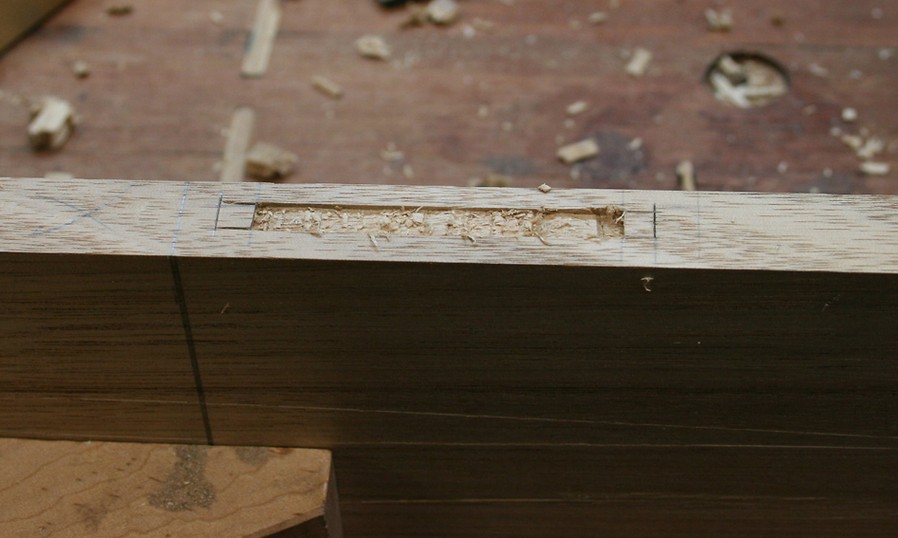
Secondly, the double line for the mortice helps prevent breakout at the edges. This may not be a big issue generally, but some of the wood I use is quite brittle. A defined edge is easier to follow.

A tip on setting a double gauge ..

1. Mark the position with your chisel:


2. Place the gauge points at the outer edges of the imprint:


3. Now slide the head of the gauge against the work piece to set its depth.


Perhaps that will make it easier and convince you to use a double gauge?!. :)

Regards from Perth

Derek

Re: Mortise marking

#3

Re: Mortise marking

Pam Niedermayer - Austin, TX

Same here, and while I don't worry about the edges breaking, I do find the double line a helpful guide, just easier and faster to place the chisel properly. I do set the two blades directly off the blade, saves some time drawing and placing of the first chisel imprint.

I've tried marking the mortise with a single line, before I had a mortising gauge, and ended up getting a somewhat staggered cut. Not a drastic problem, but kind of irritating.

Pam

Re: Mortise marking

#4

Re: Mortise marking

Dean J in MN

Bill,

I agree, and I am apt to call my mortise gauge a tenon gauge.


I made a set of fixed pin gauges to match my mortise chisels, so I end up laying out the mortise with the double pin anyway. But, there is really no need for the second pin because, as you state, the mortise width is fixed by the chisel.

Re: Mortise marking

#5

Re: Mortise marking

David Weaver

Using the method that is in wearing's book, it's nice to have the second line so you can pop out a bit to start the mortise. As pam mentioned, it doesn't matter if the second side is perfectly clean. Wearing's method, to me, is an easy method to fire the mortise out cleanly without taking a lot of time.

Re: Mortise marking

#6

Re: Mortise marking

gregforster

I agree with Pam on the benefit of double lines; it gives you a left and right reference

to keep the chisel "in-line". I've used both single and double markings

and too often get a staggered mortise using only a single marking.

Re: Mortise marking

#7

Stephen Shepherd

What else would I do with my mortise/tenon gauge?

Stephen Shepherd

Re: Mortise marking

#8

Another approach ...

Derek Cohen (in Perth, Australia)

A double line, per se, does not ensure that you chop any straighter than a single line. After all, if you cannot maintain alignment with a line - any line - then you will end up staggering the mortice. The mortice is marked out to the width of the chisel. If you go over a line, on either side, you end up with a staggered mortice.

One strategy I like is to use the double line as a boundary to first pare away the uppermost layer. This ensures that you will work accurately thereafter.


Now chop it out ...


Regards from Perth

Derek

Re: Mortise marking

#9

Re: Mortise marking

Warren in Lancaster, PA

You can perhaps make a mortise passably well with just one line, but it would be some fun to see you saw the tenon with just one line. The advantage of using a mortise gauge is that one uses the same gauge setting for both mortise and tenon. This eliminates the compounding error attendant with measuring the two separately. You just saw to the line. Unless you sawed crooked, you are done. There is no crank and measure, crank and measure the table saw, no test cuts on scrap, test fitting, fine tuning and such.

Re: Mortise marking

#10

perfect description

Bill Tindall

"There is no crank and measure, crank and measure the table saw, no test cuts on scrap, test fitting, fine tuning and such."

You described my tenon making precisely! And you may have successfully goaded me into trying to saw them straightaway.....as soon as I acquire a mortise/tenon scriber.

Re: Mortise marking

#11

Moses Yoder

Re: What else would I do with my mortise/tenon gau

Moses Yoder

An alternative use, if set up the right width, would be to pick both nostrils of your nose at the same time. For this purpose you would of course want to file it dull.

Re: Mortise marking

#12

Re: I was thinking back scratcher

David Weaver

If you removed the beam, you could use it (the beam) as a short reach back scratcher.

Re: Mortise marking

#13

Re: Another approach ...

Alan Schwabacher

That's a nicely shown example of what was meant above by "the method in Wearing's book".

Re: Mortise marking

#14

Re: Mortise marking

Ronald Dean

I can't beleive no one on this thread mentioned this:

http://www.leevalley.com/US/wood/page.aspx?p=67466&cat=51&ap=1

RD

Re: Mortise marking

#15

Re: Mortise marking

Pam Niedermayer - Austin, TX

I don't much like those for mortises because the markers are offset.

Pam

Re: Mortise marking

#16

Re: Mortise marking *LINK*

Bill Houghton, Sebastopol, CA

My impression has been that people use those by running first one, then the other line. That's certainly how Lee Valley shows it being used (link below). It's always seemed inefficient to me.


http://www.leevalley.com/us/wood/page.aspx?p=67466&cat=51&ap=1

Re: Mortise marking

#17

Thanks, Bill, to me, too. Love the single ones.

Pam Niedermayer - Austin, TX