New WoodChat!
Home Articles Forums Gallery Marketplace Videos

WoodCentral Forums

Knowledge You Can Build On — Est. 1998

Nearly 100 Exotic Wood Species, Direct-Imported Since 1972. Shop Slabs & Turning Stock.

Dovetailing question....

Posts

Dovetailing question....

#1

Dovetailing question....

Bill Tindall

The situation: Typical cabinet wood-walnut, cherry, etc. the operation is wasting material between pins or tails and the length of material(length of base line between pins or tails) to be wasted is say 1" or 1 1/2". What size chisel do you use to chop/pare to the base line of the dovetail?

Do you use a wide chisel so as to whack out as much as possible per chisel setting, but with greater force because of the longer shaving? Or, to minimize whacking force on the chisel do you elect a smaller chisel- say 1/2" or 5/8- so that lighter taps can be used to drive the chisel.

I use, and have seen used, a smaller chisel so that light taps can be used to drive the chisel. But I would like to know how typical this choice is. What is your "go to" chisel width for waste chopping when the amount to be wasted is an inch or more?

(information needed for a chisel test)

Re: Dovetailing question....

#2

Jack Guzman from Maine

Re: Dovetailing question....

Jack Guzman from Maine

Bill,

I always use the widest chisel possible without causing damage to the sides of the space being chiseled out. ---Jack

Re: Dovetailing question....

#3

Re: Dovetailing question....

John Pappas

Bill, I use the widest the space will allow. Now, my widest chisel that I use for chopping dovetails is 3/4". I take small(shallow) bites so that I don't have the whack the heck out of the chisel. You pose a good question and I will follow this thread with interest.

Re: Dovetailing question....

#4

Re: Dovetailing question....

Mark Salomon

This is an interesting question. I suspect that our woodworking fathers/grandfathers would be puzzled by the question because it seems to get things a bit backward. My understanding is that dovetails joints were often (usually?) sized by the chisel that you had available. So, you would lay out the tails in a way that would result in pins slightly wider than the chisel that you had available for chopping out the waste from the tail. So I guess the direct answer to your question is to use the largest chisel that fits the space/socket. But, it probably makes more sense to lay out the dovetails in a way that accomodates your chisels in the first place.

Re: Dovetailing question....

#5

A dovetailing answer ...

Derek Cohen (in Perth, Australia)

What is your "go to" chisel width for waste chopping when the amount to be wasted is an inch or more?

Hi Bill

One of the reasons for using a 3/4" chisel in the tests I am doing is that this represents the largest size I consider manageable for removing the waste from the pin board.

One might size a tail to fit a chisel width (say 1/4"), but spaced dovetails across a cabinet carcase involved waste of approximately 1 3/4".


I imagine that the reason for using the widest chisel possible is that this minimises the risk of chopping off the line. A narrow chisel is easier to twist, even fractionally, and the resulting line can become a collection of divots.

The disadvantage of wide chisel, however, is that it required more force to penetrate the wood, and this in turn increases the risk of damaging the edge, regardless of whether one takes fine slices (as seen in results of my recent chopping experiment).

The advantage of a narrow chisel is that it penetrates wood more easily, requires less force to do so than a wide chisel, and holds an edge better.

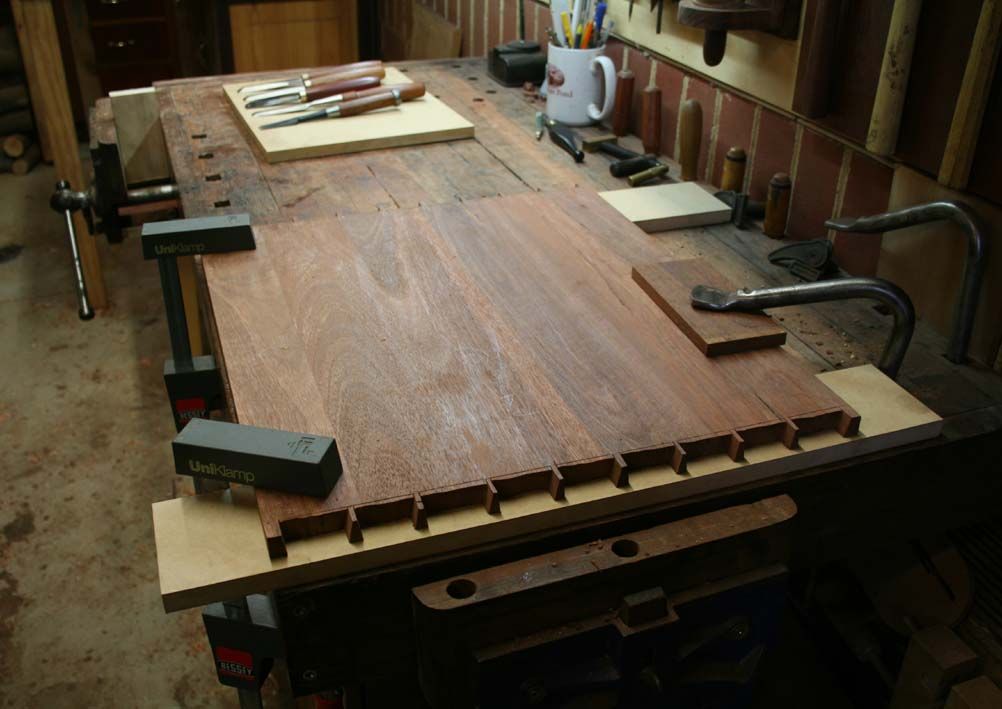
So what does one need to do to use a narrower chisel more reliably? Easy. Create a fence at the baseline of the dovetail, and chop against that...

Here is an image of undercutting the baselines of fretsawed waste..


This is a well-known technique.

Better still, however, is to do this earlier in the sequence. Saw the vertical lines, then undercut at this stage ...


...now fretsaw out the waste. Now you are ready to remove the remainder with even a narrow chisel. Still, I would not consider anything under 1/2" wide.


One of 8 recently done ..


Regards from Perth

Derek

Re: Dovetailing question....

#6

Re: Dovetailing question....

Warren in Lancaster, PA

I use a coping saw to remove the waste to 1/32 of the line, then use a 3/4 or 1 inch chisel for cutting to the line. If there is 1 inch or a little more between pins I use the 1 inch chisel. I use the 3/4 chisel for stuff I can do in 2 passes (1 1/8 to 1 1/2). If it is 1 9/16 or larger I use the 1 inch exclusively. There is no problem using a 1 inch chisel for harder woods like white oak, jarrah or persimmon. I don't have a 1 1/4 chisel that I use for this type of work, but that is a reasonable option.

Re: Dovetailing question....

#8

Re: Dovetailing question....

Bill Tindall

There are three variables to consider- pin size, tail size and number of tails in the joint. While the pin size can be fixed to accommodate some chisel width this decision leaves the tail size dependent on the number of tails. In the back of a drawer where need for strength is minimal the tails could be a inch or more across where as in the front of the drawer they would be much smaller.

Re: Dovetailing question....

#9

Re: Dovetailing question....

Ron in Sterling, CT

"What size chisel do you use to chop/pare to the base line of the dovetail? "

This is an interesting query. I use the widest chisel I can without crowding to close to the edge. I normally cut out the majority of the waste with a coping saw, then use the widest chisel that will "fit" and cut up close to the scribed line. I then use my "go to" 1/2 " paring chisel to make the final cuts. Works for me in hard, or soft woods. My 2 cents worth.

I will be following this thread with interest.

Ron

Re: Dovetailing question....

#10

Re: A dovetailing answer ...

Phil Smith

"The disadvantage of wide chisel, however, is that it required more force to penetrate the wood, and this in turn increases the risk of damaging the edge, regardless of whether one takes fine slices (as seen in results of my recent chopping experiment).

The advantage of a narrow chisel is that it penetrates wood more easily, requires less force to do so than a wide chisel, and holds an edge better."

Can you give a little more detail on why small chisel stays sharp better than wide. Yes the wider chisel does take more force but it is wider so force per unit area should be the same as a small chisel when both have the same bevel angle.

Re: Dovetailing question....

#11

Re: A dovetailing answer ...

Derek Cohen (in Perth, Australia)

Hi Phil

A wider/thicker chisel blade produces more resistance than a narrower chisel blade. There is increased ease of penetration when the bevel angle is reduced (e.g. 20 degrees penetrates more easily than 30 degrees) or the width is reduced (less effort is required for 1/4" wide blade over a 1" blade, assuming the bevel angles are the same).

The extra force to drive the wider chisel through the wood will stress the bevel. If the steel folds, the chisel will be dull.

Regards from Perth

Derek

Re: Dovetailing question....

#12

Re: A dovetailing answer ...

Frank D. in Montreal

Hi Derek,

I still don't quite get how more force could cause a wider edge to dull more quickly. Let's say the edge is twice as long (the chisel twice as wide); if it takes a greater force on the handle for the blade to penetrate the wood, isn't this greater force appied over a greater edge length (blade width), thus making the unit of force per unit of blade width a constant (constant force necessary to make a given edge length penetrate)? If so, the edge should last the same in both cases, and dulling should only depend on the distance the edge travels (penetrates) in the wood. I ask because it seems my wider chisels last a long time despite the beating they get.

Re: Dovetailing question....

#13

Re: A dovetailing answer ...

Derek Cohen (in Perth, Australia)

Hi Frank

I am trying to find an explanation for something I observe. I understand that the stresses are spread out over the wider area, but still I find that wider chisels appear duller. Now the answer may simply be that narrower chisels are easier to penetrate, even when dull, thus appearing to hold an edge longer. Any ideas?

Regards from Perth

Derek

Re: Dovetailing question....

#14

Re: A dovetailing answer ...

wilbur

I'd vote for the "narrower chisels are easier to penetrate" explanation. If you have a 1/4" and a 1" chisel, the 1" chisel has a cutting edge 4 times as long as the 1/4" chisel, so it would stand to reason that you have to pound on the wider chisel harder to get the same amount of penetration.

I tried this out when I was making mortises for my workbench. Here's a photo of the penetration achieved by a 1/4" mortise chisel and a 1" mortise chisel with the same hammer blow force. It seems that the 1/4" chisel went (unbelievably) close to 4 times as deep as the 1" chisel.


There may be something to the idea that pounding on a chisel harder makes the edge deteriorate faster, but the difference in cutting edge length seems to be a more significant difference and is a simpler explanation, so I'm inclined to side with Occam.

Re: Dovetailing question....

#15

"...so I'm inclined to side with Occam."

Bill Houghton, Sebastopol, CA

...whose razor is sharp indeed.

Re: Dovetailing question....

#16

Re: Dovetailing question....

roninkokomo

I use a half inch chisel till need to pare the base lines. Then as wide as possible

Re: Dovetailing question....

#18

Re: I'll bet that went over some heads.....

Howard Pollack

The simpler the better... I understand that Occam's razor was sharpened on a Japanese waterstone (do you know if that is actually true...)- Howard

Re: Dovetailing question....

#19

Diamonds   

Bill Houghton, Sebastopol, CA