We value your privacy.
We use cookies to enhance your browsing experience, analyse site traffic, and personalise content.
By clicking “Accept all”, you consent to our use of cookies. You can also choose
“Essential only” or learn more.
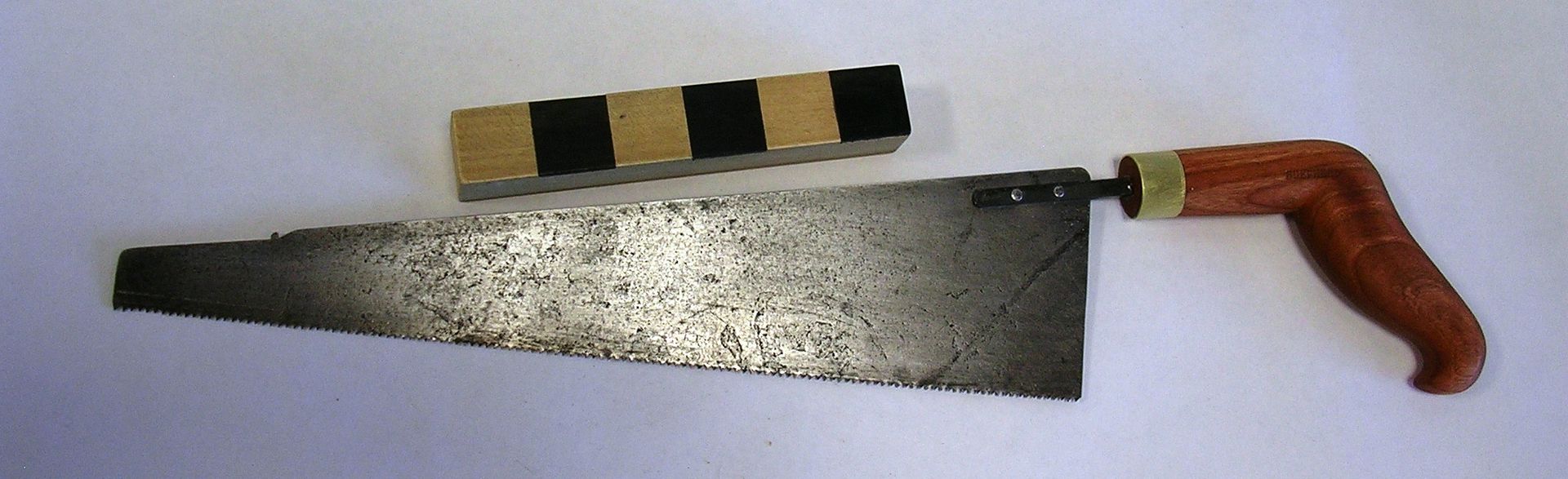
Only qualifies as a Sixth Back hand saw as less than 1/6th the saw is backed. A short tapered iron [back] tang with two holes for rivets was provided by a blacksmith friend. I upset some barbs on the edges with a cold chisel and it is glued with hide glue into the square tapered mortise in the handle. The blade [12 7/8" long, 11 teeth per inch] is from an old broken saw, I drilled the holes for the rivets, a cherry handle and brass ferrule. I can grip the handle with 4 fingers easily and comfortably.
A little bit 18th century, a little bit Dutch and a little bit American. One coat of linseed oil and turpentine, I will also expose it to some direct sunlight to darken the cherry. It cuts nicely, I ripped a maple wedge for a toothing plane I made. Sharpened rip but with skewed teeth.
Nice job on the design of the handle. I like how it is set back from the heel of the plate. Allows full use of the length of the blade no matter how small it becomes from multiple sharpenings.
I think I would have used a little wider metal part that attaches to the plate.
Is the nib original?
I have often thought that it would be a good idea to make backsaws with the handle set back like that, again, so the full length of the blade can be performing without banging into the cheeks of the handle we see on most all backsaws.
Stephen's 1/16th backsaw got me thinking how a backsaw might be attached to a somewhat normal handle without having to drill holes in the blade or saw a slot in the handle. Other than milling a slot in the back for the blade, perhaps even a caveman could make a saw like this.
Another advantage, there are no handle cheeks to get in the way of using the full length of the blade. Without the cheeks the life of the saw is extended.
I bought an old no-name 16" backsaw on eBay. A cheap way to buy a blade compared to buying a piece of new spring steel from McMasters. And it gives the opportunity to combine the old with the new.
I cut the blade down to 12". The back is 1/4" x 3/4" steel bar stock. I milled a slot in the back the same width as the blade is thick. .030. This allows a press fit in the 1/4" deep slot.
It's 12PPI filed crosscut, meant for general purpose use.
The hand grip is a resemblance of a Disston No.4 backsaw but with extended horns. I like long horns. I like how they snug up around my hand. The wood is Cherry finished with 4 coats of Lacquer.
The solid steel back is very rigid, allowing no twisting or flex.
The female threaded part of the screws are made to extend almost all the way through the wood and the back. This allows lots of thread with the threaded male part being 9/16" long. The two larger screws have .594 dia. heads. The small one has a .500 dia. head.
This was a fun little project. However, I'm not a saw maker per se'. This will be one of a kind. I call it... My New Concept Backsaw.
Longer answer.......I machine my own saw nuts or screw sets, as some people call them. I also grow my own walnuts, but of course that's OT. To be honest, I don't grow them, I have a tree that does it for me.
I have never found a screw set made the way I think they should be made. Bad Axe Tool Works comes close, mainly because Mark and I talked a lot about the subject when he first started designing his screw sets. He decided to make the female threaded part short enough so it doesn't have to be removed in order to remove the handle. Only problem with that, not very many threads and it doesn't extend through the saw plate.
I like a larger screw head for maximum clamping between the underside of the screw head and the wood. Machining the shaft of the female threaded part to extend through the blade or in the case of this saw, through the back, creates less tendency for the handle to loosen, but only if the shaft is a slip fit in the holes through the metal and the wood, for that matter. The shaft being long enough to extend almost to the other side allows plenty of thread for the male threaded part with the slotted head. With this design, you only need to drill a single size hole all the way through for the female threaded shaft. The counterbores for the screw heads are only .062 deep on both sides. When using a harder wood, like Rosewood for example, probably wouldn't need counterbores. Due to the odd size of the larger screw heads, I had to make a counterbore with a removable pilot. I prefer a removable pilot because it makes a counterbore more versatile. The counterbore is made from tool steel and works fine without hardening if only used on wood or non-ferrous metals. The screw heads are an odd size, (19/32") only because that's what I could find on eBay at a reasonable price in brass.
This is probably waaaay more than you wanted, but hey....
Where did you get the brass saw bolts? I think the saw looks real nice. Does attatching it further from the blade make it harder to cut a striaght line?
sorry i missed a post. The machining on those nuts and bolts look real nice. I am in the process of building a saw and it looks like I will be machining mine also.
Once you get to sawing with it, you don't feel that it's attached to the saw differently. It's the relationship between the hand grip and the tooth edge that makes one saw feel and perform differently than another saw. I pretty much copied the hang and grip angle of the Disston No.4 backsaw.



 To be honest, I don't grow them, I have a tree that does it for me.


