New WoodChat!
Home Articles Forums Gallery Marketplace Videos

WoodCentral Forums

Knowledge You Can Build On — Est. 1998

100+ Wood Species + Full-Shop Services: Lumber, Veneer, Tools & CNC. Everything in One Place.

Low tech heat treating - for discussion

Posts

Low tech heat treating - for discussion

#1

Low tech heat treating - for discussion

Derek Cohen (in Perth, Australia)

OK, I would like some comments on the most low tech method I know of heat treating a blade. Let's call this a learning experience and I will takes the lumps and criticism.

Low tech in that it requires the least amount of time and equipment. The big advantage is that it can be done in about 10 minutes.

Here is the situation ...

I made a chisel yesterday for a woodworking friend. The basis of the chisel was the blade out of a black, plastic handled Stanley I have had for 10 or more years. The steel is reasonable, but on the too soft side to hold an edge for long, and the black handle is just plain Horrible.

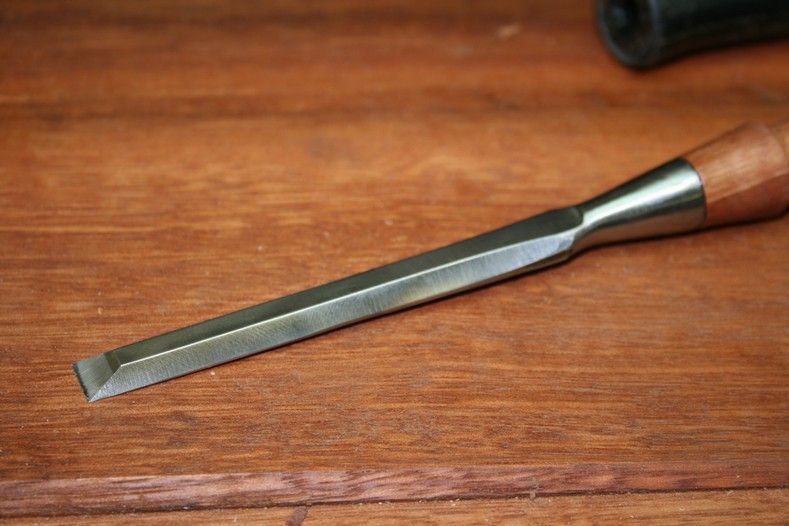
I wanted to turn this into a nice looking chisel that could be used for paring dovetails. First thing I did was to wack off the handle (easily done with a hammer), and then ground the shoulder of the blade until they were narrow (there is a pictorial on my website). This was the result. You can see the interesting tang ...
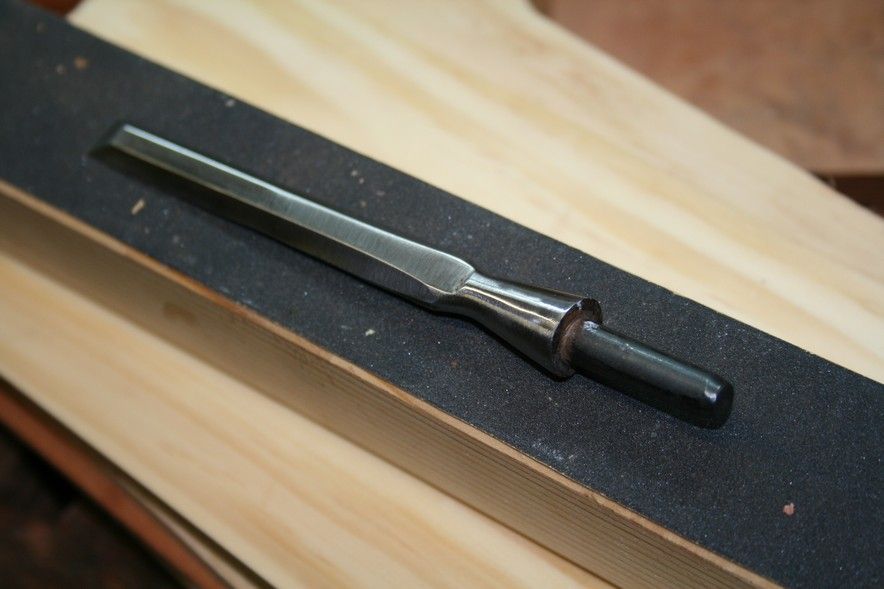

Incidentally, the Marples/Irwin blue handle chisels look the same.

The heat treating was done with two butane torches (if I was working with a large blade I would work with the blade on a brick to increase heat) ...
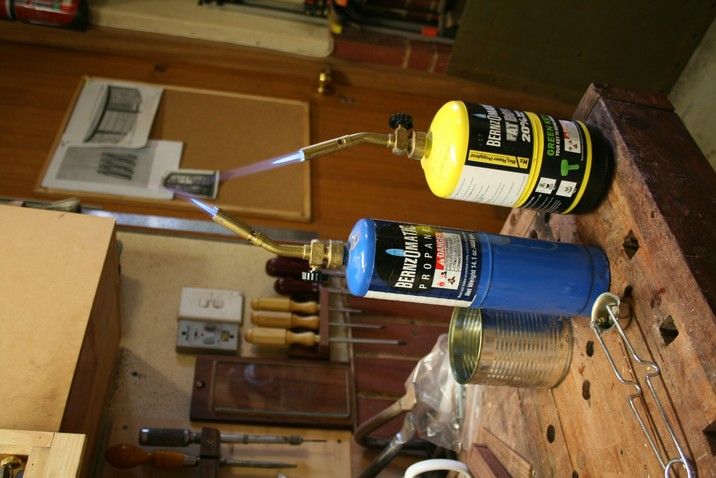

Alongside is a tin of peanut oil for part-quenching. Why "part-quenching"? Because I have no idea what the steel is. I suspect it is a O1 type rather than a W1 type. So I plan to quench in oil (which can be too slow for W1) and then re-quench in water. I have done this before successfully - any comments?

I do not heat the steel to cherry with the lights on. It is difficult to judge colour in the light, so the lights go off and I am left with a gloom.
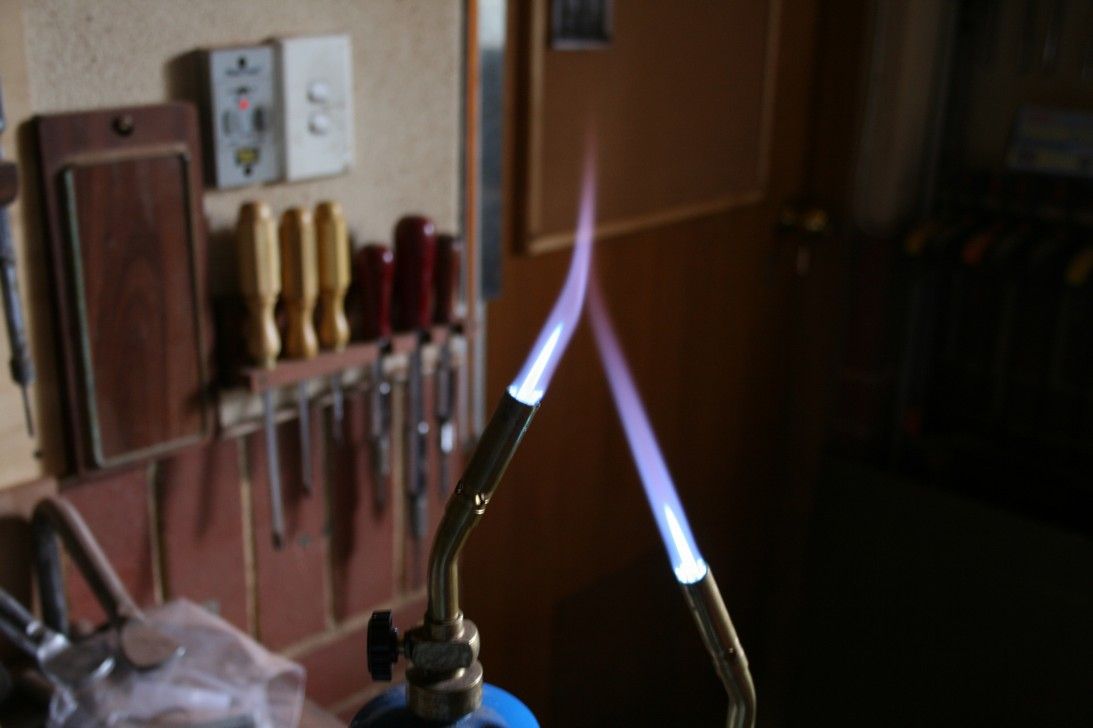

I did not think to take a picture of the cherry (partly because it was difficult, but mainly because I only thought of pictures after this stage!). So just imagine cherry red for the first 2" of the blade. Then dunked in peanut oil until still warm, and then under cool water.

A file slides off the steel (i.e. the steel is harder than the file), so I consider it ready for the next stage.

First I clean off the blackened steel with fine sandpaper, getting back to a bright surface (all the better to see the colours in the next stage). So it is time for tempering.

Back to the torch - this is what I meant by low tech. I start about 2" back, get the steel hot and watch the colour changing as it moves along the blade towards the bevel end. As it get the palest of yellow I immediately quench it in the oil and again the water.

Here is a picture. The flash has made the yellow a little whiter than it actually was, but the steel was a faint yellow ("straw") at the tip.
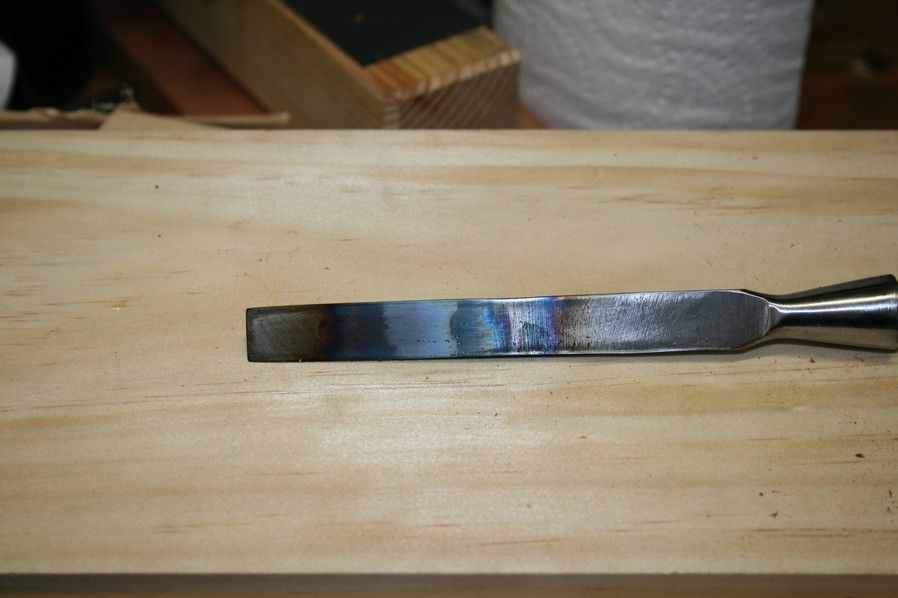

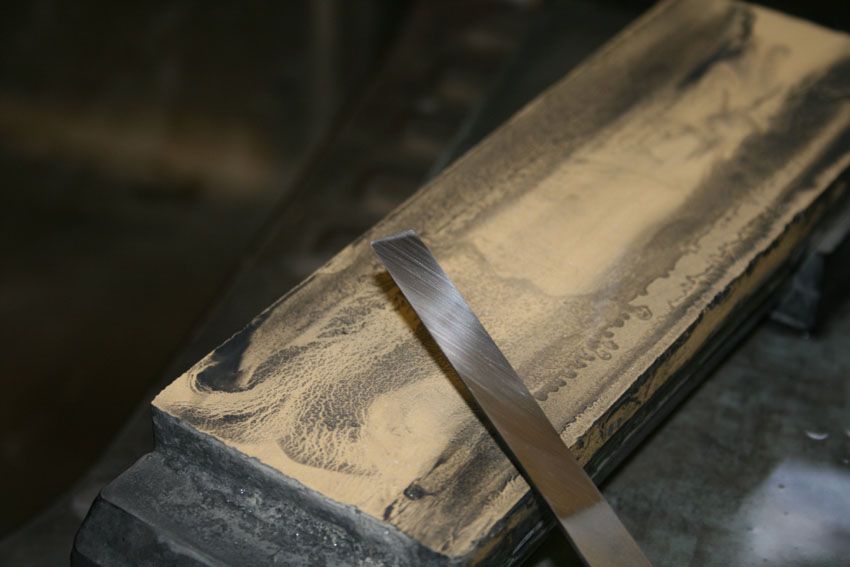
The blade is now cleaned, lapped on 400 grit diamond stone, 1000/5000/12000 Shaptons - however I must point out that only the last 1" behind the bevel was lapped to 12000.

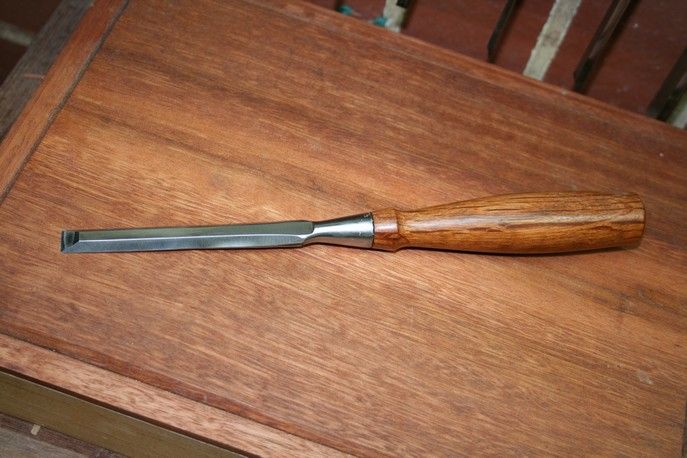
The final chilsel looks like so ..


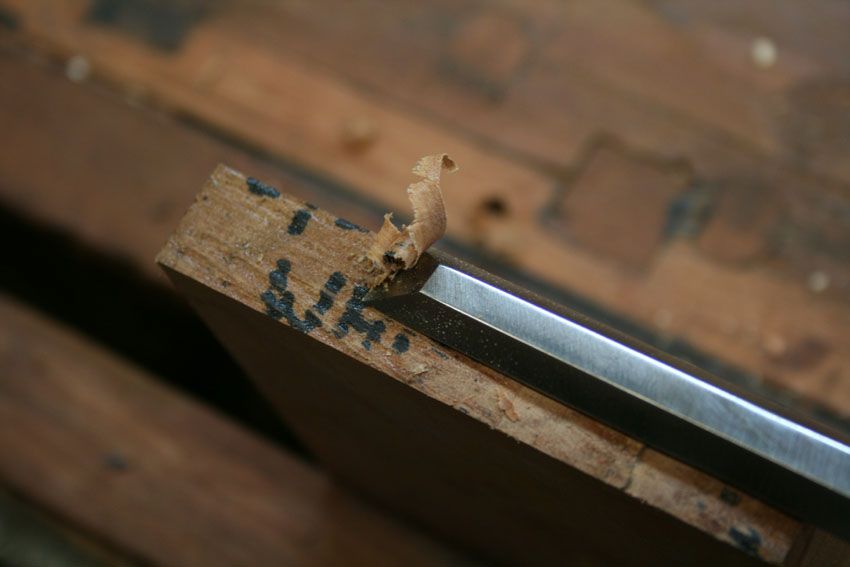
The proof of the pudding lies in the eating. Paring endgrain Radiata Pine (Truly Horrible Stuff). Blade needs to be sharp for this ...
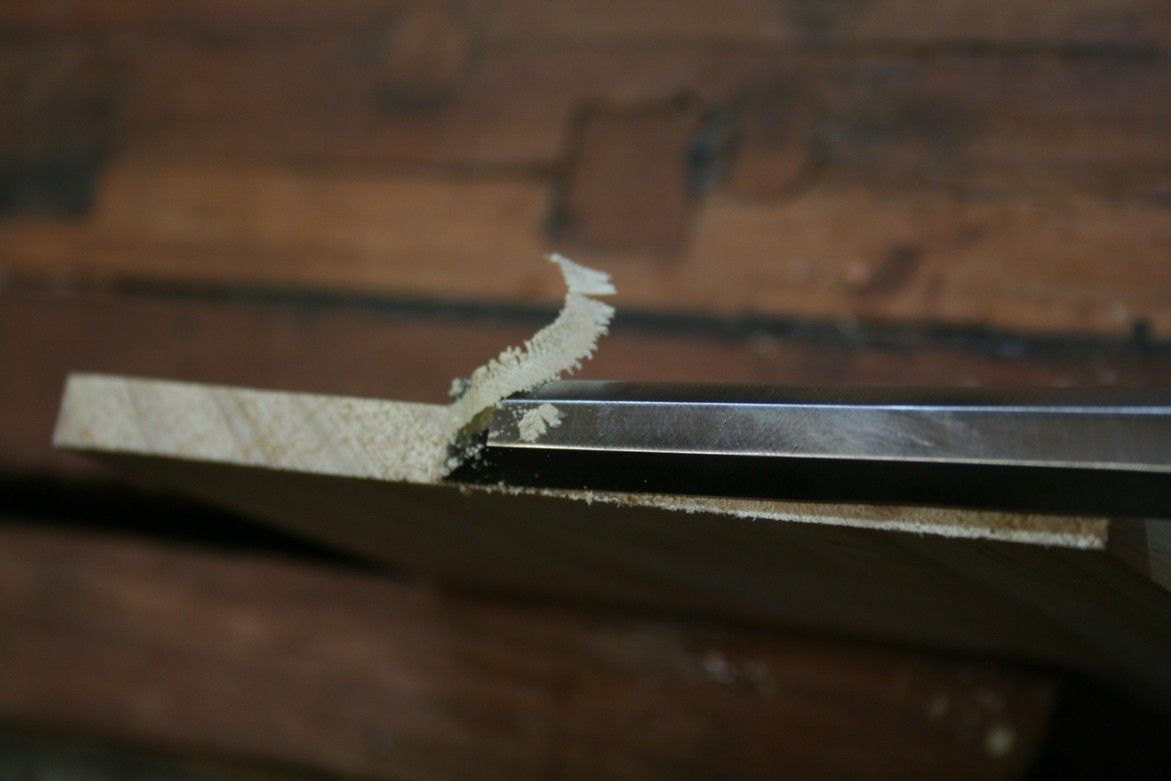

It held up well in very hard wood as well. This is Wandoo endgrain - one of the hardest woods in the world.

Open for discussion ..

Regards from Perth

Derek

Re: Low tech heat treating - for discussion

#2

scott grandstaff

Re: Low tech heat treating - for discussion

scott grandstaff

Bravo taking on a whole chisel! But yeah this is how I do small tools of all kinds.

If you put a block under the short bottle you can bring them up to the same vortex and it might go a little faster for you. Works better for me.

I have often found the steel too hard/brittle in the middle with a single surface heat tempering. Sometimes it tempers clean through, but often its harder in the middle.

I usually temper small tools just like you did it, but three times.

Polish off the tempering colors inbetween so you get to see them again.

Even better for me is to place the tool on the oven rack as I am baking a cake or pie. 35 to 50 minutes at nominal 325/350 does a fine job for me. You get the whole tool end to end, through and through.

I usually surface temper the blade starting well behind the edge, all the way including the tang with a torch after, to a good solid spring blue.

I have heartbrokenly snapped off tangs I didn't temper enough.

yours Scott

Re: Low tech heat treating - for discussion

#3

Re: Low tech heat treating - for discussion

R Payne

I have done small tools nearly the same as this. The differences are I don't use both oil and water, I don't think once the steel has cooled enough that it needs a subsequent quench in water. I also temper in a kitchen oven. Or it used to be a kitchen oven, it now lives in my shop. And I only have one torch so that limits the size of tool I can heat treat.

If you preheat the oil to 130 F or so (roughly 55 C), it works faster and may be suitable for W series steels as well. The preheating of the oil can be done with another piece of steel that is heated then dunked in the oil to bring the temperature up.

ron

Re: Low tech heat treating - for discussion

#4

Re: Low tech heat treating - for discussion

Neal in San Jose

Have you tried MAPP gas? I upgraded some time ago for soldering pipes and it works better in that application. MAPP gets much hotter than propane - 5300f vs 3600f, so I would expect it to yield better or at least faster results in heat treating. The torch I have has three relatively parallel flames that cover a wider area and it would seem to have some advantages.

The downside I see is the up-front cost of a new tourch or two.

Re: Low tech heat treating - for discussion

#5

Re: Low tech heat treating - for discussion

ThomD

I'm sure you could do a great job with MAPP. That said, if you have enough heat in temp and volume, you can actually get better results with a slower rate of elevation, because the heat has a longer time to penetrate. Fast heat transfer is great when brazing or welding, and one wants to limit the heat affected zone, but in this case one wants a large HAZ. Also, most propane torches can have MAPP bottles fitted to them , so while the gas is much more expensive, the test is no more than the cost of new bottles.

The method Derek describes is pretty much the method shown in the FWW video with Jim Cumming. I doubt Blue Chip chisels are O1 since that is not all that common in the tool trade, other than as a reaction to the recent preference for O1 in some circles. Mostly chisels are high carbon steels of rather simple format, but I'm just guessing too. My own feeling is that once one is at this point why not just make one's own chisels, rather than depending on expensive inputs of blister pack chisels. Only a few of those would pay for a grinder. One nice thing about working from raw stock is the chance to know what it is and to use in it a large enough size one can forge thick and grind thin for best results.

Two things that are hardly any more high tech, but will yield better results are, judging the heat from magnetism, rather than colour, or using a thermocouple, or a templestic. Magnets are very reliable when used with a bit of care. Not all steels are at their best at the point of demagnetizing, so a little research would help. A little knowledge of how long your steel likes to be held at peak temp will also help. This is one place where propane might be an advantage, in holding a heat. Finally for drawing the temper, a stove is normally more reliable, will soften evenly through and through, and will hold at heat as many steels prefer. Though it is best for cutting tools like chisels or knives. Stuff like screw drivers will require higher heat. Another device that is good for tempering, is a metal piece the surrounds the tool and can be heated in a controlled way to the necessary heat, then the tool is suspended in it. This is one way to get higher, or consistent heats without an oven.

Re: Low tech heat treating - for discussion

#6

Re: Low tech heat treating - for discussion

Warren in Lancaster, PA

I was shown a similar tempering method by a blacksmith years ago. He heated up the chisel and just quenched the very tip. Then with the rest of the tool still hot he watched the colors move toward the tip and then quenched again for the appropriate temper. The trouble with methods like his and yours is that the hardness varies along the length of the tool. The edge gets softer as you sharpen. If you end up using the tool regularly you have to harden again. I think it is more helpful to temper a large portion of the tool all the same. That way if you like the chisel you can use it for many years with the same temper.

Re: Low tech heat treating - for discussion

#7

Re: Low tech heat treating - for discussion

Derek Cohen (in Perth, Australia)

The trouble with methods like his and yours is that the hardness varies along the length of the tool. The edge gets softer as you sharpen. If you end up using the tool regularly you have to harden again. I think it is more helpful to temper a large portion of the tool all the same. That way if you like the chisel you can use it for many years with the same temper.

Hi Warren

I agree in principle. In fact I do use the oven to temper the steel for most blades, and especially for those that are wide, such as plane blades (for example, I have had to re-harden several vintage plane blades). I have even acquired a small electric oven which will be used for such purposes.

The advantage for me in tempering with a torch is that it is so quick, and is useful for many smaller blades. I rationalise - as you can see when you look at the picture of the blade I posted - that there is at least 1" of steel that is useable, and that this chisel should have many, many years of life if used reasonably (in the workshop of a serious amateur woodworker). The brown colouring is softer than the straw, but should still hold a good edge. In fact, the dark yellow/brown is the colour I would aim for if a chisel was going to be pounded on, such as a mortice chisel. A little softer but more tolerant of impact.

Regards from Perth

Derek

Re: Low tech heat treating - for discussion

#8

Re: Low tech heat treating - for discussion

Ron Hock

Hi Derek,

Your technique is fine, and obviously successful; congratulations! I'll elaborate on two points, however. One, forget the cold water part of the quench. If it's oil-hardening steel, it will quench quite well in oil and if it's water-hardening, it MIGHT quench in oil but probably not. The extra cooling won't matter and may contribute to problems. The official procedure is to allow the quench to cool the steel just enough so you can handle it then temper immediately. The transformation we seek takes more time than the quench and dimensional changes can continue to occur for some time*. With thick pieces of steel, the insides may still be growing while the outside has already shrunk and can therefore fracture. I've never had this occur but experts say it can so temper immediately.

Next, the surface colors start to form around 375F which is fine for most edged tools but we like ours a bit harder and use 325F for Rc62 in O1. So that light straw edge will work well and be easy to sharpen but it won't hold an edge as long as it could if tempered to 325F. I recommend an accurate oven or deep-fryer to temper steel to 325F if you want Rc62. Otherwise you have to stop the torch-temper just before the color appears. Like that joker on the bus who, when asked which stop to use says, just watch me and get off at the stop right before I do.

*Back when I was a knife-maker I'd make long thin fillet knives that would tend to warp horribly during heat treatment. I threw a lot of them away until, one time, I pulled one out of the quench oil and just started bending it straight. I was amazed that I could do so and in twenty minutes or so I couldn't bend it at all any more. After that bit of time, it would have broken before it bent but for a brief window, it was quite malleable.

Re: Low tech heat treating - for discussion

#9

Leo Cuellar

Re: Low tech heat treating - for discussion *LINK*

Leo Cuellar

Haven't tried these yet, but intend to get a few when the next credit cycle is past. Seems like a good way to get consistent results for tempering the way that you do it. In light of what Mr Hock said about stopping before the color draws out, this would be an acceptable low tech low budget alternative. I just acquired a small old forge, but haven't had the time to try it out yet :D

I am always awed by the work that you share with us!

Scroll down the page a ways...


Temperature Indicating Crayons and Liquid

Re: Low tech heat treating - for discussion

#10

Re: Low tech heat treating - for discussion

BrianA from Monument

Warren,

Wouldn't the blacksmith's method create a more brittle shaft with a tempered cutting edge?

This does not sound like what we are looking for in a chisel; I think we are looking for a tough shaft with a hard yet not brittle cutting edge.

or am I missing something.

Brian.

Re: Low tech heat treating - for discussion

#11

Re: Low tech heat treating - for discussion

Warren in Lancaster, PA

I will try for a more thorough explanation. The smith heats the tool to cherry red then quenches the tip, hardening an inch or so. At this point the tip is cold and hardened but further back is not hardened and is still quite hot. He quickly cleans the tip with a wire brush so he can see the colors. As the heat from the hot portion moves towards the tip it gradually tempers the hardened zone. One can see the bands of colors slowly move down toward the tip. When the appropriate color reaches the tip he quenches the whole tool so that no more tempering occurs. At the time of this quenching, the area near the tip is the coolest so it will be the least tempered and therefore the hardest. Further back, closer to the portion left hot in first quench, the steel will have reached higher temperatures and so it is more tempered (softer). At the time of the second quench the back portion of the tool is no longer cherry red, not hot enough to become hardened.

The chisel Derek shows might have a hardness of 60 at the tip gradually decreasing to maybe 40 or so two inches back. As Ron mentioned the hardest tools available have been so lightly tempered that that the colors do not show up.

Re: Low tech heat treating - for discussion

#12

Re: Low tech heat treating - for discussion

Derek Cohen (in Perth, Australia)

So that light straw edge will work well and be easy to sharpen but it won't hold an edge as long as it could if tempered to 325F.

Thanks for the reply Ron. It is always great to has your input.

It is interesting that you recommend a colour lighter than light straw (essentially white) since that has been the traditional recommendation forever (it seems).

Regards from Perth

Derek

Re: Low tech heat treating - for discussion

#13

Re: Low tech heat treating - for discussion

Ron Hock

I suspect that the reason "light straw" is the lowest tempering color is simply because it is the first one we can see. There is a lot of conflicting info about which color corresponds to what temperature but my limited empirical testing bears out that for Rc62 you have to get off the bus at the stop before I do.

This thread and the recent one about heat treatment at SMC tell me that when all is said and done, there are numerous ways to successfully harden tool steel and that the range for "success" is fairly large. I've tried to offer what I've learned from "official" sources but will never argue with seat-of-the-pants success. So, to anyone out there wishing to try their hand at hardening some tool steel, go for it!

Re: Low tech heat treating - for discussion

#14

Very refreshing outlook.

Bob Hackett

For a person of your experience and expertise to have such an open mind about what the rest of us do is a very refreshing change Ron.

Thanks for taking the time to post.

Re: Low tech heat treating - for discussion

#15

Re: Low tech heat treating - for discussion

Tom Colligan

Derek, thanks for the topic; it was sure to get great input.

Is there another name for Wandoo wood as I can't find it in the books that cover woods of the world. (Don't tell me it was a made up term!)

What wood did you use to make this handle? It looks special. Thanks, again. Tom

Re: Low tech heat treating - for discussion

#16

Bending steel after quenching

Andrew F in Australia

Hi Ron,

The reason why you can still bend it after you quench is that martensite has a start and finish temperature. I know you'll be familiar with TTT (time temperature transformation) curves.

Immediately after quenching, it's below the Ms temperature and martensite starts forming, but it needs time (20 seconds or so? - really depends on cooling rate) before it reaches the end of the martensitic transformation. In this time, you can work/flatten/straighten it, but you don't have long.

Eventually, the martensitic transformation finishes and it's hard and brittle.

Hope this explains it for you.

Cheers,

Andrew F

Re: Low tech heat treating - for discussion

#17

Re: Low tech heat treating - for discussion

Derek Cohen (in Perth, Australia)

Hi Tom

My apologies for not replying earlier.

Wandoo is "Eucalyptus Wandoo". It has a Janka hardness of 15.0kN. That is about as hard as it gets. Chiselling steel is less difficult! :)

There is an interesting description of it here: http://www.scottwise.net/html/back_and_sides.html

The wood for the chisel handle is West Australian Sheoak (Allocasuarina fraserana).

Regards from Perth

Derek

Re: Low tech heat treating - for discussion

#18

Re: Low tech heat treating - for discussion

ThomD

- I've tried to offer what I've learned from "official" sources but will never argue with seat-of-the-pants success.

Sometimes the seat of the pants stuff like multiple quenching is just a way of getting a handle on something that could be done in a more linear fashion with higher tech gear, but the end point is the same. And sometimes it is better because the person doing it more closely meets what they are after than what any formal process at a distance can.