We value your privacy.
We use cookies to enhance your browsing experience, analyse site traffic, and personalise content.
By clicking “Accept all”, you consent to our use of cookies. You can also choose
“Essential only” or learn more.
'Lo all. I'm back from a hiatus. Hope everyone is well.
I have a question. I was perusing some hand tool websites and came upon a tool that looks like a spokeshave but it has a scraper planed bedded at 90 degrees to the sole of the tool. It looked like it would do a wonderful job finishing up that last little bit of scraping after a spokeshave. I, for the life of me, cannot remember the name of the tool. It's on the tip of my lingual apparatus, but beating on the back of my head has not, to date, dislodged it.
A little help, please. Also, has anyone built one? If so, what's the scoop?
I haven't made or used a scraper like that. Looks like a very useful tool, though.
What I do use a lot is another Lee Valley product, which is their super-thin scraper (see link). These are good for the final detailing on curved surfaces because they're thin enough that you can bend them in the fingers of one hand to match the curve, and use the other hand to hold the work. I use them with a hook.
I have a couple that I found, but my real treasure are ones that a Kokomo Galoot named Scott Post made for me. They are great!. I have three sizes and I use them for awkward grain situations.
Old 3/4" bandsaw blade is a wonderful resource for scraper blades. It can be used in beaders such as the Stanley #66, you can make your own scrapers, and of course a scraper shave.
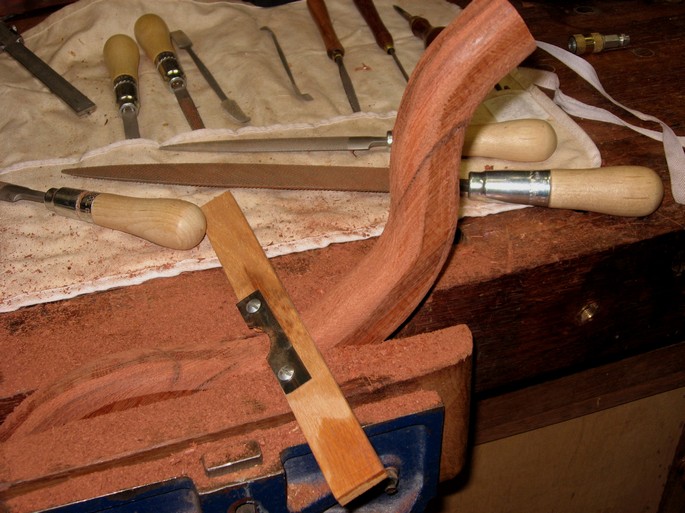
This one took about 5 minutes to make (and looks it!). Not pretty but it did the job of shaping two braces ..
Here are a few of my cabinet scrapers all made of beech. All blades have bevels, all but the toothed blade has a burr turned. The top holds the blade tipped 5 degrees forward. I have two blades for this one, one straight and one toothed.
The middle one is a travisher shape and the blade is straight up and down and held in place by two small wedges.
The blade for the travisher and jarvis are a commercially available scraper blade with one end convex and the other concave, just snapped the scraper in half and had two blades already to shape. I filed a bevel and turned a burr.
The lower one is the jarvis, blade is perpendicular, held with two wedges and works well on round things like spokes.
Those are beautiful! Do you find that the absence of a brass footplate makes them wear more quickly? If not, I think I'll commence to makin' a couple. I keep a small scraper of the size in the pic in my shop apron.
They seem to wear well, all are several years old and show no appreciable wear. My dogwood spokeshaves however have shown some signs of wear and I think I will need to insert a wear plate, either bone or lignum vitae.