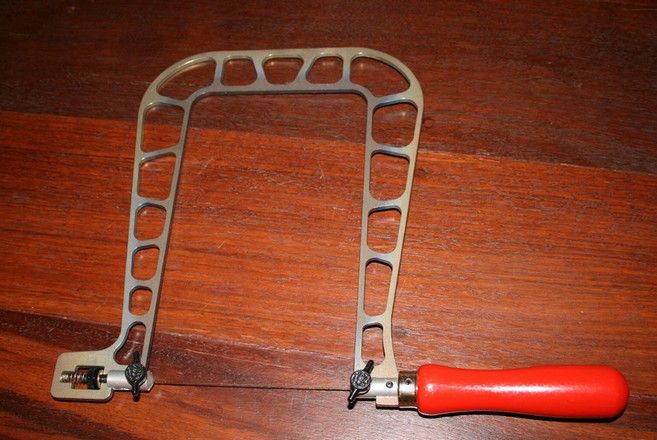
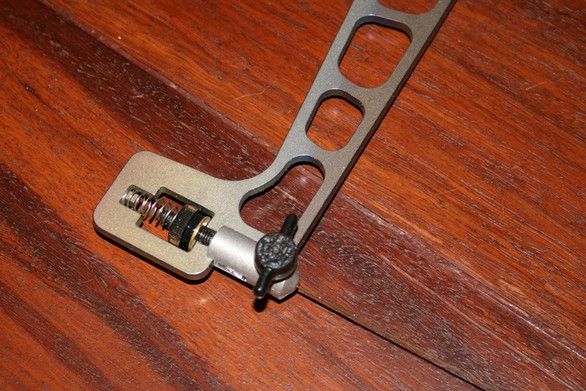
Hope this'll do 'til I borrow a camera... *LINK*
David Barnett
Warning: most of this will be of little or no interest to anyone other than Mainely Bob.
"As you know I have shoulder problems.I have been trying to adapt to this new to me technique of sawing with the blade vertical and using only my forearm. I thought it was just me but from your post it sounds like I`m not alone in my trouble with isolating the shoulder.You say rocking your body helps, how so You also mentioned handle mods,could you describe what has worked for you or link to a pic (nod, nod, wink, wink, say no more)?"
While my right shoulder (rotator cuff) was injured, the weight of my arm alone was excruciating. At worst, sawing was simply out of the question. Now that I've healed sawing is again enjoyable. Even so, having had carpal tunnel syndrome and shoulder problems on my right side, I'm very aware and careful of repetitive tasks.
Firstly, Bob, let me say that I'd not likely waste out DTs with the saw held vertically. I don't relish bending to see the underside of the workpiece. So for DTs you'll just have to chug along as best you can. At least the strokes are short and the sawframe light. One thing, though, don't rotate your arm bringing your hand into supination. Pronation is the way to go, and quartering with the right thumb at 10 o'clock is better still.
I should say right here that I'm not particularly fond of the standard sawframe handles in line with the blade. For most people this may never present a problem, but for people with hand-wrist-elbow-shoulder issues, it can truly suck.
Notice that I said 'may' in the last sentence. If you do a lot of fret sawing with standard handle orientation, I'm convinced some sort of repetitive motion injury will eventually present, which is why I favor ergonomics that promote lighter gripping at offset angles for enhanced control and stamina.
Difficult as it sounds, it's really straightforward and easy, and an hour or so of fiddling about will yield life-changing rewards.
I just want to say one word to you, Bob. Just one word... plastics.
Or rather more specifically, thermoplastics.
Yes, while there was craft before modern thermoplastics; pitch, wax, shellac, and whatever other amorphous goos, glues, resins, plasters and oleaginates could be pressed into service to hold things relatively fast, low temperature modelable reusable plastics have improved the lot of the fumble-fingered and those unfortunates with only two hands. Jett Sett, Plastiform and now Thermo-Loc are the new shellacs, with safer, more comfortable working temperatures and economies of reuse. While these are primarily intended for fixturing, they have become very popular for on-the-fly ergonomic tool handle mods. I keep finding new semi-permanent uses for the stuff and find myself buying more.
Whether you heat Jett Sett in hot water (140F) or nuke Thermo-Loc in the microwave, it's easy to find the shape that feels just right. If it adds too much weight to an existing handle you can replace it, hollow it out, shorten it, make a new featherweight modeling form. You'll think of more tricks and uses, too. Ergonomically formed offset graver handles bring my thumb into play for extra control and finesse. Tapered triangular wax carving tool handles beat skinny round ones anyday. Fly tying tools. And so on.
If you want a new handle right away and reusablity isn't too important, get some hand-kneadable epoxy putty. Pretty versatile.
Okay... I'll take a break. I am still cameraless, but I'll borrow one midweek and show you what works for me. Thousand words.
Oh... almost forgot... rocking. I do this for sawing, engraving, filing, stone setting, wire inlay, all sorts of precision tasks. For sawing the stroke is short and obviously slow, but extremely precise for notching settings and undercutting prongs. For woodworking, this is how I pare. Rocking limits the axes of motion and degrees of freedom. I rest my arm against my side and simply rock bath and forth. Great control under the microscope, especially with the workpiece at waist height. Of course, I have the advantage of considerable avoirdupois for arm support. At least it's good for something.
Sources for fixturing compounds:
Otto Frei
http://tinyurl.com/mbe4q - Jett Sett
http://tinyurl.com/2cn4cgv - Thermo-Loc
Rio Grande
http://tinyurl.com/233uhlo - Jett Sett
Contenti
http://tinyurl.com/2g6ttzw - Jett Sett
SEP
http://tinyurl.com/29zwzj2 - Jett Sett (good price)
FDJ
http://tinyurl.com/26sz338 - Thermo-Loc
GRS
http://tinyurl.com/237dgrx - Thermo-Loc
I knew I'd mentioned some of this on WC. Just search on Jett Sett for more.
http://tinyurl.com/2gyv7du
http://tinyurl.com/22jjc68
http://tinyurl.com/22nbce4
Here's a link to how goldsmith Brian Meeks modifies his saw handles. They're in line with the blade but that's what works for him.
Brian's sawframe handles