Home Articles Forums Gallery Marketplace Videos

WoodCentral Forums

Knowledge You Can Build On — Est. 1998

Veritas - Innovation in Tools

Workshop storage question

Posts

Workshop storage question

#1

Workshop storage question

wilbur

I have 2x4's mounted up on my walls that I am going to attach either 3/4" plywood or pine boards to. Then I plan to attach various tool storage devices to the plywood/pine boards. This could range from a chisel rack to a tool cabinet, and maybe even some lumber storage.

Assuming that there's no difference in price, which would you choose -- plywood or pine boards?

Re: Workshop storage question

#2

Boards would be purty-er.

steve mackay

Re: Workshop storage question

#3

Re: Workshop storage question

Bruce, a MN Galoot

As much as I would prefer pine boards, I'd prolly just put up a decent grade of plywood. IMHO it's just a tad more versatile. I can't even tell you why I think that. If nothing else, it would likely be faster to install plywood.

My own shop will have OSB on the walls, painted white because I need the light -- one of these days.

Re: Workshop storage question

#4

Jack Guzman from Maine

Pine boards

Jack Guzman from Maine

The only advantage of plywood is that it will go up quicker. Pine looks better and is easier to attach things to. ---Jack

Re: Workshop storage question

#5

Re: Workshop storage question

Bob Hackett

If it were my shop I`d go with ship lapped boards.I`d also go with a limed finish rather than paint.The limed finish will look "woody" and keep the pine from darkening so much yet will still reflect light well judging from the closets we finished that way.

If you decide to change something up or need to replace a damaged or previously modified area it`s far easier with boards rather than plywood panels.

I find the visual differences between boards more interesting than the continuously peeled grain of a ply panel.Some like it though.

Re: Workshop storage question

#6

Re: Workshop storage question

Derek Cohen (in Perth, Australia)

Hi Wilbur

In my shop I have used ply, partly because it was cheap and partly because it was easier to install. I do prefer pine to ply, but I recognised that the ply would largely hidden by what goes over it - and I wonder if that might also apply to you?

In my case I have cabinets and wall hanging tools. There is not a lot left to see.

If the uniformity of the ply is an issue, but you want to keep down costs, then slice up the ply into "boards" and attach these in a random order so the grain no longer matches.

This wall is lined in ply (and the cabinets are now getting doors)..


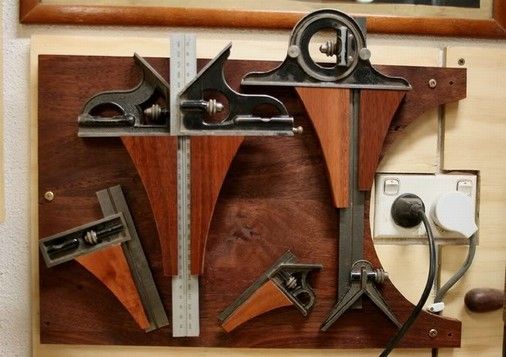
I made tool holders as "art". Just a bit of fun. When I get bored with this I can do something different - that is one of the advantages of not worrying about a few screw holes in ply.


Regards from Perth

Derek

Re: Workshop storage question

#7

Re: Workshop storage question

Wiley Horne--So. Calif.

Hi Wilbur,

I'd go with the easiest to get home, offload, wrestle into the shop, manuever around obstructions, cut to fit around other stuff on the walls like vent pipes and whatever, wrestle into place and get two screws into before it falls down. BTW, are you going to need any new electrical boxes or 220V run before you seal things off?

I mean, they're both gonna be painted white, right? If there's limited natural light, I'd make it bright white. And there will be stuff covering that nice pine shiplap or T&G.

Sometimes a 4x8 sheet is the easiest thing in the world to get inside, place, and fix. Like if you're gonna walk it through a garage door with someone else on the other end. Other times, it's danged near impossible and you'll prolly break something doing it. Like when you need to get a sheet down some steps and through a door off to the side--by yourself.

So it's a practical matter, I think.

Wiley

Re: Workshop storage question

#8

Re: Workshop storage question

Hank Knight

Wilbur,

If I ever replace my white peg board, I'm going to use pine bead board. It looks nice painted or natural, and is a little more interesting to look at than plain boards. I think ply is even uglier than my peg board unless you're going to cover it up like Derek did. Another thought I had was to use natural cedar boards and run them diagonally. It looks really nice in a rustic sort of way, doesn't deteriorate and you can hang stuff on it.

Sounds like you are really getting serious about fixing your shop up. Can't wait to see it done.

Hank

Re: Workshop storage question

#9

Cedar

Bill Houghton, Sebastopol, CA

Some cedars are allergens. I can no longer cut the cedar we can get locally in the shop, and have to wear a dust mask when cutting it outside.

Re: Workshop storage question

#10

Re: Workshop storage question

R.J.Whelan

Wilbur,

I'm not sure where you live, but if you're in, or close to, a fair sized city you may be able to find a retail fixture supplier.

There is a product called "slatwall" (available in white). This product is somewhat expensive, but I put up two sheets in a former shop and the various accessories that attach to this system came in very handy. The real beauty of the system is everything attached to the slatwall is moveable without leaving behind holes or other evidence of earlier layouts.

FWIW .... rj

Re: Workshop storage question

#11

Limed finish

wilbur

Do you have a method for a limed finish on pine boards? I've found some for oak, but it looks like the focus is on filling the open grain with a light finish, which isn't exactly the same for pine.

Re: Workshop storage question

#12

Pine it is

wilbur

Thanks, everyone! I'm going to go with the pine. Wiley's comment about getting whatever is easiest to maneuver really rang true. If I was to go the plywood route, I'd be wrestling those large sheets by myself. The pine boards will be much more manageable.

As for painting it, I'm going to leave the boards unpainted for now. The light situation in my basement shop is not ideal, but I think that installing a few additional fixtures and task lighting will work really well for my current lighting needs. Plus, I'm hoping that what light advantage I miss will be made up for by the look of the natural wood.

Re: Workshop storage question

#13

Just don't shellac it

Bill Houghton, Sebastopol, CA

I grew up in a house that had a serious case of the knotty pine decorating scheme that was popular in the late 40s, and one room of our house now has it as well; and, over the years, it gets DARK.

Re: Workshop storage question

#14

Agree and the time to decide

Wiley Horne--So. Calif.

is right now, before the boards are on the wall and covered with tools. A pine room really starts feeling small and dark, even though it has a mellow ambiance. Maybe there is way, similar to the one suggested by Bob (liming), to preserve the grain yet still lighten the wood. I would go for lightness and brightness over every other consideration, but that's just me.

Bill Tindall at one time actually had some figures as to how much difference it made in a shop to have a light bench and light walls, and it was surprisingly large (to me).

Wiley

P. S. Stephen Shepherd is an expert on graining pine--perhaps he could assist here.

Re: Workshop storage question

#15

Stephen Shepherd

Re: Agree and the time to decide

Stephen Shepherd

The pine will eventually darken either usually red or sometimes yellow with age and there isn't anything that can be done to stop it. Limed [Whitewash] finish is probably the best and should be done to both sides of the wood to keep the balance.

If you can't decide now at least give them a coat of size [can be thinned down shellac] on both sides and install them. Then later you can lime/whitewash or paint them [use oil based paint] to suit your fancy.

Stephen

Re: Workshop storage question

#16

Re: Limed finish

Bob Hackett

The traditional way would be to use whitewash but what we did was to use a light colored milk paint like a stain and then seal afterward.For durability we used spar varnish but most any good transparent top coat/sealer will work.

Re: Workshop storage question

#17

Re: Workshop storage question

thomd

I used drywall, which has worked out well. I wouldn't use conventional plywood, since it looks so rotary veneerish, which is anti handwork. Good for a boatshed maybe . But I would use a number of things painted or better finished.

One bad thing about wood is the fire issue. If you are certain that is never going to be an issue... But from woodstoves to grinders, to small scale forging, to spray finishing, dust, to welding or brazing, I prefer a fireproof wall. Skim coat plaster, or solid drywall would be the ideal. I don't think the wood look is desirable if like me you want light, and you figure over time the whole thing will get racked over anyway.