Home Articles Forums Gallery Marketplace Videos

WoodCentral Forums

Knowledge You Can Build On — Est. 1998

Precision you can feel — woodworking perfected with Lee Valley

Is there a chair doctor in the house?

Posts

Is there a chair doctor in the house?

#1

Is there a chair doctor in the house?

Derek Cohen (in Perth, Australia)

Here is set of chairs that my father designed in the late 1930's. Bentwood laminations of what I think is either Beech or Ash. I restored the chairs several years ago ...


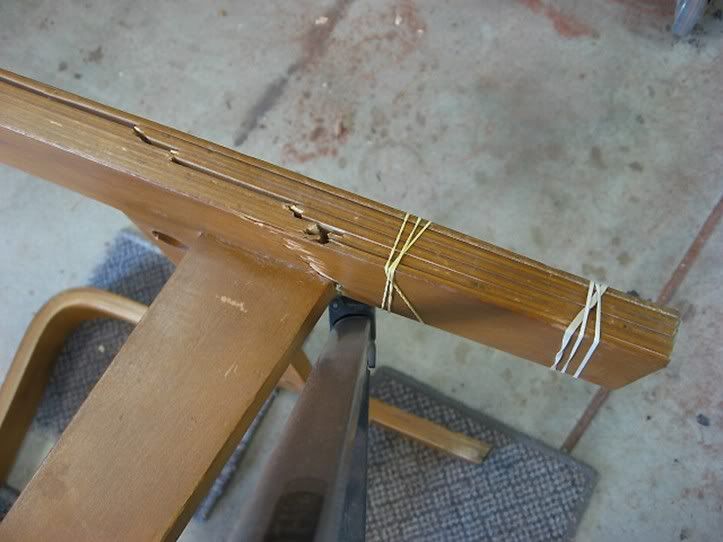
A side view of a chair leg:


This evening my son (the 17 year old with muscles like walnuts) sat down hard and the chair leg collapsed!


The one piece of luck is that the front lamination is still whole, and this means that I should be able to repair the leg without it showing from the front ..


Here are details:

The break is over the tenon ..


I can push the top sections back, and I think that these can be glued back as is, if indicated ..


This leaves the lower section (made up of three leaves) ..


Is there is any point in trying to glue back these pieces as they will not be supported? Even with epoxy. Some surgery is needed.

I have solid Beech and Ash boards that can be used in the repair.

How would you go about this repair?

Regards from Perth (where it is pretty late inthe evening)

Derek (about to head for bed)

Re: Is there a chair doctor in the house?

#2

Re: Is there a chair doctor in the house?

R.J. Whelan

:( - bummer

Derek ... I think the chance of making a completely new bent lamination and having it exactly match the original is pretty small.

I suggest glueing everything back together with epoxy and then installing a large butterfly spanning the entire broken area and extending into solid (unbroken) wood at each end. I would cut the butterfly relief from the underside of the lamination and go as deep as possible without coming through on the face side and glue in the butterfly with epoxy.

Good luck - let us know what you end up doing and how it works.

I would definitely banish the muscular one to more sturdy chairs. I wish I had a dollar for every piece of furniture my own son "tested to destruction".

RJ

Re: Is there a chair doctor in the house?

#3

Not a chair doctor, nor play one on TV

Paul M.

I think that your plan to glue these together again is valid. The 3 broken leaves will not add any strength to the leg, but are needed to patch the hole.

What I would do is consider creating another new leaf to add to the leg behind the three broken ones. Run this up behind the tenon and feather this out to level with the rest of the leg above the tenon. This will add a new ply on the outside of the break which will help increase the structure around that fragile area. The full length ply on the front and this new ply on the back will bridge this area to add a bit of strength.

A nice throw pillow that has cross-stitching that says "sit gently please" could be placed on the chair as a reminder. I doubt this chair will ever be up to full strength again.

Re: Is there a chair doctor in the house?

#4

Jack Guzman from Maine

Re: Is there a chair doctor in the house?

Jack Guzman from Maine

Derek,I think I would opt for surgery. I'd go further up the leg past the tenon in the back and remove laminations in steps. I think you'd need at least two laminations in the back going past the break to give that joint any kind of strength.---Jack

Re: Is there a chair doctor in the house?

#5

I'm no help but...

Scott Burr in Ben Lomond CA

Your father has (had) a good eye for design. Must be where you get your :)

Re: Is there a chair doctor in the house?

#6

Re: Is there a chair doctor in the house?

Bruce, a MN Galoot

I agree with this. Think of the repair as a scarf joint, although it'll be stepped. West System, the epoxy people, recommends a 1:8 ratio for a glued scarf joint to be as strong as the original material. Since the legs of that chair appear to be about an inch, that means you'll need to scarf that back for at least 8" to achieve full strength. That also means it'll be a PITA to repair. I'd do it in steps rather than all at once. That way you'll be able to match the curve.

Re: Is there a chair doctor in the house?

#7

Re: Is there a chair doctor in the house?

Kieran

Finally a situation where both your pediatric psychology traing and woodworking knowledge can be put to the test. Go easy on the boy, you know the state of their frontal lobes at that age! (Oh yeah, I forgot, I think you guys mispell pediatrics as paediatrics!) :) Kieran

Re: Is there a chair doctor in the house?

#8

Ouch

Pam Niedermayer - Austin, TX

I think I'd try to regularize the joining points to give the upper parts places for the lower parts to rest; and I'd try to have the outer lams cover the joins, not because it will look nicer, but for support.

But that's just a starting point.

Question: What does "muscles like a walnut" mean exactly? Hard? Small and hard?

Pam

Re: Is there a chair doctor in the house?

#9

Re: Ouch

Derek Cohen (in Perth, Australia)

Hi Pam

"Muscles like walnuts"? Well Jamie is about 5'11" and growing, works out almost daily at the gym, and has arm muscles the size of my thighs. He does not sit down gently ... he collapses onto a chair or sofa.

I yelled at him very politely. :)

Thanks for the suggestion. I will have to post my plan and the start of the repair separately as Photobucket is not cooperating at this moment.

Regards from Perth

Derek

Re: Is there a chair doctor in the house?

#10

From a boatbuilding point of view

Bob Hackett

The repair would be made by cutting back the broken lams to stagger the joints and then they would be splinted between the intact(a blessing)front lams and one or more back lams that were added for strength.

The traditional BBer`s adhesive would be West System epoxy or it`s equivalent.

Good luck with it.

MB

Re: Is there a chair doctor in the house?

#11

A plan and a start, but a decision remains ..

Derek Cohen (in Perth, Australia)

Many thanks for the suggestions so far. They have helped me formulate a plan. There is still a decision to be made, and I would appreciate any input there is.

Firstly back to the break ..


Now if I put all the pieces back, it looks like this.


My plan is to epoxy everything together, then brace the weak area(s). At the front of the leg the brace is, luckily, the unbroken face leaf (blue, below) of the bentwood lamination. Also luckily, there is a stagger to the broken leafs underneath (yellow and red).

However the opposing outer leaf is broken off inline with the leaves alongside it, and this means that it is freer to flex, and this is the weak point in the construction. This is the area that needs to be braced.

Here are the areas ...


There are two bracing options. In the first a mortice is routered into the side of the leg (black, below) and a Beech tenon/insert epoxied into this (I am fairly sure that the wood used here is Beech). The downside to this option is that the insert is visible from the side of the chair.

In the second option a mortice/insert is placed at the rear of the leg (green, below). This would be 1 The advantage of this is that it cannot be seen from the side or front of the chair and only from the rear.


What thoughts on the choces here, and on the size of the mortice/insert?Dimensions of the chair leg are 3" wide x 1" deep.

Progress so far is that the centre leaves are epoxied (with West Systems) and drying. This is looking solid ..


Regards from Perth

Derek

Re: Is there a chair doctor in the house?

#12

Re: From a boatbuilding point of view

Derek Cohen (in Perth, Australia)

Hi Bob

Our posts crossed, but I think I am doing what you suggest - with the exception that the one outer leaf cannot be staggered unless I can cut back the leaf there and match the wood. So at this point I am looking for a rear brace to reinforce the break. What do you think?

Regards from Perth

Derek

Re: Is there a chair doctor in the house?

#13

Re: A plan and a start, but a decision remains ..

Pam Niedermayer - Austin, TX

I'd dissemble, including the stretcher, repair by treating the leg as a solid (i.e. remove the mortise), then recut the mortise as it was.

Pam

Re: Is there a chair doctor in the house?

#14

scott grandstaff

Re: A plan and a start, but a decision remains ..

scott grandstaff

If they were mine, I would do just what you are doing, and then add small solid wood blocks from the frame to the floor behind each front leg.

The front legs are lightly supported being as the front frame only catches each one around 3/4" at most, and they will always be somewhat frail.

The trick will be designing these short legs in an attractive manner to compliment the overall design. (I wouldn't just use square blocks. Maybe tapered? Maybe tapered at both ends some, more at the bottom and less at the top where it supports the frame??? )

Ash would seem ideal if the chairs are made from this.

Color matching a vintage finish won't be easy either. But I'll bet you get it in the end, whatever you use.

yours Scott

Re: Is there a chair doctor in the house?

#15

Re: From a boatbuilding point of view

Bob Hackett

If you couldn`t live with the idea of adding an additional lamination to the inside of one or both arm/leg pieces then I would suggest cutting back the inside lam to the horizontal area where the line would show less(you`d have to lay down to see it).You will have the joins showing thru the edges of the mid lams too so wherever you put the join on the inside won`t look completely out of place.

It`s always a heartbreaker to have a family heirloom damaged and doubly so when it was made by a family member.If you think of the repair as your mark on the pages of it`s history then it becomes easier to take.

One day in the future you may be visiting your son`s home after he`has a family of his own and you`ve passed the chairs on to him. When his son/daughter flops down in one of those chairs you may get to hear him tell the story of how he once broke Great Grandfather`s chair doing much the same thing and how Grandpa(you) had to go to great lengths to repair it.

Those types of moments make all the time and trouble more than worthwhile.

MB

Re: Is there a chair doctor in the house?

#16

PS

Bob Hackett

I just realized that not everyone thinks like a boatbuilder.

My answer assumes(bad I know) that you would do as most BBers would do and trim back all damaged/broken material and replace with new,then blend the new with the old during the finishing phase.

Re: Is there a chair doctor in the house?

#17

Good plan!

Wiley Horne--So. Calif.

I like it. After studying this a long time, I think your black insert is the way to go, adhering to the lamination lines, and laminating the insert itself to match. I would go as deep as you dare, but don't think you can make it all the way to the tenon. The insert will be half the remaining strength of the leg, so it's important.

I agree with Bob Hackett's thoughtful insight--this is part of your Dad's chair's family history. Your son will be able to show his son or daughter.

Wiley

Re: Is there a chair doctor in the house?

#18

Re: A plan and a start, but a decision remains ..

Pam Niedermayer - Austin, TX

It could be that there's a design flaw built in that makes all the legs fragile, perhaps there should be no laminations from just above the mortise to the floor.

Pam

Re: Is there a chair doctor in the house?

#19

Re: A plan and a start, but a decision remains ..

Bob Hackett

Depending on the wood,the lay-up and the adhesive used,laminated pieces are usually stronger than solid wood.Think of how plywood fails compared to solid wood.

Funny the thought of a weak point should come up though Pam.I was looking at that tenon area and the proposed repair and one of the things that popped into my head was that if you reinforce that area then are you just transferring stress to another area and setting that new point up for failure?

Then I got to thinking that the chairs have been around for at least 2 generations and the chances of having another body builder cannonball into one is at least about 20 years out from now. :D

MB

Re: Is there a chair doctor in the house?

#20

Re: A plan and a start, but a decision remains ..

Bruce, a MN Galoot

I don't think there's anything wrong with chair design, either. I do, however, have a son who I witnessed launch himself from halfway across the room into chairs and couches. I seriously doubt that very many chair designers take that into consideration. That kind of force is very hard to design for - the Windsors I've built wouldn't take it, either.