Re: stone mold and Shaker brain dump
Derek Cohen (in Perth, Australia)
Hi Adam
Thank you for the detailed reply. This was not an insignificant effort.
What I'd like to do is use your comments/critique as the basis for further discussion. I'll reply to each point, and then hope that others may chime in as well.
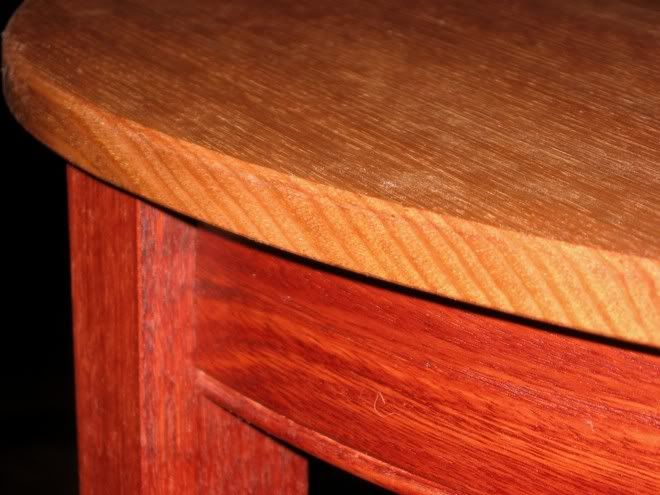
I'll pop in that horrible picture again, the one taken in the dark, so we have an image to go with your points ...

The rationale behind this table: The idea was to build a small table in the Shaker style that was high enough to take a standard diningroom chair, which makes this the same height (30") as a Shaker dining/work table but it would be about 3" higher than the classic Shaker side table.
If it's not too late, I suggest added a "stone mold" to the top's edges. I would underbevel the top all around then round off the upper surface with a bench plane (not a molding plane) Creating the so called stone mold. The upper radius will be greater than the lower radius.
Every Shaker tabletop in this style has square edges. Some tops are bevelled from the underside, but I have not seen one that has round edges.
Also, there's something funny about your apron. Maybe too small.
You are correct. I deliberately reduced the width of the apron from about 4 1/2" to 3 1/2" as i wanted a lighter look. Lynndy did not want a drawer, which is likely the reason why the traditional Shaker apron has a wide appearance.
The top is 33" long and 19" deep. There is a table in Beckvoort's book (page 154) with identical dimensions (although it has slim drawers at each end and the overhang is just a little greater). I was not aware of it until this minute. So there! Goodness me, I was not expecting that!
I might have extended it to the pommels on the legs. I might suggest a nailed on molding there, like a cockbead. These sorts of features were not unheard of. Both the rounded table edge and the bead help maintain finish and allow for a nice hand hold to move the piece (which the Shakers did frequently).
I think that the proportion of the apron down the pommel is correct. Neverthless I actually do like the idea of a cockbead molding along the bottom of the apron, something I have used with several other pieces.
Adding a cockbead is easy enough, and I will try this out and see if it re-balances the apron in a positive way.
As for pegs, I have only seen round pegs and I assume them to be structural, never decorative. As for contrast, they typically seemed to unify pieces incorporating different species with paint washes or stains. I don't think contrast was what they were after.
As noted elsewhere, round pegs it will be (made with my trusty dowel plate).
Like Mission, I think Shaker is popular because it's easy to make and mass produce (I'm thinking Pottery Barn furniture). But to do it well, you really have to get inside their heads and reproduce all the little details and get them just right. I think Becksvoort does a really great job.
I have the Beckvoort book, as noted above, in which he has some wonderful pieces. I also have a book by Moser.
I think that Shaker furniture is frequently copied commercially because its lack of ornamentation lends itself more easily to mass production, while hobbiests may view it as less of a challenge. Personally I like simple lines where the proportions create the sense of balance. This balance is harder to achieve than one realises. All to often I see "Shaker" pieces looking chunky and clumsy. Perhaps the slimness of my effort may be seen as a reaction to these.
Regards from Perth
Derek


