Re: Best way to correct the sole of a wooden joint
Wiley Horne--So. Calif.
Hi Wilbur,
That is a beautiful plane, and I was struck by it when you introduced it a few weeks ago. If it were mine I would fix the sole, because a big woodie jointer like that is fantastically satisfying (to me, anyway!).
One caveat: I only know about woodies in moderate So. Calif. weather--so don't know whether your plane goes through methodical contortions with seasonal weather changes.
If I had the plane here, this is what I would do. Oh, as a preliminary, you already have diagnosed that you're 3 thou out. That particular sole configuration will not work well, because if you're set for a standard 1-2 thou shaving, then anytime you put weight on the rear of the plane, it will lift the blade out of the cut.
You want to proceed in such a way as to minimize what is removed in the mouth area. So, for example, every shaving taken from the far heel of the plane will require an equal shaving to be taken from the mouth. If it were mine, my first attempt would be to take 3 thou from the rear of the mouth, and try to leave the heel alone. You will end up taking a little from the heel, but give ground grudgingly there. Also, if you go with this sloping transect, you will also need to remove a bit from the toe, but that will become apparent. The idea is a sloping transect that is depth neutral at the front of the mouth.
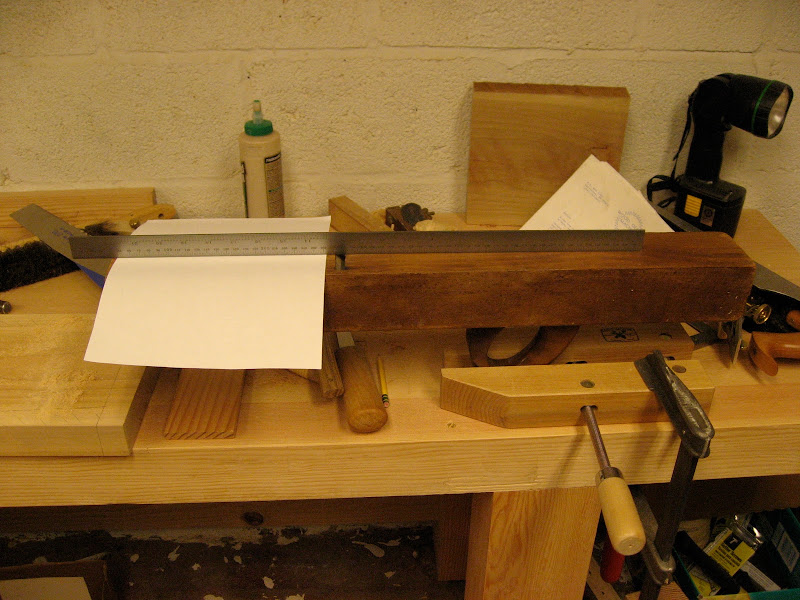
Insert the blade, and set it to usable tension, though retracted a little. Rather than start removing wood wholesale from behind the mouth, I would take a shoulder plane, or other rebate plane, and run a transect which is 3 thou deep behind the mouth, tapering to zero deep at the heel. Check as you go with your straight edge--you are going to get the straight to lay flat, while removing as little as possible.
Once you get the straight edge to lay flat, then use a heavy scraper to reduce the rest of the sole to conform to the 'accurate transect'. As you proceed with all this, use winding sticks of some type to make sure you are keeping twist out of the sole. If there is twist, then you will need to eliminate that as you proceed.
Do you have a flat place (3/8" glass plate, jointer bed, table saw wing, whatever) that checks flat against your straight edge? If so, you can put pencil on it in order to do the final truing of the sole.
I would shellac and wax the sole, but there may be something better. I would defer to Larry Williams or Don McConnell (in a heartbeat, are you kidding?!) on what to apply.
If you don't have one, this would also be a stellar opportunity to buy an 18 x 24, or 12 x 18 granite plate, toolroom grade, doesn't have to be thick--2" or 3". It would allow you to perform quick checks over time on how the sole is doing. The advantage of the granite plate over a straight edge is that the plate will give you a true impression of the entire sole in one shot, whereas a straight edge requires numerous transects plus winding sticks.
Wiley