Home Articles Forums Gallery Marketplace Videos

WoodCentral Forums

Knowledge You Can Build On — Est. 1998

If you sell to woodworkers, your customers are already here

High or low angle plane

Posts

High or low angle plane

#1

High or low angle plane

Will

I'm looking for some advice. And it's not about my lawnmower or my computer. So ends my rant about OT postings. I love to work with curly cherry. Please don't tell me how foolish that is. I already hate myself for loving the *%$! stuff. But love it I do. The question I have is. Is it better to use a high or low angle plane on highly figured wood. The only plane I currently own is a LN low angle block (LN 60 1/2). It does a great job of cleaning up machine marks off the edge of pieces. As well as adjusting the fit of miters. But it's just too small for anything else. But before I go out and spend the money on a #4 or a #7, I would like to hear your opinion on both the pros and cons of the high and low bed angle. As well as what grind angle do you prefer for the blade. Also, what plane do you recommend for smoothing the face of a board? My goal is to machine close to final dimension, then use hand planes to get to the final. I know that I'm trying to cover a lot of ground with one post.

Thanks for any and all advice.

Will.

Re: High or low angle plane

#2

craigd

Re: High or low angle plane

craigd

I think you are looking for a high *cutting* angle (between 50� & 60�) smoothing (bench) plane; the bed angle, bevel up vs bevel down doesn't matter a whole lot (IMHO, others may disagree, which is reasonable). My favorite cutting angle (of the moment) is 55�; with a lot of [domestic] hardwoods, I can go with the grain, against the grain without worrying about tearout, which is where you want to be when doing a final clean up. I have bevel down and bevel up 55� planes, they work pretty much the same (I also have 35, 45, 50 & 60 BD planes to compare with). I'll probably get slagged for this but I think Stanley Baileys are pretty much utility planes (I have 2 - 7). Yes, you tweak them and they work well on nice wood but do a face plant on twichy grain. Bedrocks are better, and easier to tweak, but the 45� cutting angle will be an issue when the grain isn't so straight. So, my suggestion is, unless you like working on old tools (I do) and know what a back bevel is, look the offerings from Vertas and Lie-N. #4 is a nice size for cleaning up a surface that has been machined flat.

ps - a low angle 60 1/2 has a cutting angle of 37� (12 + 25), which is best suited for cross and end grain work.

Re: High or low angle plane

#3

Re: High or low angle plane

Derek Cohen (in Perth, Australia)

Hi Will

Craig gives good advice. Assuming that you are a novice to smoothing planes, what needs to be added is that the easiest way to get a high cutting angle is with a bevel down (BD) plane with a high bed angle, say 55 - 60 degrees. All you then need to do is sharpen the blade. I would not go below 55 degrees and some prefer 60 and above.

The limitation with a BD plane in this range is that it requires more effort to push than a bevel up (BU) plane with the same cutting angle. The other advantage of a BU plane is that you only need to hone a high secondary bevel to achieve a higher cutting angle. The BD plane is simpler but the BU plane has more range.

BD planes to consider are from LN (they make a 55 degree frog for the #4 1/2), Brese Planes, and Steve Knight (and you may be able to pick up a second hand one).

BU planes are available from LN and LV. My preference would be BU for your circumstances.

Regards from Perth

Derek

Re: High or low angle plane

#4

Moses Yoder

Re: High or low angle plane

Moses Yoder

The Lie Nielson #4-1/2 is an exceptionally nice plane, and with the higher angle frog would be an ideal plane for figured wood. The wider iron makes for a little faster smoothing, although it is a bit harder work (better excersize :D ) I like my Bedrock 604-1/2 for all my smoothing jobs.

Re: High or low angle plane

#5

Consider scraping, too *LINK*

Bill Houghton, Sebastopol, CA

Cabinet scrapers aren't expensive, either Stanley 80s on deBay or the LV scraper (link below). They can be helpful on grain that otherwise stubbornly tears out when it sees a sharp edge coming.


http://www.leevalley.com/us/wood/page.aspx?cat=1,310&p=46266

Re: High or low angle plane

#6

Re: Consider scraping, too

Will

I do own a scraper. I do not own the ability to use it properly. :) But this would be a good reason to learn.

Re: High or low angle plane

#7

Thanks!

Will

Thanks for the advice. I now know more than I did yesterday.

Re: High or low angle plane

#8

Re: High or low angle plane

Hank Knight

Will,

I agree with the advice you've been given already. You're looking for a plane with a high cutting angle. I think your decision is between a traditional bevel down plane with a 50 or a 55 degree frog or a bevel up plane that will allow you to change the cutting angle to suit your needs. I find regrinding blades for bevel up planes to change their cutting angle a bit of trouble. Keeping extra blades ground for different cutting angles is a little easier but it adds to the cost. Nevertheless, bevel up planes are much more flexible than bevel down planes for this sort of thing. My bevel up jack has become my favorite plane for this reason. I also have a LN bevel up smoother, but I find the bevel up jack to be more useful.

My favorite dedicated smoother is a LN 4 1/2 with a 50 degree frog. It is a wonderful smoother that handles curly cherry very well; but it is a large, heavy planes and that doesn't see much use for anything except smoothing. I think you would find a regular #4 smoother more useful and a better all-round plane. The #4 is smaller and lighter than the 4 1/2 and useful not only for smoothing but for all kinds of other tasks for which a 4 1/2 is a little too large and heavy.

If I were in your shoes with a block plane and looking to add a second plane for smoothing, I'd be looking to buy either a #4 with a high angle frog or a bevel up jack with one or two extra blades. I think you would be happy with either choice.

Long winded, but my $.02 nonetheless.

Hank

Re: High or low angle plane

#9

I'm in the LN 4-1/2 camp...

Scott Burr in Ben Lomond CA

With a high angle frog (50 deg). Also their bronze No. 4 with the high angle frog is a wonderful plane if a 4-1/2 feels too big or heavy. I don't know why you mentioned a No. 7, it's too long to be a good smoother.

I like curly cherry also. I've never had a hard time planing it with a regular angled smoothing plane.

Re: High or low angle plane

#10

Re: I'm in the LN 4-1/2 camp...

Will

The #7 would be for edge joining. The general consensus I'm getting is that a #4 with a high angle frog would be the best choice for what I want to do. Now all I need to do is save up a few thousand pennys and whistle one up.

Will.

Re: High or low angle plane

#11

Not nessaraly (southpark speak)...

Scott Burr in Ben Lomond CA

I'm going to clean house, thin the heard, get my nu*t's cut off...Ahh you know :)

If your looking for a nice No.7 send me a email, I'll show you what I have. It will be nice and you'll keep a lot of pennies :D

Re: High or low angle plane

#12

Short term loan?

Bob Hackett

If you know your way around wood planes I might be willing to loan my Steve Knight 55 degree smoother so you could test drive a high angle plane before shelling out the cash.

MB

Re: High or low angle plane

#13

scott grandstaff

Re: High or low angle plane

scott grandstaff

What is the size of this work we are talking about?

What is the size of the mechanic?

These are important questions since you don't use the same tool on a bowling alley as you would on a pocketwatch case.

And a 6'6" 260 pound linebacker of muscle doesn't reach for the same tool as a 5'3" mathemetician who hasn't seen the sun in years.

But you know me, a small backbevel on a 5 dollar Ohio woodie or the same backbevel on a Stanley #4,................

or a good sharp hook on a 5 dollar #80 scraper,

will likely get you there just fine.

I love beautiful tools for their inventive and artistic value. Making them and having them around that others make are both very satisfying.

Keep them in a nice polished cabinet and walk past everyday and sometimes stop and pull one out to admire.

Its nice. Real nice.

Its like the reward for the blisters and splinters and dust you face in your actual work.

Projects come and go and they mostly go as soon as you are finished, but they let you keep your tools.

You don't need pretty tools for working though.

For hot sweaty dusty down-in-the-trenches work, learn to use ordinary tools. You have to develop skills anyway if you want to work wood. Its nearly the same learning curve whether a 20 dollar tool or a $20,000 tool. And no matter what you start with, you have to lean to fettle and maintain them anyway.

So you might as well have the work part for cheap, and your little private museum too.

If you are like me, you will slowly improve your working set as you go.

So you just need more tools. heh heh

yours Scott


Re: High or low angle plane

#14

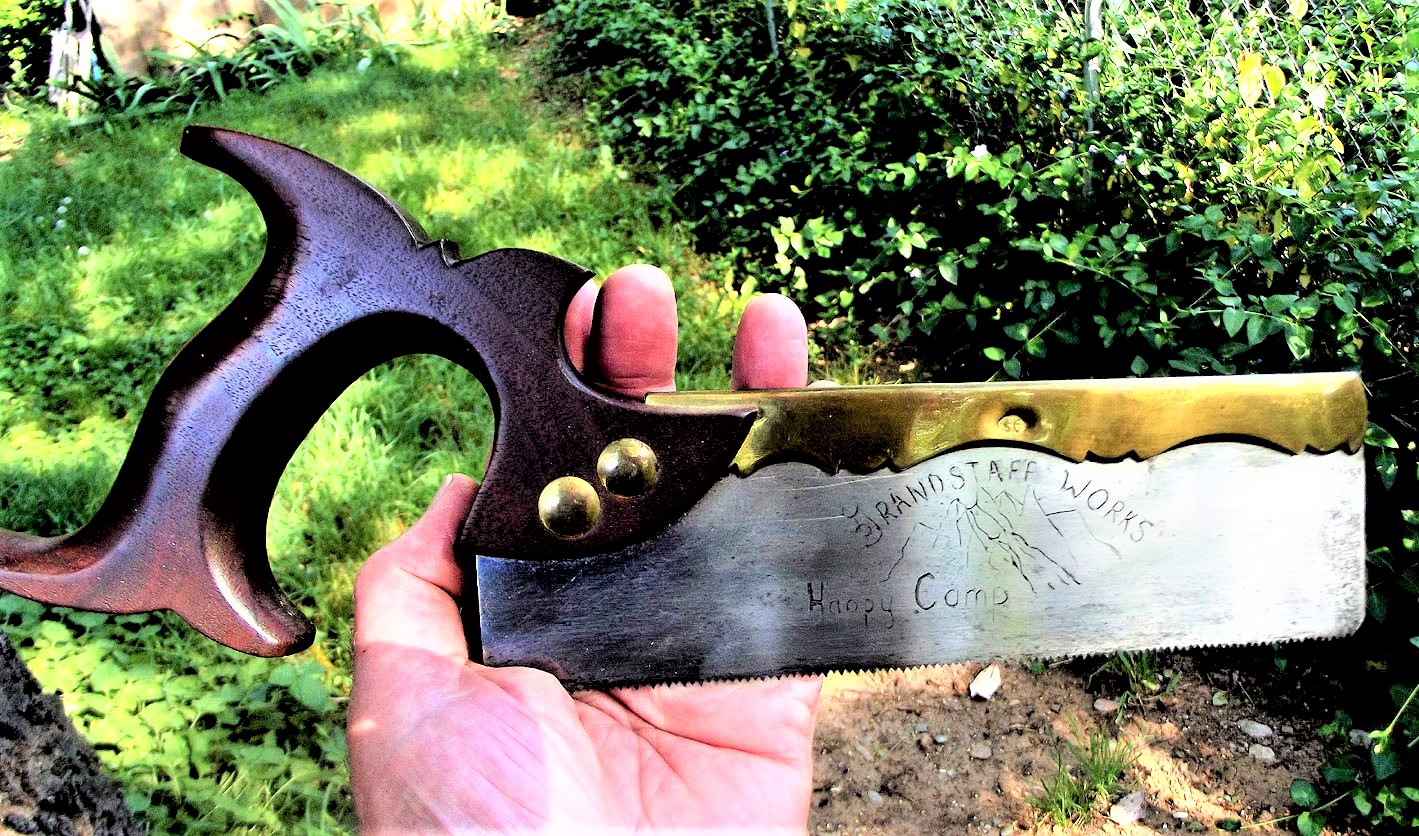
Nice little working tool, there, Scott

Bill Houghton, Sebastopol, CA

Purty little saw.

I'd like to add a vote for simple, too. I've got a few upper-middle-end (LV) tools now, thanks to a period when some consulting gave me some play money, and I use them and like them; but my daily drivers, which work just fine, set me back $1, $2 or (rarely) $5 or $10. And, if I didn't have the LV tools, I think I'd still be able to make things. I've come to realize that I live in old tool Lake Woebegon, where the tool-bearing garage sales tend to be above average; but even those who live where decent old tools are as rare as polar bears in Miami can get decent old tools from the trustworthy dealers for a lot less than from Lee Valley or Lie-Nielsen.

And I don't have any saws like yours; I'm pleased as punch to own some early-20th-century Disston and Sons saws.

Re: High or low angle plane

#15

Re: High or low angle plane - yes!  NM

ThomD