Home Articles Forums Gallery Marketplace Videos

WoodCentral Forums

Knowledge You Can Build On — Est. 1998

Personalized Wooden Watches, Engraved Free

Secondary bevel on mortise chisels not important?

Posts

Secondary bevel on mortise chisels not important?

#1

Secondary bevel on mortise chisels not important?

wilbur

A while back, I came to the thought that the idea of a primary and secondary bevel angles on a pigsticker mortise chisel might not be that important. Usually, they are constructed so that the primary angle is about 20�, and there is a secondary bevel of about 35�. The idea is that the low primary angle will allow the chisel to penetrate more deeply, but that the higher secondary bevel angle will allow the edge to hold up to the chopping.

The reason that this didn't make much sense to me is that regardless of what the primary angle is, the wood is being cut by the secondary bevel, and the wood fibers being cut have no idea what the primary bevel of the mortise chisel is. So it didn't stand to reason that the geometry of the chisel at a point where it may not even be touching the wood would affect the penetration of the chisel.

The other reason that didn't make much sense is that Japanese mortise chisels uniformly do not have a primary/secondary bevel. The ones that I use and the ones that I have seen have a single bevel, usually about 35�. My feeling is that Japanese woodworkers wanted to get things done just as badly as western woodworkers, so if there was an advantage to a secondary bevel, they would have used it.

But that's the conventional wisdom: the primary bevel helps with the penetration of the chisel into the wood. Of course, there's nothing like real data. Except that I didn't have a pigsticker mortise chisel. I posted a query on Woodnet, and a few days later I found out that one of the Woodnet members called up Tools for Working Wood and had them send me a Ray Iles 1/4" English mortise chisel! I was flabbergasted, and it just goes to show how great woodworkers are.

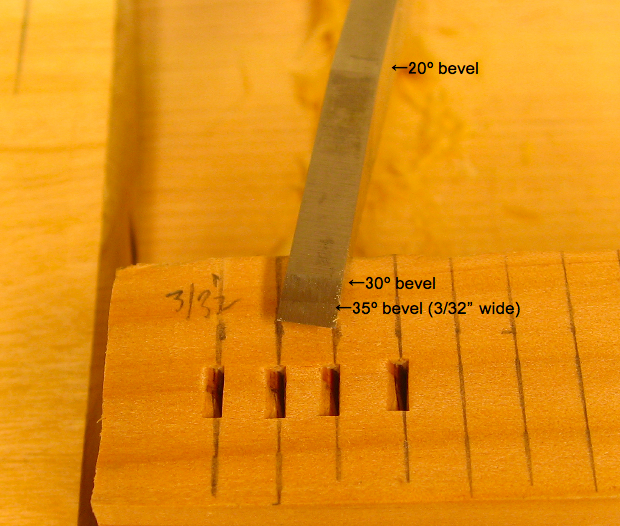
So here's the experiment. The chisel came with a primary bevel of about 20�, a secondary bevel of about 30�, and a tertiary microbevel of 35�. I laid out a piece of scrap wood with a bunch of lines 1/4" apart to do some chopping. I sharpened the chisel on a Tormek, finishing up with the honing compound on the Tormek's leather wheel. Then I measured the length of the 35� bevel, which was 3/32", lined up the chisel on the line, and gave it four whacks with a big wooden mallet. I repeated the chopping routine four times. This is what the scrap wood looked like when I was done.


It's a bit hard to see in this picture, but hopefully you can see the differences in shading and the lines towards the cutting edge that represent the transition from the 35� tertiary bevel to the 30� secondary bevel, and the transition from the 30� secondary bevel to the 20� primary bevel.

I then took the chisel back to the Tormek and ground it down some more so that the secondary bevel got bigger. I repeated the above routine when the bevel was at 5/32" (honing on leather wheel, four whacks with a wooden mallet, repeat four times). I repeated this with bevel lengths of 7/32", 9/32", and 11/32".


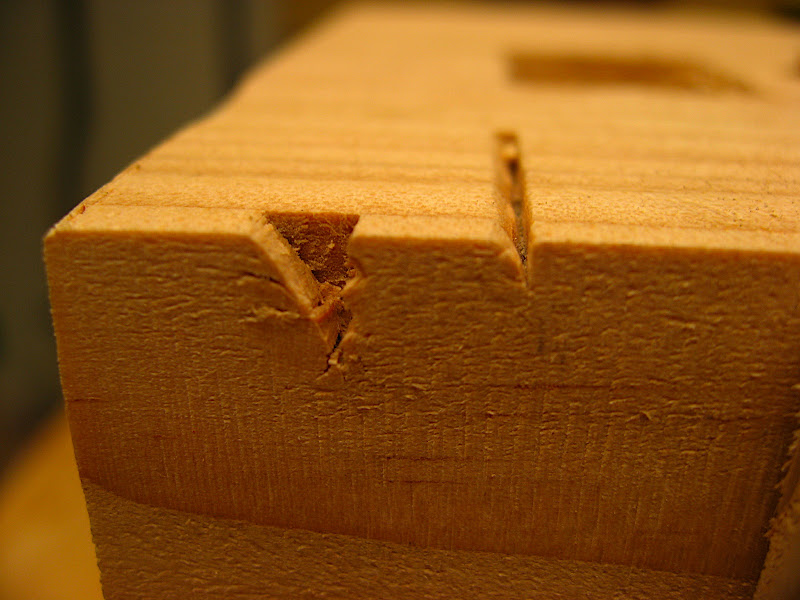
I stopped at this point because after four whacks, the secondary 35� bevel was large enough that the primary 20� bevel wasn't getting to the wood anymore, whereas it had gotten to the wood with the other chopping runs. So I figured that the primary bevel really had nothing to do with the penetration of the chisel at this point. You can see the primary bevel not reaching the wood in this close up picture.


And here you can see how much bigger the secondary bevel is compared to where I first started.


So what were the results? I took a saw and sawed through the chops that I had made.


The black horizontal pencil line was drawn parallel to the surface of the board. There's some variation in the depth of the chops, but it's pretty clear to me that the length of the secondary 35� bevel did not really impact how deeply the chisel penetrated the wood to any great degree. If there was an impact, the first set of chops should have been deeper, and the chops should have become more shallow as the secondary 35� bevel became longer as I ground away at the mortise chisel.

So why would you have the secondary bevel? My guess is that the main reason is that it makes the chisel easier to sharpen if you have it. I certainly got a first hand look at how the sharpening of the chisel got harder as the secondary bevel got bigger. It took me much longer to go from 9/32" to 11/32" than it took to go from 3/32" to 5/32".

So why don't Japanese mortise chisels have a secondary bevel? With Japanese chisels, the sharpening is made easier because the hard steel layer which does the cutting is very thin, and most of the thickness of a Japanese mortise chisel is softer steel, which is very easy to grind away. So with a Japanese mortise chisel it's as if you have the advantage of sharpening just the microbevel without having to have a primary and secondary bevel.

There is a limitation to my experiment, and that is that I didn't have a more precise way of delivering equal blows to the chisel at each stage other than me trying to stay consistent with the chisel pounding. But I did try hard to do it consistently, and the fact that I did sets of four with each bevel length tends to even things out.

Anyway, I have to really thank the Woodnet member for sending me the chisel, and I'm going to send it to him now that I'm done with it. I can also say that the Ray Iles English mortise chisel is a really nice chisel to use, even for someone who really likes using Japanese chisels. Even though som amy things are different with the Ray Iles English mortise chisel compared to a Japanese mortise chisel, from the shape of the handle, to the length of the chisel and the blade, to the addition of the secondary and tertiary bevels, it was really nice to use. If anyone is considering a mortise chisel, you should strongly consider this one.

Re: Secondary bevel on mortise chisels not important?

#2

Jack Guzman from Maine

mortise depth

Jack Guzman from Maine

Wilbur, There is one other factor involved that I think would make a difference. That is mortise depth.I've never seen a Japanese mortise chisel but I do own a couple Ray Iles of the type you mention. When making a mortise of say 1 1/2" I think a continuous 35 deg. bevel would mean that more chisel would be in the mortise when trying to clean it out.This seems like it would give you less room to lever out your waste.I find this to be the most difficult part of cutting mortises.The deeper you go,the less room you have to work the material out of the mortise.---Jack

Re: Secondary bevel on mortise chisels not important?

#3

Re: Secondary bevel on mortise chisels not importa

Derek Cohen (in Perth, Australia)

Hi Wilbur

I am curious to know the size of the secondary bevel on the RI mortice chisel you used? If the picture you showed of it is what you received/used, then I am not surprised it did not penetrate far.

This is what the RI looks like with a 1/32 - 1/16" wide secondary bevel ..


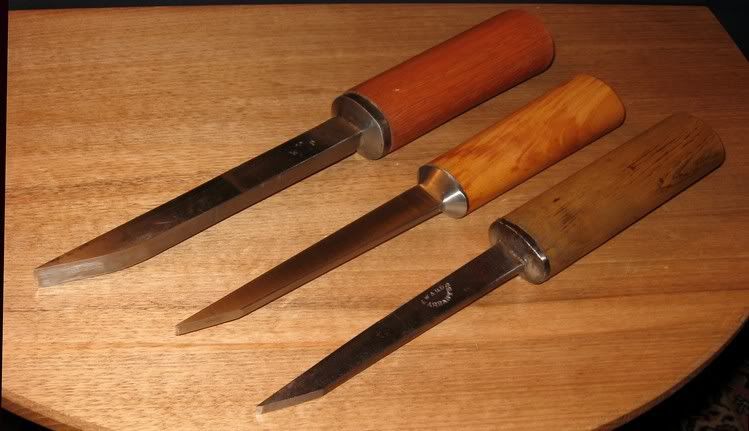
That was a picture from TFWW. Below is a picture of two vintage OBM chisels flanking a RI ..


Note that the lower chisel has been honed a few times and the secondary bevel is a about 1/16. It still works as well.

Here is what you posted:


Here is a mortice I am chopping in medium hard (about the same as US White Oak) Tasmanian Oak. This chisel has been used a lot and is now at its maximum, about 1/8". I usually regrind the primary bevel at this point. Still, without trying too hard (since I am deliberately trying not to go too dee), I may be penetrating deeper than your example.


From: http://www.inthewoodshop.com/Furniture/AHandcutMorticeandTenonPrimer-BlindMortice.html

Was your RI ground/honed like mine?

Regards from Perth

Derek

(reprinted from WoodNet, where I first read and responded to your post)

Re: Secondary bevel on mortise chisels not important?

#4

Re: Secondary bevel on mortise chisels not importa

wilbur

Hi Derek,

The chopping was done with 35� bevels ranging from 3/32" to 11/32". The chisel came to me with the 35� bevel a little over 1/16". After my first honing, it was 3/32".

The last photo you posted was to show where I ended up with the chisel sharpening. I'm sorry that the first photo, which is nearly how the chisel came out of the box, wasn't better, but here's an annotated closeup that will hopefully clarify how the chisel was set up at the beginning of this experiment. Again, this is how the chisel arrived out of the box from TFWW, after honing the bevel on my Tormek.


Re: Secondary bevel on mortise chisels not important?

#5

Stephen Shepherd

Re: Secondary bevel on mortise chisels not importa

Stephen Shepherd

I work almost exclusively on soft woods, given that and how I was taught a secondary bevel is the lazy way of sharpening and a bad practice like back bevels on blades that should be flat.

On mortise chisels I count on the square flat bevel edge [sharp] to true up the cheeks as the mortise is being chopped.

Stephen

Re: Secondary bevel on mortise chisels not important?

#6

Re: Secondary bevel on mortise chisels not importa

Wiley Horne--So. Calif.

Hi Wilbur and all,

This is a fascinating result! What I like about the experiment is that it fairly closely approximates the actual process of mortising. I think this may also explain the result you're getting. I am wondering if the equal penetration you're getting, even with the wider bevels like 9/32" and 11/32", is due to each strike causing a weakening or partial failure of the adjacent grain, so that the next strike is attacking grain that has partially failed, or is set up to fail due to the presence of a nearby relief hole, namely the hole that the last strike has made!

Question: If you look at the sawn cross-section, can you see evidence of failure of the grain between strikes? That is, where a later strike has created shear planes along the grain lines of the grain block right behind it?

If so, this would tend to confirm something that is frequently said about mortising, especially by old hands--that a steep attack angle on the chisel is very effective in busting out blocks of grain. A block of end grain that has become isolated has very little holding it in place, so the wedging action of the mortise chisel may readily bust it loose.

Outstanding experiment!!

Wiley

Re: Secondary bevel on mortise chisels not important?

#7

Re: Secondary bevel on mortise chisels not importa

wilbur

Hi Wiley,

Actually, the issue of grain failure when chopping a mortise is why I spaced the chops about 1/4" apart. I wanted to take out the factor of the waste busting out into the void contributing to how deep the chisel would penetrate with each blow, and I tested how far apart I needed to space the chisel blows on some scrap before doing this experiment. There isn't any grain failure in the board between the chops -- it's all penetration of the chisel into the wood.

Just to show that there are factors that I know will affect how deeply a mortise chisel (or probably any chisel, for that matter) will cut during chopping, here's a photo that I took showing the difference between my 6mm and 24mm Imai mortise chisels, both of which have 35 degree bevel angles. This is a significant difference in the depth of the chop between these two chisels.


Re: Secondary bevel on mortise chisels not important?

#8

Re: mortise depth

wilbur

That actually is a very good point, Jack. I do find that when I get to the end of a mortise, I have to lean over my Japanese mortise chisel by a decent amount to clear out the corner due to the 35 degree bevel angle. If my chisel had a 20 degree primary bevel, it would have to be tilted less.

Taking this factor into account, it's interesting to note that the length of my Japanese mortise chisel is shorter than the Ray Iles English mortising chisel. I'll have to see if the increased leaning is offset by the fact that the chisel handle is shorter.

Re: Secondary bevel on mortise chisels not important?

#9

Hi All, a question...

Scott Burr in Ben Lomond CA

How (or does) a secondary bevel help with prying chips out of the mortise? I always thought it did.

Re: Secondary bevel on mortise chisels not important?

#10

Jim in Burlington Ont.

Great test

Jim in Burlington On

I love when someone goes about looking at things from and engineering and failure analysis standpoint. I really strive to no overthink things like this and just make the chisel sharp and as I use the chisel write down what bevel works best for me over time. I still think 30 degrees is a very good starting point.

Re: Secondary bevel on mortise chisels not important?

#11

Re: Secondary bevel on mortise chisels not importa

John Pappas

"I was taught a secondary bevel is the lazy way of sharpening and a bad practice like back bevels on blades that should be flat."

Sorry, but I have to disagree here. On my Ray Iles chisel, if it had no secondary bevel, I would be honing 1 1/8" of metal. With the secondary bevel, I am honing 1/8" of metal. I prefer to think of this as prudent, not lazy. Also, while one may debate a secondary bevel on a mortise chisel, it is simply wrong to equate it to the bad practice of a back bevel on a chisel....two different subjects with totally different effects.

Re: Secondary bevel on mortise chisels not important?

#12

Re: Secondary bevel on mortise chisels not importa *LINK*

Pam Niedermayer - Austin, TX

Pretty neat test, Wilbur, although, to be honest, it never occurred to me that putting a secondary bevel on a chisel would change anything other than the cutting angle. It's the edge that does the cutting, not some relationship between two or more bevels.

I also like the western mortising chisels that have somewhat rounded bevels. Seems to me this was a big deal with Adam Cherubini, who investigated how this facilitates mortising by hand and arm without mallet or hammer, posted on WC ages ago.

I also eagerly adopted Jeff Gorman's mortise chopping method some years ago, which requires no levering at any time. It has worked very well for me, so I was pleased when someone (you?) pointed out that his site was available again.

Pam


Jeff Gorman's mortising method

Re: Secondary bevel on mortise chisels not important?

#13

Jeff Gorman/J. Maynard

Wiley Horne--So. Calif.

Hi Pam,

Thanks for linking this! Like you, I was most happy to see that Jeff Gorman had restored his website. He explores and explains the details like no one else. He is not trying to get past the details; he thinks they are the whole point.

I like Maynard's 'central V' method. Is that the one you prefer?

Wiley

Re: Secondary bevel on mortise chisels not important?

#14

Re: Jeff Gorman/J. Maynard

Pam Niedermayer - Austin, TX

Yes, I never drill before chopping; so it's the central V. The only place this approach gets dicey is on very short mortises, such as used for kumiko (much like window panes), in which case I start just short of one end, work to the other, then come back and pare the starting end.

Pam

Re: Secondary bevel on mortise chisels not important?

#15

Original thread

bugbear

Here's the original thread (started by me!) that start the discussion, ending in Jeff site-page.

I note that Pam was in the discussion!!

http://swingleydev.com/archive/get.php?message_id=99408&submit_thread=1#message

(note to Mod: I'm being offered the chance to include a picture in my post, but not a link??)

BugBear

Re: Secondary bevel on mortise chisels not important?

#16

Links and pictures *LINK*

Bill Houghton, Sebastopol, CA

Bugbear,

You don't currently have a profile. Back in January, when the new software came in, Ellis had to delete all the existing profiles, and folks had to start over. The Frequently Asked Questions section, general link in the box above, specific link below, explains how to set up a profile. Use the profile name that you'll use when posting (that is, "bugbear" rather than "Paul Womack"). Once you do that, your posting page will include several link options in addition to the ability to post pictures within your message, as in the example below (current posting page is slightly different, and, of course, does not include the imitation of a dying chicken's last march that I call my writing):


From the FAQs

Re: Secondary bevel on mortise chisels not important?

#17

All done - thanks

bugbear

Re: Secondary bevel on mortise chisels not important?

#18

Re: Secondary bevel on mortise chisels not importa

wilbur

That might have been me. I did post here when I found out his site was up and running again.

FWIW, I drill a hole at one end and chop my mortises in (mainly) one pass.