We value your privacy.
We use cookies to enhance your browsing experience, analyse site traffic, and personalise content.
By clicking “Accept all”, you consent to our use of cookies. You can also choose
“Essential only” or learn more.
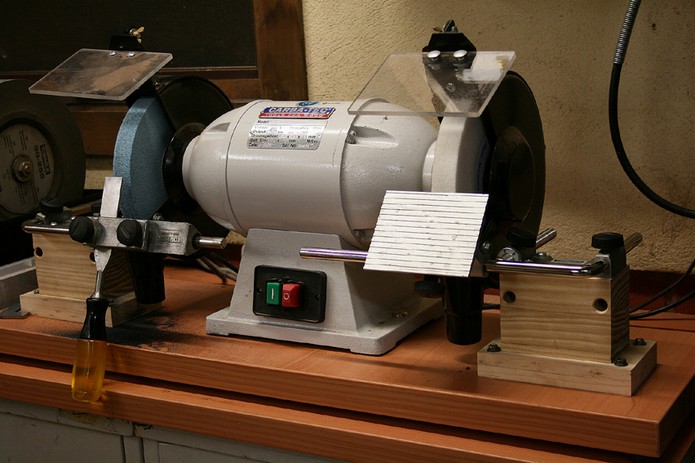
These are a couple of planes that I did not grind properly, I am could I get a couple more sharpenings out of them? I need to the Veritas Tool Rest before I retry grinding agian, and I need to clean my wheel.
I'm gonna be tied up for the next few days. Sorry I can't explain it now, but I'll get back to you. Anyhow, lot's of people have made theirs. I hope some of you chime in! Ask on the turning forum you'll get a lot of info from from them. They'll probably recommend the wolverine rest. It can pretty much do anything (with some accessories). I have it on my list. Until then.
I have the Veritas grinding jig and don't recommend it. The aluminum gets "sticky" for lack of a better word. I can't say that mine has galled.
The Oneway Wolverine basic tool rest is much better; the Veritas version is $49; the Wolverine version is $99 ($CND) at Lee Valley Tools. I would spend the extra $40 on the Wolverine jig any day. With the Veritas version, you spend $49 for a single rest so you can only use it for one wheel. With the Wolverine, you get two bases and a single tool rest that can be moved from base to base, so you can use both wheels on the grinder.
Don't bother with the skew grinding jigs, plane blade grinding jigs, etc. All you need is a nice large, steady, heavy flat, platform. With a good tool rest like the Wolverine, a bit of practice, and a very light touch it is very easy to grind a plane blade freehand and get a nice square edge that is not burnt.
When using the Wolverine jig, I put the plane blade on the rest, slide the blade into position near the wheel, pinch the blade so that my index finger is under the blade and riding on the bottom edge of the tool rest. My index finger acts as a jig to keep the plane blade a constant distance away from the wheel. A bit more pressure on my finger brings the blade closer to the wheel and vice versa. My other hand rests on the upper surface of the blade, ensuring the blade does not tip up, and helps to guide the blade side to side.
I start grinding in the middle of the blade and move towards the side, then move the blade away from the wheel and move back to the middle of the blade and start grinding again towards the other side. Repeat about 5-10 times, then check for square. If out of square, make a few extra passes on the high side. If the blade gets too hot to touch, I wait about 30 seconds then restart grinding. Note - my fingers on top of the blade are only 1/4" away from the wheel, so the blade is not getting very hot! A light touch and a heavy steel tool rest mean that the blade does not get too hot while grinding.
Dress your wheel often. I dress mine so that it is slightly convex. This makes it much easier to bring the blade into contact with the wheel in a controlled manner.
Some are very complex, but if you want my advice, keep it very simple. All you need is a good solid reference surface in front of the wheel. An adjustable angle is nice to have.
I have never understood the complaints with the Veritas rest. I have one and love it. I built my own but only had a simple wing nut and lock washer to lock it into place so I always used pliers on it. It worked okay but the Veritas rest locks into place much better than my home made version and also adjusts better. I followed instructions in David Finck's book on planemaking to build my own rest but the Veritas version turned out to be one of my favorite tools. I have a hand cranked grinder so I hold the blades with only one hand and not much pressure; perhaps that makes a difference in the stiction?