We value your privacy.
We use cookies to enhance your browsing experience, analyse site traffic, and personalise content.
By clicking “Accept all”, you consent to our use of cookies. You can also choose
“Essential only” or learn more.
I swear I did this last time I tried to finish up my workbench base glue up when it went bad.
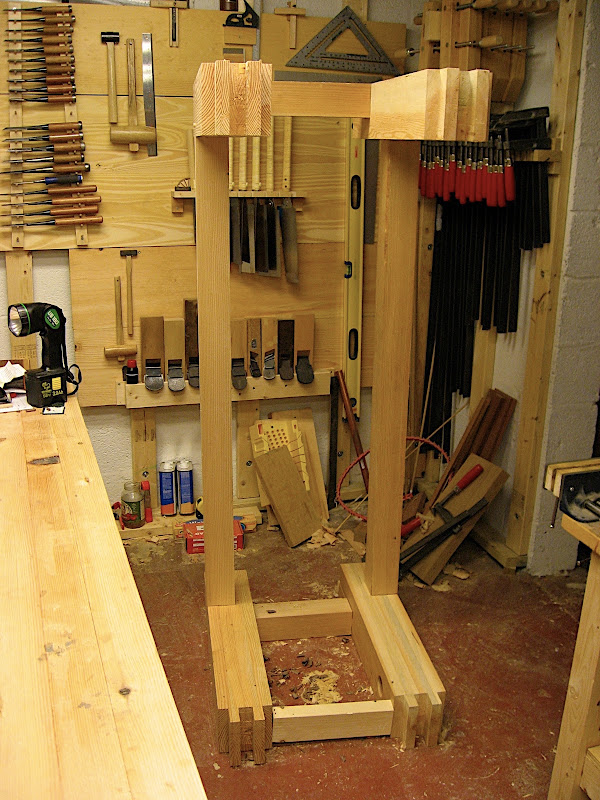
Tomorrow night my neighbor is coming over to help me with the glue up. Even though in this position gravity serves as a great clamp, I'll have some pipe clamps ready, just in case. Wish me luck this time!
Wilbur, you can glue most of this frame together one tenon at a time, pinning as you go. I would do the two end frames, then the two long stretchers into one end. At the very end you have to do two tenons at once. Actually, I am not sure this bench really needs glue. My bench has gone without since 1980.
This time you're ready.It will go without a hitch. But if you're still a little hesitant,why not use liquid hide glue? No quick grab like yellow glue.Of course if you're already using it disregard that. Good luck.---Jack
Actually, the base is almost completely glued up. The only joints that need finishing are the 2 M/T joints at the bottom end of the long stretchers, which were the ones that I screwed up last time.
I did assemble the rest of the base one joint at a time as you suggested, drawboring as I went. But I also glued the joints as well.
Was the small bit of bad luck you had with that one joint.That bad luck is well behind you.
You are far better prepared and infinitely more watchful now.Your mind and hands are ready to carry this thru to a fine finish.As a friend is fond of saying "Nothing to it,but to do it!".
We look forward to seeing the completed bench and the work you both turn out together.
If I ever build a bench like that I think I'd glue five pieces together for each leg and leave two of them extended to serve as tenons. Once I paint the whole thing John Deere green, no one will notice.
Got it done with a combination of help from my neighbor, long clamps, and some persuasion with a large mallet. For a second I thought it would bind up again, but ultimately it went together, and it's square and reasonably flat in the places it needs to be.
Now to mark out the mortises on the underside of the benchtop, and do some chopping.
Think how easy furniture joints made on that bench are going to seem now
Unless of course you start building monumental furniture like some of the 70s California roundover stuff (don't, please - not California's best contribution).