Home Articles Forums Gallery Marketplace Videos

WoodCentral Forums

Knowledge You Can Build On — Est. 1998

A55 Smoothing Plane

a discussion of coped frame and panel joints

Posts

a discussion of coped frame and panel joints

#1

a discussion of coped frame and panel joints

Bill Tindall

>I'll try again as the last try crashed.

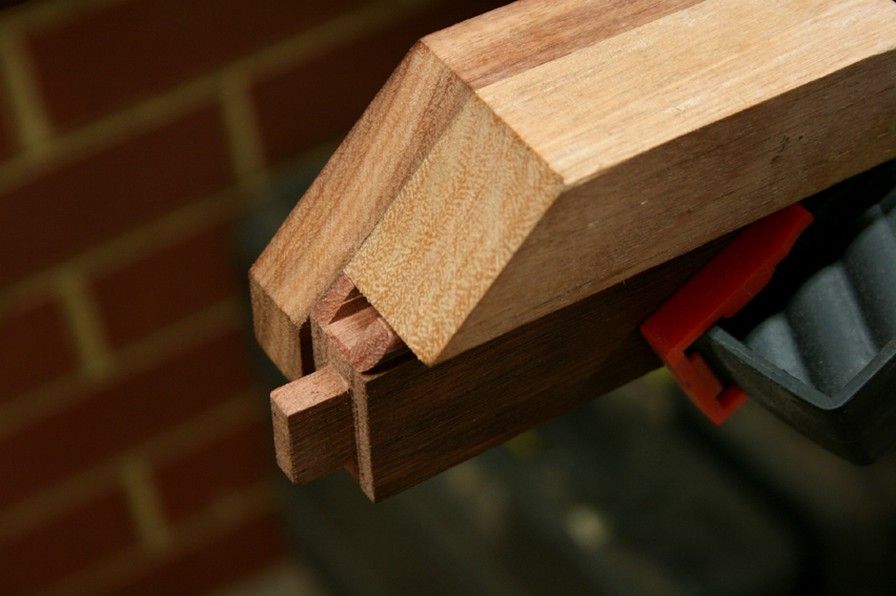
One way to prepare this joint is to miter the interior molding as shown in the first picture. This joint is easy to prepare on a table saw as all the cuts can be reliably made repetitively with stop blocks.

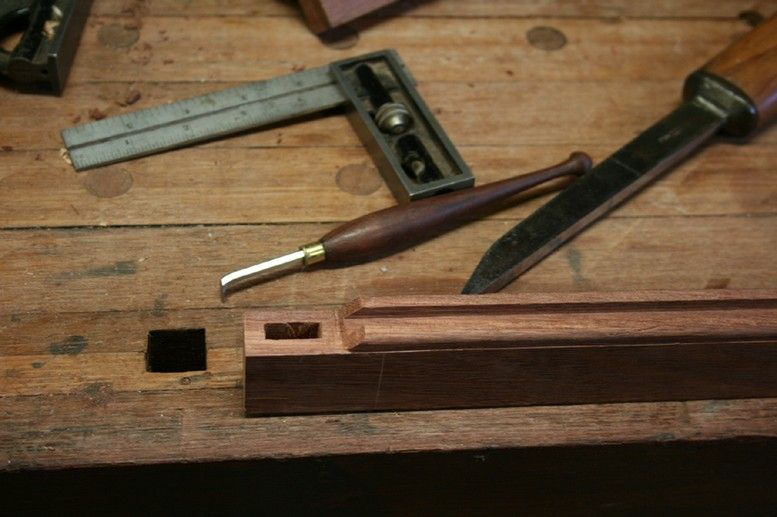
At a class I took at the Mack Headley and Sons shop we leared another way that involves coping the molded part. I begin with three cuts on the table saw as shown in the 2nd picture. Again these cuts can be reliably mass produced on the table saw.

The rest of the waste is pared off with a chisel. To make the cope the area highlighted in white chalk must be pared off with a chisel and gouge, perpendicular to the face of the frame as shown in the next two pictures.

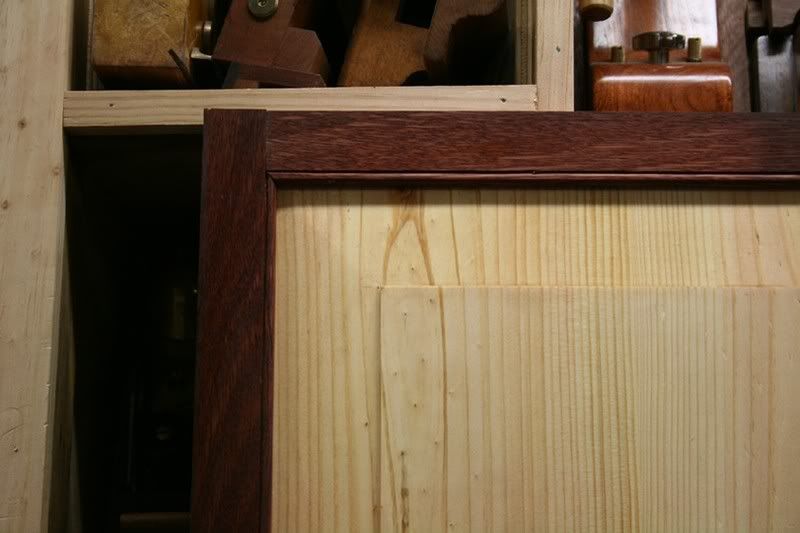
The final fit is shown in the last picture.

Some argue that the coped joint is better than the mitered joint because the coped joint will hide any opening of the mortise and tenon joint over time.

Well, I have tried it on 8 doors. It indeed goes quickly and it is not hard to do, but it involves carving tools which I don't have. I had to borrow the gouge to do these doors.

Would I do it again. Probably not as the miter seems to do well for me and I don't need to buy a gouge to do it. The joint shown first is 16 years old on a kitchen cabinet door and it is tight enough for me. However, if I was making the miter with a paring chisel cut I would not be as precise on the 45 degree angle as my table saw and a less well fitted joint would result. The coped joint would hide this shortcoming. Hence, which joint to use will depend on personal preference and not on the presumption that the coped joint is inherently better.
Re: a discussion of coped frame and panel joints

#2

Re: a discussion of coped frame and panel joints

ron in Kokomo

>The coolest way to do this is with a "door set" of planes. I have such a set made by Tod Herrli.

They are so very cool and work so well. One cuts the cope. One cuts the stick and one raises the panel.

Re: a discussion of coped frame and panel joints

#3

Re: a discussion of coped frame and panel joints

Ed Mulligan, Cape Cod

>The cope can be done with great accuracy with an incannel gouge. With the bevel on the 'inside' or concave surface the gouge can be positioned vertically for the cut.

Re: a discussion of coped frame and panel joints

#4

Re: a discussion of coped frame and panel joints *LINK*

Derek Cohen (in Perth, Australia)

>Hi Bill

Excellent post!

With regards your comment, However, if I was making the miter with a paring chisel cut I would not be as precise on the 45 degree angle as my table saw and a less well fitted joint would result. The coped joint would hide this shortcoming. ...

First it is vital that your frames are square and parallel. Cutting a 45 degree mitre with a chisel is then child's play. OK, it is not a coped corner, but I get good results with mitering.

What would be good here is a demo of a coped joint. Here is a mitred version for comparison.


Sean Hughto has an excellent tutorial on my website. Link below.

Regards from Perth

Derek


Making a Frame and Panel Door

Re: a discussion of coped frame and panel joints

#5

Re: a discussion of coped frame and panel joints

Warren in Lancaster, PA

>Bill, the traditional way to make this joint has different shoulders on the front and back of the tenoned piece so that you don't have to cut out anything at all on the back side of the stile. Your method seems more like a combination of hand and machine work. Also your method of coping involves first making a mitre and then the cope, but I just cope , no mitre, a lot less work. It is often more work to do something by machine and then come back and try to make it look like hand work. I think the number of doors one makes in a batch has a lot to do with the efficiency of these methods because of the table saw set up time. Probably for one or two doors it is faster to use the cope. By hand it is much faster to make the one cope joint than to make mitres on both stile and rail and get them to match.

Looking at your two doors, the mitre looks like it is executed with slightly better precision than the cope, but I think the cope still looks better.

Re: a discussion of coped frame and panel joints

#6

Re: a discussion of coped frame and panel joints

Jorge Casta�eda

>Derek,

Nice tools, beautiful work.

Thanks for the tutorial.

Jorge

Re: a discussion of coped frame and panel joints

#7

Re: a discussion of coped frame and panel joints

Ken Bellock (Houston, TX)

>Since you are already burning electrons with the table saw, why not cut the cope with a router, jig, and a router bit of the same radius as your cope. I would imagine that would make for a perfect, fast, and repeatable fit.

Re: a discussion of coped frame and panel joints

#8

not "my" method

Bill Tindall

>I am describing what I was shown at Headley's shop and I presume it is what they use for making furniture. I found after the fact that a local period furniture maker with an impressive pedigree uses the same process.

I didn't understand the description of the method you use. I would be pleased to have a more comprehensive description of it for comparison.

The coping process I described is the same as has been used for house trim since time began so I presumed it to be a common, if not traditional, way to do a coped joint- namely saw the 45 degree cut which defines the material to be removed, and then remove it. I can't envision any other way to do base and shoe molding and I don't see how this frame molding is any different. Without the 45 degree cut I don't know how one determines the profile to be chiseled away.

As far as comparing the two results, they will be equivalent when the walnut frame is held together by something more than gravity.

Re: a discussion of coped frame and panel joints

#9

Re: not "my" method

Warren in Lancaster, PA

>Sorry, Bill, I did not mean to suggest that you made the method up. My main thoughts were that when working by hand, the scribed (coped) joint is faster and that it looks better than the mitre even when the mitre is well executed.

I do not cut out the back of the stile where it meets the rail. The inside edge of the stile seen on the back of the door is a straight shot top to bottom. Just the front (moulding portion) is cut away where the rail is. That is what I usually see on old work. I assemble the door before cutting away the moulding and mark where the rail moulding meets the stile moulding. Then I chisel away the moulding. With small simple beads like you show I don't bother to mitre before scribing (coping); it is pretty easy to judge by eye.

Re: a discussion of coped frame and panel joints

#10

Re: not "my" method

Wiley Horne--So. Calif.

>Beautiful work, Bill. Both ways.

Detail question: If the mold section is 1/4" wide, say, what do you find the best size gouge to make the cope? I guess I'm asking, are you looking for a gouge that is a perfect fit to the cope, or is it better to use a smaller gouge and nibble? Or something else?

Thanks, Wiley

Re: a discussion of coped frame and panel joints

#11

Well dang! and a question

Bill Tindall

>Before I read your post I discovered I had cut the miter too short such that I needed to remove about 3/32 more material. I discovered this problem whilst inserting the rail into the mortise. I looked at the situation and realized I could just scribe around the simple quarter round profile on the rail to mark what needed to go away, thereby independently "reinventing" what you just described. Indeed, trivial. Now why didn't I think of that sooner? If this stuff is in books I never found it.

Will you describe the preparation of the style. How does the molded part get marked and removed? This operation is trivial on a table saw, but I can't imagine a way to do it easily otherwise.

Re: a discussion of coped frame and panel joints

#12

my bumbling method

Bill Tindall

>Indeed this is my method and it may be best for the novice. I went with a gouge exactly matching the profile. Big mistake. Should have been a shade smaller. In my inexperience hands several nibbling cuts would have been better, though slower. If the fist cut wasn't right on it would have been easier to nibble with a smaller profile. I just had one borrowed gouge so I was stuck. Maybe the novice needs two sizes. I think Headley told me they used one plunge with the "right" sized gouge.

Re: a discussion of coped frame and panel joints

#13

PS

Bill Tindall

>maybe if I just had at trying a joint as you describe it would become obvious like the cope part?

Re: a discussion of coped frame and panel joints

#14

Re: Well dang! and a question

Warren in Lancaster, PA

>I take a lot of care truing up the stock. I first do the mortise and tenon work. Next I plough the grooves and then do the moulding with an ovolo or a hollow. Then I mark where the mouldings meet and remove the moulding where it abuts the rail and cut the cope. I don't cut the stiles to length until the door is glued together.

Re: a discussion of coped frame and panel joints

#15

Re: a discussion of coped frame and panel joints

Pam Niedermayer - Austin, TX

>Ron, I'd love to see some photos of those planes. Did Herrli make them? Or you in a class?

Pam