Home Articles Forums Gallery Marketplace Videos

WoodCentral Forums

Knowledge You Can Build On — Est. 1998

Good Hope Hardwoods - Walnut Slabs & Specialty Hardwood Lumber

Up against the wall, woodworker!

Posts

Up against the wall, woodworker!

#1

Up against the wall, woodworker!

Roy Anderson

>I wish I had a shop big enough to put my workbench right in the middle so I could walk around it and access it from all sides. If you are blessed in this way, how does this help you? If you are a normal mortal like me, how does it help or hurt to have your bench crammed up against the wall? How have you adapted the rest of your shop layout to account for this?

My shop is literally 10 ft. by 10 ft. in my basement, but I do have an adjunct area for sharpening, storing finishing materials and for storing wood. Still, it's necessary to give a lot of thought to space efficiency.

Re: Up against the wall, woodworker!

#2

Same size shop . . .

steve mackay

>as your's. But I'm in the corner with an " L " shaped bench against the walls. The walls are peg-board and one big window. My most-used tools are withing arms reach. The bigest advantage is the window though. I've tried a LOT of different lights and bulbs but NOTHING comes close to natural light for studying grains or checking joints. If I were makeing furniture I could see a bench in the middle of the floor though. As it is I need to floor to pull the Griz TS out away from it's wall too often. Gotta be creative with a small space.

Re: Up against the wall, woodworker!

#3

Re: Up against the wall, woodworker!

James Watriss

>In a big shop, I have my bench in the middle of the floor. It's nice to be able to clamp to both sides. But I also have it near a table, which is against the wall, which holds the day to day junk, and the most-used tools.

From my small-shop experience, having it against the wall means you don't have access to that other patch of floor next to the wall... so there's less junk to trip over on the floor.

IF you don't have a window right there, I recommend painting that wall white, and getting GOOD lighting... halogen, and/or (prefereably and) fluorescent. Halogen's a fair substitute for natural light sometimes, and fluorescent will tell you how the finish will look under that kind of light. I've had great looking pieces turn greenish when I brought them into rooms that were lit with fluorescent.

A small side table is also important, or even better yet, a small cabinet on wheels, with a working surface, to hold tools, and stuff. (never at a lack for "Stuff."

Small shops are all about improvisation, and discipline. (discipline not to accept the day to day torrent of offered projects, and misc tools and hardware that seem to find small shops, much in the same way that piranhas find wayward animals... and consume them.

Re: Up against the wall, woodworker!

#4

Lights for the workbench

Derek Cohen (in Perth, Australia)

>Hi Roy

I was going to post this on its own, but I think it fits your thread. It is one advantage to having a bench against a wall!

I have fluorescent lighting throughout the shop, in addition to natural light through a window. Unfortunately my bench is not close to the window, and it is not practical to have it in that position (I do, however, have my sharpening centre by the window).

I have always needed more light over the bench, especially as my eyes age (I need reading glasses to make out the markings on everything).

A couple of days ago a light bulb went on over my head (pun intended). I have a wall of cabinets above the bench (unfinished - still needing doors). I had been trying to find a way of hooking up a spotlight on a bracket. Some plant the base in a dog hole. The problem with that is it takes up valuable bench space (my bench is small enough). I do have one of those round magnifier lights on a movable stand that I pull over when cutting dovetails, but again this is not ideal since it is always in the way.

So this idea came to me. Why not think of the woodshop bench and overhead cabinets as if it were a kitchen. Why not install under-cabinet lighting?!

Today I fitted 2 fluoro strips, each 20 watts. These are slim line and take up very little space. They connect in line and require only one power cord. Each has an on-off switch. I also needed to add a shield under the cabinets. Standing up the light cannot be seen. Bending down the light was in my eyes. The shield blocked this off, but not the light on the bench.

Below is a picture of the lights taken at an angle that enables them to be seen. In practice, they are hidden.


Here is what they look like under working conditions ..


And a picture of a rule. The lights-on conditionis the picture on the left. On the right is taken with the light off.


Hope this helps someone else do the same.

Regards from Perth

Derek

Re: Up against the wall, woodworker!

#5

Re: Up against the wall, woodworker!

George@Colonel's Workshop-Havertown PA

>Good Afternoon Roy,

Me too. While my main shop is somewhat larger than yours, I've contended with space constraints. I used to repair and restore furniture, and also worked for a couple antique dealers. So, I never knew which tool(s) would be needed for the next job. I acquired the full complement of stationery equipment and shop tools. I put everything on casters, and organized all workbench/tables with shelves. Most tools went in their own obligated boxes which I also built for that task. I lined all walls with plywood and made racks and brackets for "always needed" items such as chisels, mallets, squares, etc. Jigs and templates are also stored on the walls. This arrangement maximizes floor space to accommodate the larger power tools which are rolled out when needed. It ain't ideal, but it works. I also have a smaller room, about your size, which has my wall-hugging carpenter's bench, lathe, and "wooden walls" which hold the Neanderthal Shrine items. My sharpening/buffing center is also in this room. Ceilings are used in both rooms to the maximum extent with multiple flourescent fixtures, and hanger brackets for off cuts, veneer strips, and some lumber. I also like the retractable electric outlet installed in the ceiling of my main shop. The cord in long enough to service the entire room, thereby increasing the flexibility of stationery tool operational placement. Working in confined spaces require continuous compromise and imagination.

George

Re: Up against the wall, woodworker!

#6

Re: Up against the wall, woodworker! *LINK*

Wiley Horne--So. Calif.

>Hi Roy,

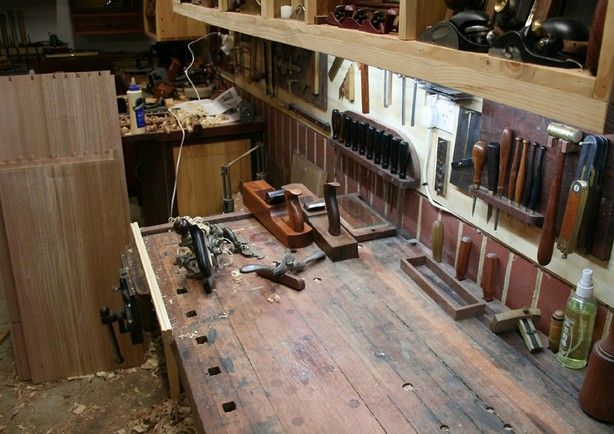
I'm in a small space, up against the wall, and in a corner, too. Attached is a link from a few years ago (and several saws ago) on the one day in history when the area was swept up and things put away.

What's good about this setup is that there are two walls immediately to hand where tools can be kept in quick reach. What's bad is everything else--inadequate lighting (I like Derek's new brainstorm a lot!!), can't clamp across the bench, can't practically flatten the whole bench unless you're heavy into scraping, and some other stuff I forget right now.

But that's life. So what can you do? First, you have to deal with the 'clamping across bench problem'. I did this by arranging to clamp against a pretty deep apron, which wraps around the two open sides--it also serves as rear jaw for vises.

Then there's the problem of storage in a small space. I put drawers under the bench to deal with that. But you have to watch out that you don't eliminate your ability to clamp at the edge of the bench, which is of course ALWAYS happening. So the apron projects far enough beyond the drawers (if you use them) that you can use it for clamping. Mine projects 2-3/4" beyond the drawers, so I can get a clamp under it for holding stuff down to mortise, for example.

But then there's the problem that the drawers are the wrong depth. Like mine under the bench are all 6-1/2" to 7-1/4" deep. Turns out that what I mainly need are shallow drawers, and lots of them. So off to the right you can see a sharpening station with a dozen flat drawers in it, graduated from 1-3/4" to 3-1/2" usable interior depth. Don't forget flat drawers, and there can't be too many. If I had it all to do over, I would put nothing but shallow drawers under the bench, and find another place to store stuff like planes--because they don't fit drawers that well in any case, without a lot of waste space involved (IME anyway).

You may need provision to run a long molding or three. In that case, think about a sticking board which runs at right angles from your bench down the long axis of the space.

Light remains the biggest issue. There is nothing like natural light--if it can be had, provide for it. Get near it. Make the area light--light walls, light benchtop, everything light.

Wiley


Making use of a small space

Re: Up against the wall, woodworker!

#7

Question for Wiley, and a few other ideas

Derek Cohen (in Perth, Australia)

>Hi Wiley

I have always loved your shop. Everything about it conveys such a restful and warm atmosphere. It is so inviting!

However, I could not work on your bench. My question to you (and others with a similar set up) is how do you plane large panels .. in fact plane anything at all using your face vise?? It looks like you will slam your plane into the wall ..?


With regard underbench cabinets interfering with the length required for hold downs, I have a similar problem. What I have down is restrict the hold down to the area of overhand beyond the legs.


My shop is literally 10 ft. by 10 ft. in my basement, but I do have an adjunct area for sharpening, storing finishing materials and for storing wood. Still, it's necessary to give a lot of thought to space efficiency.

Roy

My shop is situated in a double garage. While it is pretty much dedicated to woodworking these days, there is a tablesaw, bandsaw, and other machinery, and I still have to keep room to park one car inside ... so space is always at a premium.

One of the space-saving ideas I came up with was to make a fold-down work bench ..


In addition to as many dedicated cabinets on the wall ...


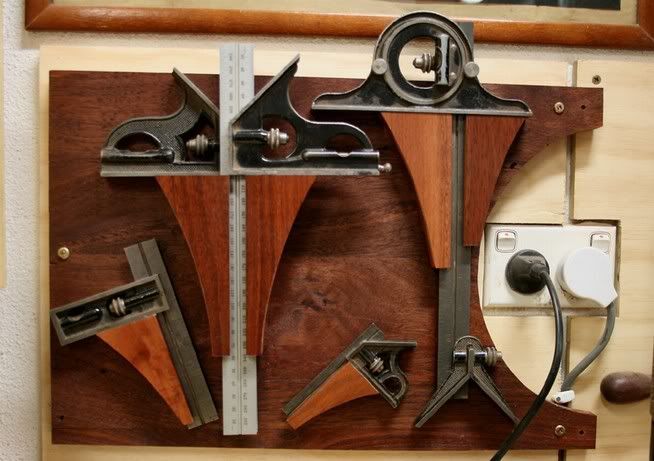
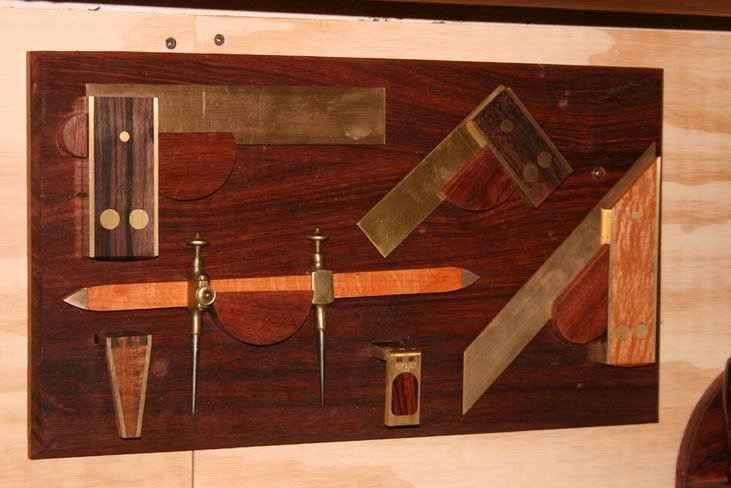
... I also hang those most-used tools on the wall (hey, its a bit of fun, anyway ... "tool art") ...


Regards from Perth

Derek

Re: Up against the wall, woodworker!

#8

Re: Question for Wiley, and a few other ideas

Wiley Horne--So. Calif.

>Good question, Derek! How do you not plane into the wall on the left??

I should explain--I'm left handed. So I am planing left to right, toward the open end of the bench. I catch panels between the end vise and front-strip dogs. If lateral support is needed, I wedge from the other side. You do remind me though, that big panels are a good reason for locating a bench in the middle of the space--no question you have much improved access.

At one time, I thought I would use that face vise for sawing joinery, like tenons and dovetails. But it turns out that I do all that stuff using the end vise; the face vise mainly gets used to hold the near end of boards being edge jointed--which proceeds from left to right also--or for odd jobs that I need to do while the end vise is occupado. Why saw joinery down at the right end? The light is better down there.

Holddowns...... A holddown shank is about 10" long. I made sure to leave room to use them about anywhere. In the photo above, the apron is 8" deep, and the drawer tops are an inch or so below that. Advice to Roy: Leave clearance for holddowns by locating drawers or storage 9 or 10 inches down. I found the apron to be a useful thing to have in that otherwise dead space below the benchtop. Because it provides both a ledge and a face for clamping stuff to.

Derek's folddown fixture is a great idea. It brings out the idea that you can come off your bench at right angles with various fixtures--a bench extension like Derek's, or a sticking board for moldings. I have used my end vise as a take-off point for some simple framing when I needed more width of bench to plane a wide panel. Yes, your bench can be extended outward!

Wiley

Re: Up against the wall, woodworker!

#9

Re: Question for Wiley, and a few other ideas

Joel

>When I worked out of my apartment my shop was smaller than 10x10 so I think I'm qualified to comment. All my tools I actually used were in a traditional toolbox on the floor or in an instrument cast in a drawer under my bench. (my blog had pictures of the tool box about a year or so ago). Excess saws, specialty planes, stuff I don't regularly used was stored in the living room in a decorative tool box. I also kept stuff in my closet. but basically for normal use a simple kit is all you need. While it's great having the displays of everything if you remove all the stuff not usually needed - you save tons of space, and more importantly less need to figure out storage. I have lost count of the number of planes I have, but actually stored in the shop were just 1/2 dozen (jointer, panel, smoother, shoulder, scrub) and maybe one or two more. everything else, the combination planes, etc were stored elsewhere because otherwise they just got in the way. same with saws, chisels.

Re: Up against the wall, woodworker!

#10

Fold downs

Pam Niedermayer, Austin, TX

>My first workshop was in a single car garage; so my first "bench" was a fold down table made from a hollow core door. I didn't have very many tools at all, just the basics, so it all worked out fine, was able to build darkroom furniture with the large pieces in the center. Great idea to extend your bench this way.

Pam

Re: Up against the wall, woodworker!

#11

I just wish....

Marv

>I just wish you'd clean up your shop once in awhile. You know, make a place for each tool and always put them back in place. Sweep the floor from time to time...jeeeez

Marv

Re: Up against the wall, woodworker!

#12

Oh sure!

Derek Cohen (in Perth, Australia)

>Hi Marv

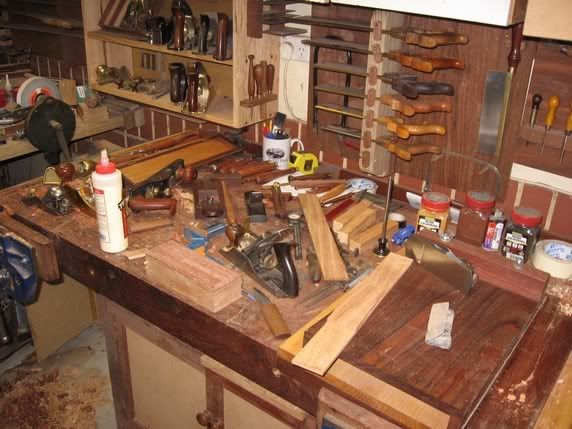
Don't confuse the newly-cleaned-shop-for-picture-posing from the garage-that-poses-as-a-workshop ...


... and the typical mess that occurs when building something as small as a box!


.. or as large as this Pine roofing beam ..


.. that I worked ..


.. into a lathe stand (the posed picture!) ..


Regards from Perth

Derek

Re: Up against the wall, woodworker!

#13

Ok, now THAT's more like it!

Marv

>

Re: Up against the wall, woodworker!

#14

Seldom work from the back of the bench

charlie belden

>While I went to great pains to have the drawers in Das Bench accessible from both the front AND the back (they slide through) - I haven't actually found the need to open them from the back of the bench. In fact, I don't recall ever actually working from the back of the bench.

Having a LONGER bench would've come in handy when working on a floor to ceiling linen cabinet. Maybe a little wider bench would help at times - but leaning over a WIDE bench is a PITA - that's what a layout and assembly bench is for.

It's handy to have some space behind the bench - say for some clamp room - but that means that tools and things can fall off the back. So you'd need enough room between the wall and the back of the bench for a small person (you do have a small kid somewhere around right?) can crawl back there to retrieve whatever fell back there off the bench top.

I've got a Veritas Twin Screw Vise on the right end of my bench. I have clamped a long board that sticks out the back for planing, though the front shoulder vise would have done the job.

It is kind of handy to be able to sweep off the bench front and back though.

Re: Up against the wall, woodworker!

#15

You don't have a choice

roninkokomo

>With that floor space you will have to be against the wall. Doesn't do any good to wonder what you are missing, you simply cannot afford the space.