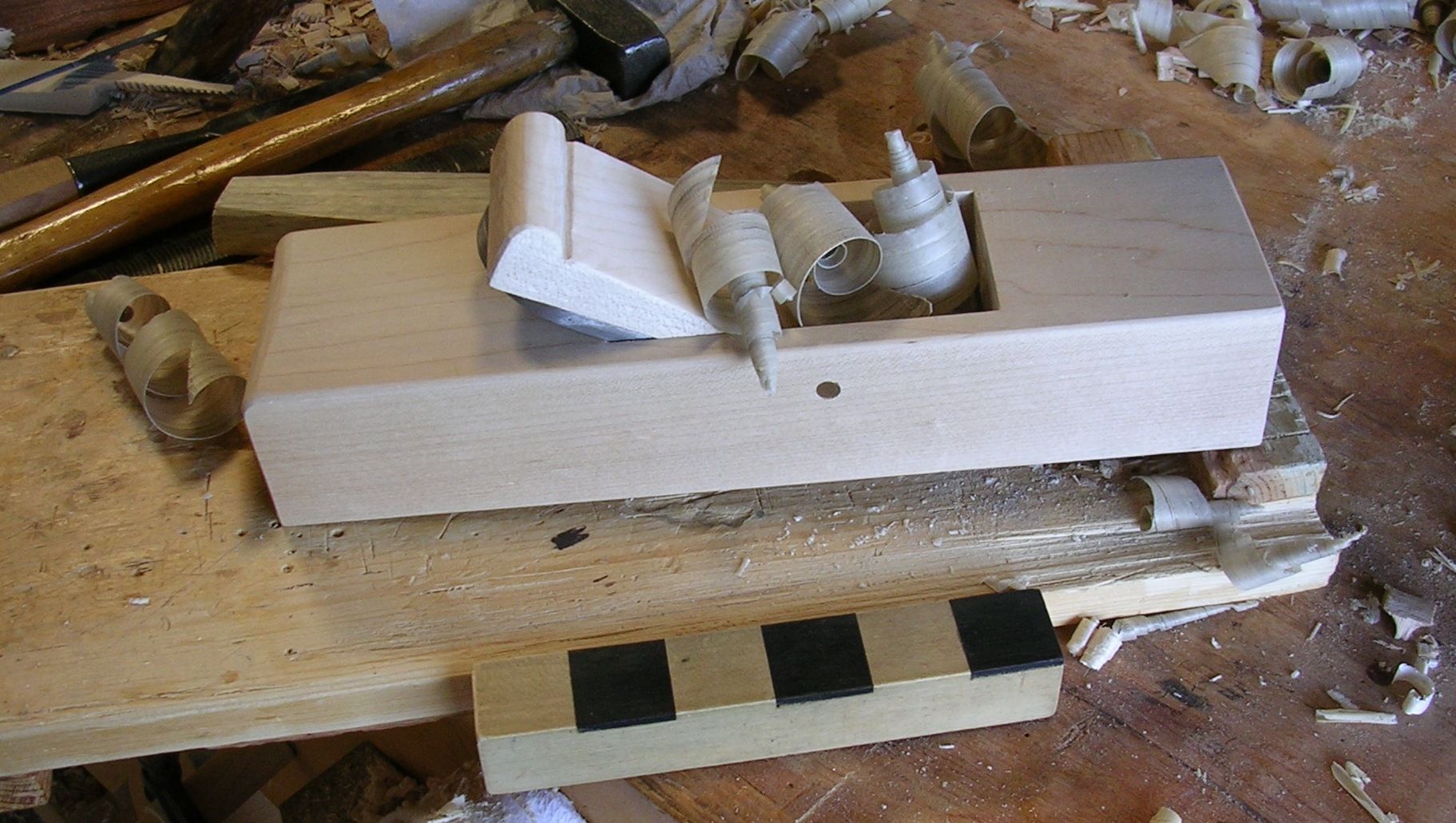
Re: Then why not call it a miter plane? [LONG]
Wiley Horne--So. Calif.
>In the absence of historian Don McConnell, I'll give you my two cents. Generically, the strike block is a miter plane, but it is a specific kind of miter plane. Also, as Paul says, the terminology has historical reference in Moxon and elsewhere, and so the term remains with us.
Whelan, in The Wooden Plane, discusses the strike block on pp. 62-63. The strike block was the last of the bevel-down wooden miter planes; there was an intermediate bevel-up wooden plane, dand then after a time the bevel-up metal miter won out. It is worth mentioning that bevel-up metal miters were in use in Germany back into the 1500's--Josef Greber shows photos of some surviving ones, with highly ornate metal work.
Wilbur asked about the distinction between mitering angles and end grain shooting. Here is what Moxon (1703) says. If you want to sing along, refer to Chris Schwarz' Moxon book, p. 25. Moxon says: "The strike block...is a plane shorter than the jointer, having its sole made exactly flat and straight, and is used for the shooting of a short joint because it is more handy than the long jointer. It is also used for framing and fitting the joints of miters and bevels, but then it is used in a different manner from other planes. For if the miter and bevel you are to fit be small, you must hold it very steady in your left hand with the sole of it upwards, and its fore-end towards your right hand, and you must hold your work in your right hand very steady. Then apply the sawn miter or sawn bevel at the end of your stuff to the fore-end of the strike-block and so thrust it hard and upright forwards until it passes over the edge of the iron. So shall the edge of the iron, with several of these thrusts continued, cut or plane off your stuff the roughness that the teeth of your saw made. But if your work be so big that you cannot well wield it in your right hand, you must set the end of your work in the bench-screw and plane upon it with a smoothing plane."
Chris Schwarz gathers from this, and I agree, that Moxon is talking about shooting short long grain joints (because the shorter plane is handier than a long jointer), and also for 'framing and fitting' miters and bevels. Moxon doesn't answer Wilbur's question, so perhaps he is including all end grain cuts--angled miters and end-squaring--in the same description. The interesting thing is that this work is done freehand. No shooting board is in sight.
Moxon shows a squarish plane, like Stephen's, with no tote. There were American models with totes, like the Dominy strike block shown in Whelan, p. 63. John Aniano made a beautiful strike block, much like the Dominy one (perhaps an intentional copy?), several months ago on these pages.
Yours truly was most pleased to receive a C&W strike block a few months ago, bedded at 40 degrees. I believe John Aniano's was low angle as well. Stephen's plane at 30 degrees should be an exceptional end grain cutter, and I would suggest that he scrape the sole just behind the mouth--with the iron fully tensioned--to eliminate the possibility of a bulge there, due to the very low angle of the plane, and the iron being pressed down upon somewhat thin support.
Wiley