Home Articles Forums Gallery Marketplace Videos

WoodCentral Forums

Knowledge You Can Build On — Est. 1998

Veritas - Innovation in Tools

Grinding Nirvana - Tormek and more

Posts

Grinding Nirvana - Tormek and more

#1

Grinding Nirvana - Tormek and more

Derek Cohen (in Perth, Australia)

>Question 1: Approximately how long does it take to establish the hollow in, say, a badly rounded 5/8" plough iron or 3/4" chisel? Secondly, can you grind continuously, or do you have to stop and cool the work, as you do with a higher speed dry grinder?

Question 2: The Tormek system has numerous attachments and gadgets. Which ones do you really need for sharpening chisels, gouges, plane blades?

The simple answer is that it is possible to grind indefinitely on a Tormek since the wet grinding system continuously cools the blade. I�d go so far as to say that it is impossible to burn an edge on the Tormek. That is what the Tormek is all about, and the best introductory statement to this machine.

Still, there is a place for other types of grinders, and there are pros and cons to everything.

I have the 10� Tormek and an 8� half-speed Carba-tec dry grinder. In Australia the latter runs at 1400 rpm. This is slower than the typical USA half-speed model, which runs at 1750 rpm. The benefit of a slower grinder is that it generates less heat than a full speed machine. For note, an 8� machine runs at approximately twice the speed of a 6� machine, as measured at the circumference. For reference, the Tormek runs at 90 rpm.

There are a few tricks to reducing heat on a dry grinder. The simplest is to dress the wheel frequently since they load up with iron filings as they grind, and these filings create friction, which create heat. The other common approach is to use a friable wheel. Even better, use a friable and coarse grit wheel, the coarser the better.

In my opinion, the �coolest� running wheel is the blue Norton 3X, and second to this is the white Norton. I use 46 grit wheels. Many dry grinders machines come standard with 60 and 120 grit wheels. These are too fine for bench chisels and likely designed for HSS lathe chisels.

Keep in mind that a grinder is the first stage of sharpening. A grinder does not produce a working edge. A blade that is well-prepared on a grinder is significantly easier to hone.

Why I use a Tormek

One of the common criticisms levelled at the Tormek is that it grinds slowly. It does. However this observation needs to be placed in context.

Firstly, it is my grinder of choice for thin blades, where the blade does not create a �heat sink� for itself. Such as Japanese chisels, with their laminated steels, and my Berg paring chisels.

Secondly, the Tormek works pretty quickly on high carbon steel. It is satisfactory on A2, but noticeably slower, and it is too slow on HSS.

I often read �tests� of grinding speed where the blade is deliberately chipped (chopped) with another blade. This is meaningless in the real world since how often does one have to re-grind a blade? In most cases, what one does is return an established bevel to a full hollow. This does not take long � perhaps a minute or two at the most with A2 and half that time with HCS. Yes, I can grind at twice this speed with a dry grinder, but the difference is insignificant in this context.

Compared with the various clones on the market, the Tormek is more heavily built. The motor is very difficult to stall - you can create very high down force on the wheel with the blade. This will increase grinding speed.

There is a third reason to use a Tormek. The 10� wheel creates a very shallow hollow. One of the arguments against using a hollow grind on a Japanese blade is that it removes needed support. As may be seen below, this is unlikely to be so.

Here is a Miyanaga ground on the 10� Tormek. It has had a little use.


So why do I also have a dry grinder?

My plan has been to develop the dry grinder for my lathe chisels. I had been looking into buying the solid Wolverine Grinding Tool Rest to replace the LV tool rest (good but lightweight). I liked the idea that it interchanged a tool rest for bench chisels and plane blades with a rest for lathe chisels. I have been freehanding all my lathe chisels to date, but I realise that, while this is fine for spindle work, I will need to improve the accuracy of complex grinds as I begin to do bowls.

The Wolverine is not available in Australia, and so I had begun to look at alternatives. The one that caught my eye was a recent product from Tormek. No, not another wet grinder ... but a tool rest for a dry grinder, the Bench Grinder Mounting Set BGM-100.

This is not really a new product, but a packaging of the universal support and adjustable mount. It comes with a manual for setting up and use.

So this is this one I bought, and have just set up, and used. There it is ...
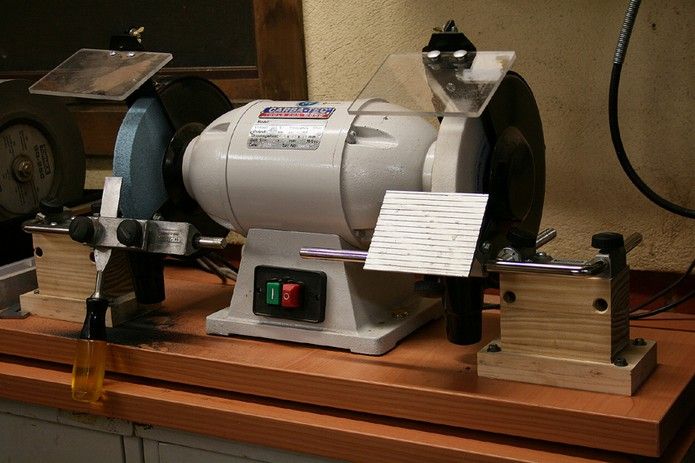

Note that I actually have just the single universal support (the tool rest) for the grinder. The second one here is borrowed from the Tormek. I do have two mounts so that a support can be swapped from one side to the other.

There are also two types of tool jigs: the chisel/plane blade holder and a flat rest. I do not, as yet, have any for lathe chisels.

The chisel/plane blade holder is terrific for grinding a perfect hollow, while the flat rest allows for freehanding a hollow or grinding a skew (or any other custom need).

What is great is that one can move between the machines (Tormek and grinder). This is facilitated by the ability to set the grinding angle exactly when using the AngleMaster:


Here is a chisel I re-ground from scratch. It took about 1 minute or less to set up the angle to 25 degrees and a couple of minutes to grind fully (note that I keep a finger on the edge of the steel to feel if it is heating up) ..


The 3X stones is cool enough to grind to the edge of the steel (the blade is an old Stanley). A few swipes on my waterstones ..


I also ground the camber for a D2 jack plane blade. To do this I used the flat rest ..


After honing ..


What I like about this set up is that it is so easy to obtain a repeatable angle, as easy as to grind a clean camber, and the promise of great flexibility and range in grinding all types of blades.

Some will say that the Tormek jig on the dry grinder is akin to training wheels on a toddler�s first bike. I will say that I have nothing to prove as I am comfortably proficient in freehanding blades on a flat rest, and the Tormek jig ROCKS! Quick to set up and a reliable grind on straight edges. I use the flat rest for curves and skews.

My Sharpening Centre

I had the opportunity to re-build the workshop at the end of 2008 as the garage/workshop was gutted in preparation for an office addition above. One of gthe first things I added was running water.

So .. here is my sharpening centre (still has doors to go on the sink cabinet) ..


To now answer the question about containing the mess that the Tormek creates, I have enclosed it in a plastic tray. The inner dimension of this one is 13� square.

... and Shapton waterstones used (1000/5000/12000) ...


Regards from Perth

Derek

Re: Grinding Nirvana - Tormek and more

#2

some nits to pick with this discussion

Bill Tindall, E.TN

>1. I don't believe that metal loading is the primary source of heat generation with a bench grinder. Heat generation is a result of dull grits. Sharp grits mill off particles of metal and these particles carry heat away from the metal (shower of sparks). Dull grits plow across the metal surface, generating enhanced frictional heating, and don't eject a hot metal particle. The best route to sharp grits is a friable abrasive particle and a soft wheel bond for these particles. The soft bond continuously renews particles at the wheel surface. Any wheel loading up with metal is way too hard of a bond to be used for tool sharpening. Personally, I use a G or H bond for tool sharpening. Many wheels sold for tool sharpening are K bond, way too hard.

2. With proper wheel selection it is reasonable to use a 120 grit wheel on a 3600 rpm grinder for sharpening, even on a thin Stanley plane iron. This is not a theoretical boast. I do it regularly.

3. The main advantage of a fine wheel and slow speed is control, not grinding coolness. Coolness results for proper wheel selection. However, once one gets used to grinding, 3600 rpm and 60 or 80 grit is acceptable. But, metal goes away rapidly with this combination so any slip up can lead to the need for considerable re-straightening of the edge.

4. If you are grinding lathe tools heat generation is irrelevant. M2 is tempered way hotter than you will get the tool during grinding.

5. A word about the 3X wheels. The unique advantage of the 3X wheel is not coolness. Even more "coolness" is obtainable with other wheel formulations, Norton 25 pink with G or H bond, for example.

The traditional friable abrasive particle grossly fractures to smaller particles in use. So to keep a supply of optimum sharp grits at the wheel surface these fractured particles need to be shed, through use of a soft wheel bond. This property leads to short wheel life in production situations. A new type of particle was developed, called ceramic or seeded gel(SG), and this particle microfractures at its surface. This type of fracture restores the particle sharpness while preserving the particle size. The result is a wheel that can be made to run cool with a harder bond and hence much longer wheel life. These "SG" wheels are priced to give some of the economy to the abrasive supplier and some to the customer. Hence, these wheels make sense for situations where the life of the softer bond wheels is unacceptable. (This isn't my situation nor most of yours)

Norton saw a marketing opportunity to lessen the cost of the SG wheels by diluting this SG abrasive with ordinary white stuff, call it 3X (for 30% SG abrasive) and sell it to the consumer market. It seems to me that if one is smitten with the SG abrasive format, or indeed have some economic justification for it, that one should buy the industrial SG wheels. If heat generation is important, then buy the softest bond SG wheel you can find. You will get significantly longer wheel life for your money, not better coolness.

5. The singular disadvantage of the Tormek was not mentioned, price. You can buy an industrial grade grinder and the best tool rest and still have money to spare compared to buying the Tormek. For that matter you cna buy a used Unisaw for the price of a Tormek. For some price is not a factor and in this case only the need to deal with water would be a disadvantage with this machine. In my experience the only disadvantage of a bench grinder with a good rest is the need to develop the skill to use it to sharpen. This skill is not more than typical for hand tool operations, and in my case, less so.

6. The Tormek excels for doing sheep shears and probably other shears too. Here the issue is enhanced control as a result of the slower rate of metal removal. .

Re: Grinding Nirvana - Tormek and more

#3

Re: some nits to pick with this discussion

Derek Cohen (in Perth, Australia)

>Hi Bill

To respond ...

Keep in mind that my post was in response to Wiley's request for info on the Tormek, and I added a few related comparisons. In no way is it a definitive text on grinders or grinder wheels - just a comment on my experience.

2. With proper wheel selection it is reasonable to use a 120 grit wheel on a 3600 rpm grinder for sharpening, even on a thin Stanley plane iron. This is not a theoretical boast. I do it regularly.


While I accept what you say, I would note that (in my opinion, based on what I hear and read) the average woodworker is not confident about using a high speed grinder and needs all the help they can get. I would not recommend a 120 grit wheel on a 3600 rpm machine to the average individual, no matter what type of wheel it was. You may be able to use it, but I know from experience how difficult these are to control. Similarly, even low grit (36 or 46) grey wheels are going to give most a lot of trouble. That does not mean that they cannot be used, or that they cannot do a decent job. I know some swear by them. But not for the majority (in my expectation).

5. The singular disadvantage of the Tormek was not mentioned, price. You can buy an industrial grade grinder and the best tool rest and still have money to spare compared to buying the Tormek. For that matter you cna buy a used Unisaw for the price of a Tormek. For some price is not a factor and in this case only the need to deal with water would be a disadvantage with this machine. In my experience the only disadvantage of a bench grinder with a good rest is the need to develop the skill to use it to sharpen. This skill is not more than typical for hand tool operations, and in my case, less so.

This is why discussions on grinding and sharpening appear so often - everyone has an opinion. :) Personally, I don't have an argument with your points. I recognise that they have validity in your context. Be thankful that no one asked about the WorkSharp!

6. The Tormek excels for doing sheep shears and probably other shears too. Here the issue is enhanced control as a result of the slower rate of metal removal.

:)

Regards from Perth

Derek

Re: Grinding Nirvana - Tormek and more

#4

I think the secret is technique not skill

Bill Tindall, E.TN

>I have less hand skills than most of you so the fact that I have no problem with over heating tools must be a result of technique. I use a large tool rest that provides a stable platform upon which to rest and slide the plane iron or chisel. I sit on a stool and have good lighting. The wheel is crowned so that only a small portion of it touches the tool. I sweep the tool right to left then left to right, with a very light touch, and being careful not to dither at the tool edges. In fact, on most passes I start the grind away from the edge. These dainty "touch and go" passes simply don't generate significant heat at the tool edge, even on a challenging Stanley plane iron.

It is all too easy to over grind the edges. In fact the only challenging issue I face in grinding is keeping the edge straight. There are some tricks to keeping the edge straight that I could describe if there is interest. I learned to keep the edge straight on a slower speed grinder and a fine grit wheel, both of which make metal go away slower(more control). Now I find the slow speed tedious and run at 3600 rpm. The fine grit does provide more control (slower) of metal removal and I thought the fine grit would aid the next step of honing. It doesn't. My next sharpening step will remove 80 grit scratches as fast as 120 grit. If I was buying a new wheel for what I do it would be 80 grit, G or H bond, and Norton Pink or equivalent.

BTW, there is a significant difference is scratch depth as a function of wheel speed. Faster results in a finer scratch.

I could not keep an edge straight with a grit coarser than 60. Metal would go away too fast to control the grind. I do use 36 grit for roughing a tool shape, like when I am making a chisel or plane iron or substantially altering the shape of a grind on a lathe tool.

Re: Grinding Nirvana - Tormek and more

#5

Re: some nits to pick with this discussion

Paul Dzioba

>I don�t own a Tormek or wet grinder but one possible advantage they might have is that they will cut down on the particles that get in the air. These particles are harmful to your lungs. I usually roll my grinder out of the shop when I use it as it throws grit everywhere.

My grinder is a 6� 3600 rpm Delta, one of their import models. I think I paid less than $50 at the Borg for it. I made a rest similar to the Lee Valley one. Their $25, 80 grit Norton wheel completes my setup. It is extremely rare for me to blue an edge. I need to be really careless. Like Bill said you need a light touch and keep your chisel or blade moving, especially at the corners.

Paul Dzioba

Re: Grinding Nirvana - Tormek and more

#6

I'm with you and Bill on this

Bruce, a MN Galoot

>I have the same setup as you, Paul, that crappy 6" Delta, except with a 120 grit white stone, which is friable as the dickens. I have yet to blue an edge, either with the crappy tool rest that came with it or with the Veritas I got some years later. It's all in the touch. I don't have any metal working skills or experience, either.

(BTW, for those lucky enough not to have the 6" Delta, the reason the grinder is crappy is that the motor is bigger than the wheel, which limits the size of what you can sharpen. IOW, I can't make a jig to sharpen planer blades.)

Bruce

Re: Grinding Nirvana - Tormek and more

#7

Tried The WorkSharp yet?

charlie belden

>India and Arkansas stones, japanese water stones, slow speed grinder, regular speed grinder, stock and Norton wheels, wolverine jigs, Tormek, Jool Tool - bought and used them all. For flat single bevel edged tools, the WorkSharp is the easiest to get quick consistent results with the minimum of fuss and mess. Set the support to one of four bevel angles and the rest is almost idiot proof. Any psa sanding disks can be used and each glass disk can have a different grit on each face. Switching a disk from one face to the other, or changing disks, is quick and easy.

Curved bevels can be handled with slotted disks with special slotted psa abbrasives - available only from WorkSharp - at a premium price of course.Here YOU are the jig - and consistent bevel angle is difficult to attain - same as with the JoolTool.

Would be nice if some of the Tormek jigs could be used on the WorkSharp.

Re: Grinding Nirvana - Tormek and more

#8

Re: Tried The WorkSharp yet?

Derek Cohen (in Perth, Australia)

>..almost idiot proof..

Hi Charlie

.. not good enough! :)

I was running a class yesterday on sharpening and demonstrating the process. Finished the hollow grind on a thin Stanley blade and moved to waterstones. Rested the hollow on a 1000 Shapton and took long freehand side swipe the full length of the stone, then switched to the 8000 Shapton and took about 3 or 4 side swipes, removed the wire edge, wiped the blade down and pronounced it finished. No one could believe that was all there was to do. I showed the group that it cut endgrain pine easily. Someone hauled out a newspaper and stated that the ultimate test would be a blade slicing effortlessly with one hand holding the paper. I held my breath since I had never tried this. It did. Whew!

Regards from Perth

Derek

Re: Grinding Nirvana - Tormek and more

#9

Re: some nits to pick with this discussion

woodburnbob

>Bill, you may appreciate my latest find from the Cascade foothills. It went on craigslist at 4AM Saturday and I owned it 2 hours later.

Lots of attachments in the cabinet besides those featured in the pic. Tooled as they say. Just took it apart, lugged pieces through house to basement, reassembled, hooked up VFD for 3-phase, had it leveled and running last night and now shopping for wheels. May put a coolant pump on it. $900. $200 more than my total Tormek bill a decade ago, too! The contrast between the principles of dressing & grinding using this approach versus Tormek or bench grinder jigs (guiding tool translation off the stone itself, and such things) are stunning if one thinks about it. Got it mostly for plain milling cutters & such, of course. Obscene overkill for WW tools, I guess, but I am going to "precision" re-grind a couple fine drawknives that are otherwise useless and experiment with dishing out some plane and chisel backs (faces). Bob


img

Re: Grinding Nirvana - Tormek and more

#10

People with skill always say it's technique.

Chuck Nickerson

>In a population, skill has a bell curve distribution. Those at the 90th percentile have little to offer those at the 10th percentile.

Chuck, who enjoys woodworking despite some 10th percentile skills.

Re: Grinding Nirvana - Tormek and more

#11

Skill ? . . .

steve mackay

>You really got my attention with your post. No, really. I've been told for years I was "talented". Always blow it off and say I'm just "clever" (wich I do belive). So, is the ten percent "talented", "gifted" or "skilled" ? Skilled might imply taught or trained in a skill. I think everyone has a talent for one thing or another. Whether it produces smoething physical/touchable or not. An artist or craftsman just winds up with something to show for their efforts. Whew ! Need to go ponder the nature of some sawdust for awhile !

Re: Grinding Nirvana - Tormek and more

#12

Skills , training and talent.

Bob Hackett

>Skills are something learned either thru reading or training,as in demonstration and then correction by a trained and proven source who knows,understands and has met the standards required(preferably repeadedly).

Mastery of those skills comes by way of practice.Some need more instruction and practice than others,that`s just the way the world works.

A good instructor can help flatten the learning curve but only practice can make it become second nature and appear to be a natural talent.

Mainely,Bob-Who speaks from experience,at both ends of the spectrum.

Re: Grinding Nirvana - Tormek and more

#13

Re: some nits to pick with this discussion

Bob Hackett

>Have you run one of these before?Was a manual included or did you source one elsewhere?

I`ve seen folks butcher alot of expensive tooling trying to figure out how these things work is why I ask.Correct operation of these rigs requires a whole different skill set and attention to detail than freehand work.

MB

Re: Grinding Nirvana - Tormek and more

#14

Great to hear from you Bob

Wiley Horne--So. Calif.

>And an amazing find! I can imagine there is still some setting up and what-not, but once you get to operating, please let us see the results. I'm very curious about the hollowing of the chisels, for example.

Wiley

Re: Grinding Nirvana - Tormek and more

#15

scott grandstaff

Re: Skills , training and talent.

scott grandstaff

>I guess its different for everybody.

I never had any fancy equipment. Never built a jig or other helpers. Never bought a fancy wheel.

Never had the slightest of instruction from anyone, except good natured encouragement, and not even always that.

If you want to learn to grind you just have to want to enough, and then buckle down and do it. You will think its impossible and you are never going to get it, but if you just keep going anyway, you'll find it.

Others have before you and more will after you.

Its not impossible, its not talent, you can't buy your way in.

You simply pay your dues.

These are full length hollows and sometimes 4 of them meeting at the middle and ending in equal shoulders.

yours Scott


img

Re: Grinding Nirvana - Tormek and more

#16

THAT`S impressive!

Bob Hackett

>What kind of grinder and rest are you using?

MB

Re: Grinding Nirvana - Tormek and more

#17

That spike . . .

steve mackay

>VERY elegant !

Re: Grinding Nirvana - Tormek and more

#18

Re: That spike . . .

Bob Hackett

>If you`re refering to the double edged blade I`ve always heard them called either a dirk or a dagger.A shorter one may qualify as a "boot knife".

I agree,fine craftsmanship to get all the lines straight and have everything meet up properly with a hollow grind that long.

The other blades are impressive as well.Thanks for posting the pic.

MB

Re: Grinding Nirvana - Tormek and more

#19

very nice grinding.

Bruce, a MN Galoot

>where do you get your heat-treating done?

Re: Grinding Nirvana - Tormek and more

#20

scott grandstaff

Re: very nice grinding.

scott grandstaff

>Thanks for the kind words guys.

The idea for the dagger came when my kids were watching the Princess Bride (as if I wasn't watching) years ago.

There was a killer prop in the hands of the herione ..............It would be a shame to damage a perfect breast.............

The grinder(s) were an ancient Baldor and a modern POS Chinese that takes about 8 seconds to come up to speed.

No jigs, I hardly even use a standard tool rest. Mostly to lean against but really, its just about totally freehand if you want a long smooth hollow grind. You need to feel for it.

I tried several jigging schemes. Nothing else I could find is worth a crap. You feel it.

First its gloves, hogging off the worst of the stock, but getting closer you do it barehand so you can feel the heat buildup.

Heat treating was done by me. Either a torch played slow (oxy/acy) or a woodstove with a roaring fire of hardwood.

Oil or --very-- hot water for the quench.

Then bake in the oven alongside a pie or cake and a 1/2? Longer than a cake takes to bake, in other words. Bout an hour and a half is my usual.

I hear peanut oil in an electric skillet works perfect too.

Polishing was done mostly with an old electric drill and small soft rubber backing pads with sandpaper, down to 220 or so.

Then a series of buffing stuff. One a big wheel I turned from particle board and then covered in leather. Hard cotton buffs and soft ones at the end.

I like my buffs mostly turning about 1000 rpm. Not the 3600 of a grinder.

Old brass scale beams for the guards, among other brass (there are what once were flare fittings on the dagger, see???),

and antique low-speed planer blades (wonderful old O-1) or used lawn mower blades make a decent knife if you get the temper just right. Mower blades are best for either practice or when you get pretty good with your heat, I have to warn ya.

Some other knifemakers, and there are plenty, are better than me in the execution. They specialize in perfect mirror polish.

My thing is looking for unique and attractive designs. Variation of design.

Nothing people can do in a knife hasn't been done somewhere, sometime. So I look for details of design and proportion that others have missed. You will never run short on design ideas this way.

Here are some large ones. The smallest has an 8" blade of 5/16" thick steel. The longest is 15"+.

yours Scott


img

Re: Grinding Nirvana - Tormek and more

#21

Don't even try here guys, Scott's...

Scott Burr in Ben Lomond CA

>A true mad man when it comes to things like this. I'm WAY outta this/his league.

I do get closer with all of his posts.

Keep 'em coming!

Re: Grinding Nirvana - Tormek and more

#22

Public apology to Bob

Bob Hackett

>After rereading my post I realized that the true tone of my post may not have come thru as I had hoped.I also realized that someone doesn`t usually lay out the money for a grinder like Bob`s unless he knows what he`s about.

It was never my intent to question Bob`s ability to correctly use the machine and if I came across that way then I humbly apologize.I have contacted Bob off line and he was very understanding.Thanks Bob.

I felt it only right to post the apology here too as this is where I chose to stick my foot in my mouth in the first place.

Mainely,Bob

Re: Grinding Nirvana - Tormek and more

#23

Re: Public apology to Bob

Marv

>Bob,

I didn't get anything negative from your post. Your questions are valid. A machine of that kind is complex and must be operated in a certain way. Without a manual, or already having knowledge of the machine's operation, it would be easy to damage the machine and or produce scrape metal while machining an expensive tool.

When I saw the picture Bob posted, I just assumed that he is familiar with the machine or he wouldn't have bought it so readily.

Bob, I commend you for offering the apology.

Marv

Re: Grinding Nirvana - Tormek and more

#24

Re: Public apology to Bob

Wiley Horne--So. Calif.

>Well said, Bob, and well done.

Woodburn Bob goes way back, perhaps further back than most of us posting on the forum. He has shown us some wonderful hand plane rehabs and reworks, infills and Stanley's I believe, which were displayed on W/C years back, and I believe Badger Pond before that. Bob's work always shows a very high order of skill and a very high order of precision. And a lot of thinking about how planes work.

He has also been generous with advice and detail over the years.

I sure hope to see further on what Bob accomplishes with this new milling machine.

It feels awkward to reintroduce to the group someone who is more senior than myself, but I wanted to do so because I was always so impressed with the work Bob showed to us.

Wiley

Re: Grinding Nirvana - Tormek and more

#25

Re: Public apology to Bob

Pam Niedermayer, Austin, TX

>I figured it was a note of caution to the rest of us bozos. :)

Pam