Home Articles Forums Gallery Marketplace Videos

WoodCentral Forums

Knowledge You Can Build On — Est. 1998

Urban Salvaged Hardwood Slabs, Milled In-House from Rare Trees. Shop Unique Walnut Stock.

Tormek question, Derek and others

Posts

Tormek question, Derek and others

#1

Tormek question, Derek and others

Wiley Horne--So. Calif.

>Hi All,

Derek recently posted about using a Tormek to establish hollow bevels in blades. I have a couple questions about Tormek.

Question 1: Approximately how long does it take to establish the hollow in, say, a badly rounded 5/8" plough iron or 3/4" chisel? Secondly, can you grind continuously, or do you have to stop and cool the work, as you do with a higher speed dry grinder?

Question 2: The Tormek system has numerous attachments and gadgets. Which ones do you really need for sharpening chisels, gouges, plane blades?

Thanks,

Wiley

Re: Tormek question, Derek and others

#2

Re: Tormek question, Derek and others

Bill Houghton, Sebastopol, CA

>I can't answer for the Tormek, but I do have the Delta vertical-wheel wet grinder, which is similar. Maybe my experience with the Delta will be helpful (or not, since it's not a Tormek...).

No, you don't have to cool the tool - the water does that quite nicely. With sustained grinding, I can get a tool warm, but that's warm as in not cold, not warm as in headed toward hot.

The Delta is slow as a teenager waking up. If I were doing major reshaping on a tool, I'd rough grind on a high speed grinder first, and finish on the Delta.

On the up side, the bevel comes out looking like a mirror, and final honing is quick.

Re: Tormek question, Derek and others

#3

Delta alternative is interesting; so is Jet and .

Wiley Horne--So. Calif.

>Bill,

Thank you. Yes, it's useful to discuss the alternatives also. Does anyone have opinions regarding Tormek vs. the clones?

Bill, can you put a metric on how long it takes a teenager to wake up? Are we talking 2 minutes or 20 minutes?

Wiley

Re: Tormek question, Derek and others

#4

Re: Tormek question, Derek and others

Alex Yeilding

>Agree with what Bill said, although this time from a Jet perspective. Still not a Tormek, but the idea is the same.

While it will never match a dry grinder for reshaping involving removing lots of metal, I will offer that if you dress the wheel first (using the diamond dresser, not the course grading stone), it makes a HUGE difference in how fast it grinds. Still, it is more of a course sharpener than a grinder. Think of it as replacing 220-1000 water stones, just faster at its job.

I think only the basic holder that comes with the tool (I believe)is all you need for straight plane blades, chisels, etc.

Re: Tormek question, Derek and others

#5

closer to 20 than 2 - usually around 10

Bill Houghton, Sebastopol, CA

>that's for the grinding.

Waking a teenager up varies, case to case. I used to have to stand at our older son's bedside and do things like recite the quatrain from the Rubaiyat about the sun striking the sultan's tower until he responded (that one REALLY irritated him, for some reason). Half an hour from first contact to standing was common.

Our younger son is more of a morning person, so five minutes usually sufficed.

Re: Tormek question, Derek and others

#6

Re: Tormek question, Derek and others *LINK*

Marv

>Wiley,

I think Leif Hanson has a Tormek, you might ask him what he thinks of it.

Marv


http://www.norsewoodsmith.com/

Re: Tormek question, Derek and others

#7

Tormek Accessories

Steve Elliott

>On the question about grinding speed for major bevel reshaping, I'd rate the Tormek as about the same as using an 80x white wheel on a dry grinder and having to be careful about not overheating. (What I'm comparing here is the two methods I've used in the last ten years.) For me both of these were really slow on the kind of blades I like, such as old laminated blades and old chisels.

As for accessories, I'd say the diamond dresser is essential because the wheel gets glazed and needs to be dressed to restore both its shape and its surface quality. In addition to the standard holder for chisels and plane blades, I like the tool rest #SVD-110. It's essentially just a standard tool rest that holds tools at a consistent angle relative to the grinding wheel. I use mine to round the corners of plane blades after I've ground them straight across using the standard blade holder.

Re: Tormek question, Derek and others

#8

Re: Tormek question, Derek and others

wilbur

>Hi Wiley,

I've got a Tormek that I mainly use for my turning tools. For my straight edged tools, I use it mainly for getting rid of nicks or resetting the bevel angle.

The jigs that come with the Tormek are fine for chisels and plane blades. I don't think they will cover skew chisels, however. There is a jig for skew chisels (SVS-50). For gouges, it depends the type of gouge you have, and how long the tool is. The short tool jig (SVS-32) is probably the most suitable for carving gouges, and the gouge jig (SVD-185) is mainly for turning gouges.

As has been mentioned already, there are some things you can do to optimize the Tormek for removing a fair amount of metal. Retruing the surface and setting the Tormek up so that the wheel is turning towards the tool is key for this sort of operation. And the water cooling allows you to grind continuously without worrying about heat buildup at all.

One time I was involved in a discussion on how slow/fast the Tormek is for restoring a damaged edge on a tool, so I timed how long it took the Tormek to repair a chisel. Here's what I posted in that discussion:

======

And to be absolutely clear, I do not think that a Tormek is faster than a dry wheel grinder by any means. I just wanted to measure how long it takes me to fix up a tool with my Tormek.

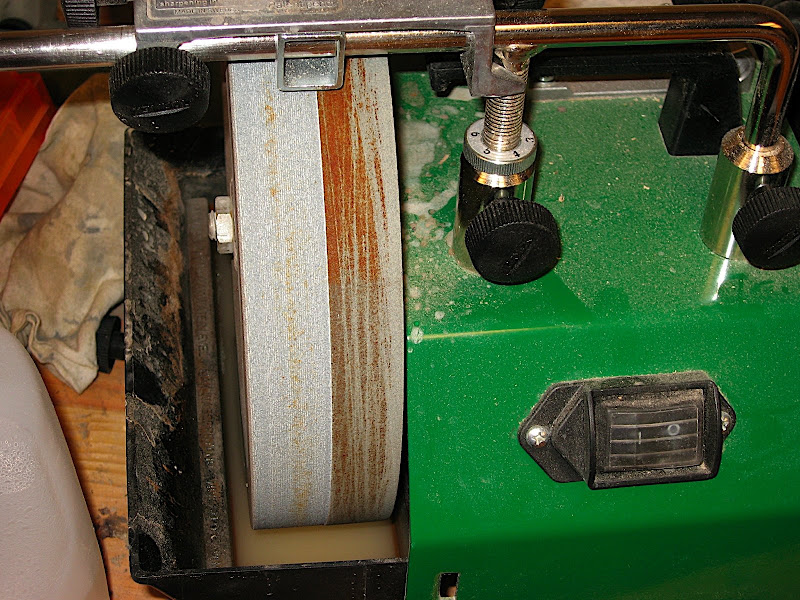
So first thing to do get the Tormek as optimized as it can be for removing larger quantities of metal. The best way I've found to do this is redress the stone wheel. This picture will show that I'm just as bad as anyone about letting the wheel get loaded up with metal as anyone, and may be a big reason why some of us are reporting results that are slower than what we would want.

The next thing to do is find a victim. I have one antique plane blade that could use refurbushing, but it doesn't really have a nick -- just a bevel angle that is much too shallow for my taste. So I decided to sacrifice a 3/4" Marples chisel. I took my chisel and banged on the concrete floor of my basement, and various other hard objects to try to get it dull.


I put the chisel into the straight edge jig (the older one), set up for a 25� bevel angle, and started grinding with the wheel turning towards the tool. I used a fair amount of pressure on the tool. This is what I got after about 2-1/2 minutes.


So all the nicks were gone after just a few minutes. Of course, one might argue that this isn't a huge amount of damage. So I decided to mess up my chisel some more. This is what I did to it:
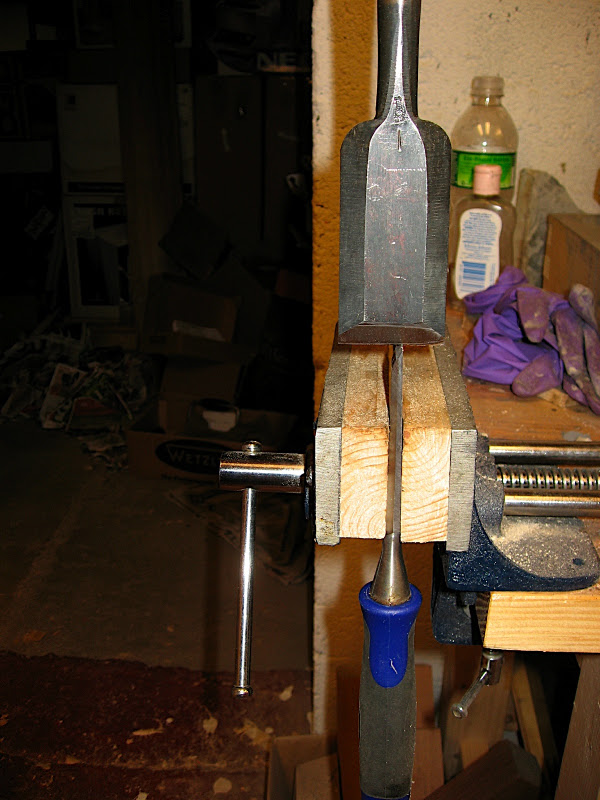

Japanese chisel vs. western chisel. This was the outcome:
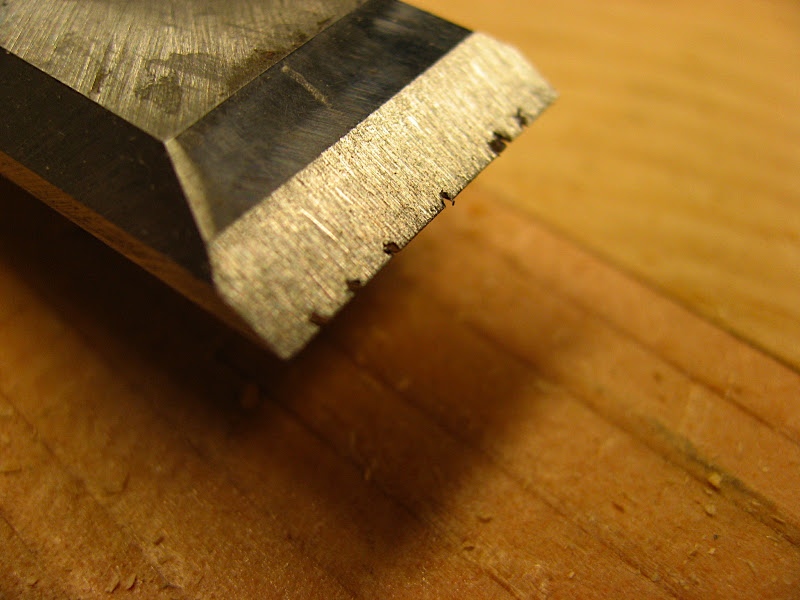

These nicks are about 1/16" deep. I set up the jig again, and this took me about 4 minutes to do:


I then used the fine stone conditioner on the wheel of the Tormek to convert it into a finer grit stone, and got this in about 30 seconds:


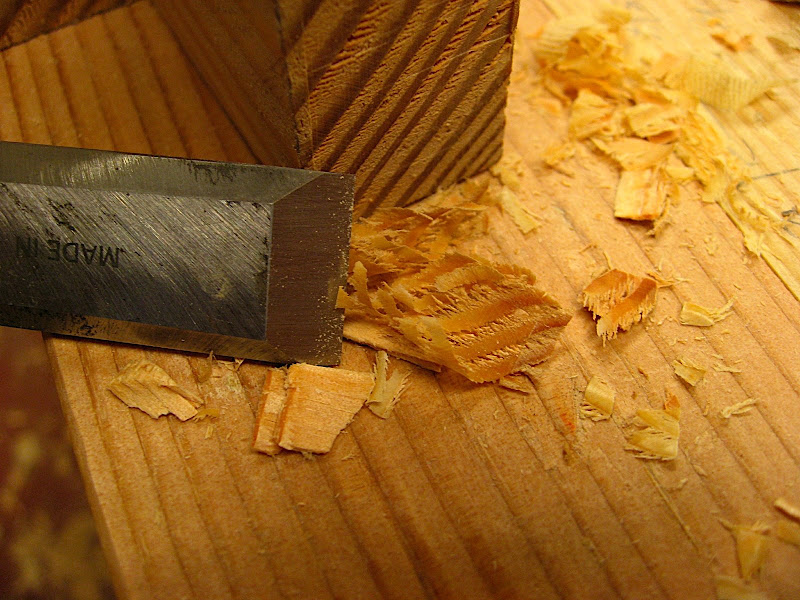
And I get endgrain shavings off of Douglas fir like this:

Now, normally I would take the tool from the rough grinding stage and go to my waterstones to hone an edge.

Again, I want to emphasize that I don't think that this is faster than using a dry wheel grinder, and as was mentioned above, you should use the tool most appropriate for the job. It just so happens that I don't have a dry wheel grinder. Some may also think that the amount of time that I spent on these operations is too long, but I can live with it.

At least we now have some numbers to discuss. 4 minutes for a 1/16" nick. Extrapolating, that's 8-10 minutes of Tormeking for a 1/8" nick.

Re: Tormek question, Derek and others

#9

Re: Tormek question, Derek and others

Joel

>I can't answer for a Tormek but with a 6" 3600 dry grinder, 60 grit wheel - if I grind to a wire edge figure 60-90 seconds. If I grind to almost a wire edge - 20-30 seconds.

I typically do the former.

Re: Tormek question, Derek and others

#10

Great information--and followup questions

Wiley Horne--So. Calif.

>Thanks to all for the excellent data and the benefit of your experience and opinions!

I have a couple of followup questions....

1. What is a realistic footprint for the Tormek?

2. How much outside the footprint does the swarf and mess get, if one is reasonably organized (not that I am, but just asking)?

Thanks again,

WIley

Re: Tormek question, Derek and others

#11

Re: Tormek Accessories

Dan Donaldson

>I have a tormek and I use one of those small diamond paddles to take off the glaze. Just a quick second with that, and it is ready to go again. I use the coarse one for this.

Re: Tormek question, Derek and others

#12

Re: closer to 20 than 2 - usually around 10

Thomas S Stockton------WebKitFormBoundaryRU4sWQOIA

>My son really hated it when I started up a chainsaw in his room one morning

Tom

Re: Tormek question, Derek and others

#13

Re: Great information--and followup questions

Richard Jones

>Wiley,

Footprint size of machine-proper is about like a cafeteria tray, which is what some folks use under them. I use a lid from a plastic tote. Mess outside of that is minimal for me, unless I am doing some really long scissors, and then it's mostly water just dripping off the far end, swarf is almost all contained within the trough.........

Rich

Re: Tormek question, Derek and others

#14

Re: Delta alternative is interesting; so is Jet an

MikeW

>"...Yes, it's useful to discuss the alternatives also. Does anyone have opinions regarding Tormek vs. the clones?"

The clones are not in the same league. The Tormek can literally run until you are tired of running it. We have. The Jet doesn't come close to the strength and performance.

However, I we prefer the Jet stones. Once the T.'s stone is used up, get the Jet stone to replace it. We can go through a stone every 4 weeks.

Whether or not this matters to someone is a peronaal consideration.

Take care, Mike

Re: Tormek question, Derek and others

#15

or

Dan Donaldson

>Dump a bucket of ice cubes in bed with him. They get up REAL fast when you do that.

Re: Tormek question, Derek and others

#16

Re: Great information--and followup questions

wilbur

>The mess isn't really an issue for the most part for chisels, plane blades, or turning tools.

If you are sharpening a long tool like scissors, a kitchen knife, or jointer blades, water sometimes does drip off the tool away from the water container and onto the Tormek. An easy way to corral this is to put a scrap piece of 1/4" thick wood under the base of the Tormek on the opposite side. The slight tilt gets almost all of the water to drip into the water container.

Re: Tormek question, Derek and others

#17

My dad would just

Bruce, a MN Galoot

>stand at the end of my bed and pat me on the bottom of my feet. It was absolutely infuriating, but it got me up.

Bruce

Re: Tormek question, Derek and others

#18

Re: Tormek question, Derek and others

John Aniano - in NJ...

>Wiley,

I have two Tormeks, one from ~2000, the other ~1985 vintage (that I retrofitted with a new motor).

How long does it take to grind a 3/4" chisel? Maybe 4-6 minutes if the bevel is bad. Wilbur gave a great description of the process and has more actual experimentation to back him up. If just touching up, it will take longer to set up the jig to hold the chisel than it will be to reestablish the bevel. Use a black magic marker to color the old bevel to help set up the jig to get the grinding wheel right on target. With the tool in the jig, just lightly touch the wheel and see where the black marker is removed and adjust the jig/blade accordingly to get the same bevel angle. Or alternatively, use their AngleMaster jig if changing the angle.

As other have said, the tool being sharpened remains cool as there is water constantly on the stone and metal. I always have the stone rotating away from me as the water tends to spill over the tool onto me and the table top if the stone is turning towards you. Can make a real mess. So, as Wilbur said, have the stone rotating towards you for fastest metal removal (and maximum water spillage). I like the idea of the cafeteria tray - I have to get me two of those...

Nice tip I got from somewhere and I'll pass along here - another use for rare-earth magnets. Using electrical tape, mount two of them to the outside vertical surface of the plastic water trough and the metal swarf in the water inside is attracted to the magnet and this tends to keep the stone cleaner.

I especially like the Tormek for oddball tool sharpening. It does a beautiful job on recreating the original hollow grind on wooden spokeshave blades. Just make up a simple wooden jig to hold the tangs and you are good to go. I've even made up a pair of wooden jigs to sharpen Felco garden pruner blades. It does a great job on these. I've also got special jigs to sharpen the bow making knives I make. Basically, if you can imagine it, take the plunge and make a simple wooden jig - I have never had an accident with the Tormek (as it revolves so slowly) and the results can be pretty amazing.

John