Re: Why?
Wiley Horne--So. Calif.
>Hi Chris,
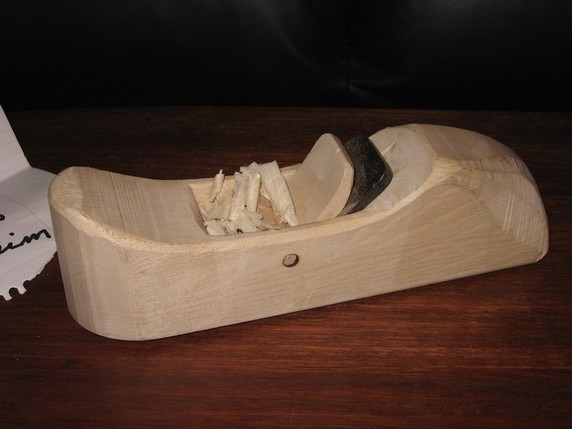
The 1-1/4" recommendation of course presumes a certain plane height, bedding length, and bedding angle. This is clear in the context provided by James Krenov in 'The Fine Art of Cabinetmaking', p. 87, as referenced by Bob Le above.
The Krenov-type plane shown in the reference uses a double-iron. What the pin is really doing is spreading the pressure on the cap iron to the blade. The cap iron is bearing on the blade at the top of the bedding, and down near the edge. In turn, the pin/wedge bear on the cap iron just below its midpoint, closer to the edge than the top of bedding, at about the 60/40 point on the cap iron.
Although the Japanese plane has its iron bedded quite differently, the pin on a Japanese plane (except for single blade planes) also distributes the pressure of the chipbreaker (subblade). The subblade on these planes does not actually secure the main blade, but rather pretensions the blade edge against heavy cuts. The subblade bears on the main blade at the top of the bedding, and very near the blade edge. I'm looking at a Mosaku/Inomoto plane where the pin is almost exactly at the midpoint of the subblade.
In each of these cases, the pin is distributing pressure onto the main blade, but also is positioned so that the blade will back out properly under hammer taps and stay in place otherwise--surely there is more experience than science to this latter point.
Wiley