Home Articles Forums Gallery Marketplace Videos

WoodCentral Forums

Knowledge You Can Build On — Est. 1998

Premium Live Edge Slabs, Hand-Selected in the Berkshires. Shop Unique Hardwood Pieces.

Shooting board comparison for Bugbear

Posts

Shooting board comparison for Bugbear

#1

Shooting board comparison for Bugbear

Derek Cohen (in Perth, Australia)

>I was about to use the #51/52 today when I had this idea to compare it with my ramped shooting board, both using the #51. I thought that this would throw some light on the effect of a ramp in shooting end grain.

One of the observations I have posted before, in comparing a ramped with a flat shooting board, was that the ramped board appeared to reduced the impact shock of the plane. The slight skew imparted by the ramped board is too low to be compared with the skewed blade of a #51 shooting board plane, but it was enough to enable the blade to enter the wood with a slight slicing action, and that this was significant.

BB suggested that I try the #51 on the ramped board. I thought about this today. Would the skew of the #51 neutralise the influence of the ramp?

First I compared the ramped board with the #52 Chute Board, both using the #51, on Jarrah end grain. Here is the ramped board ...


A close up of the shavings ...


Then I repeated this on the #52 ...


I also used Radiata Pine ('orrible stuff) on both boards ...


I went back-and-forth several times.

My impression was that the #51 on the ramped board felt smoother than the #51 on the #52 chute board. Both boards produced excellent surfaces. The difference was simply that the ramped board jarred less than the flat #52.

Regards from Perth

Derek
Re: Shooting board comparison for Bugbear

#2

Shooting board comparison � steeper bevels?

Ian (in Sydney, Australia)

>Derek

this is as good a time and place as any ...

I've been meaning to ask/experiment if changing the blade's bevel angle will make a difference to the impact shock (and edge life) when shooting tough end grain (lately Tassie Oak).

I've one of Michael Conner's ramped boards which I use with an iron LN #9

Have you experimented with the effect of a steeper bevel angle when shooting?

regards from this side of the wide brown land

Ian

Re: Shooting board comparison for Bugbear

#3

Re: Shooting board comparison � steeper bevels?

Derek Cohen (in Perth, Australia)

>Hi Ian

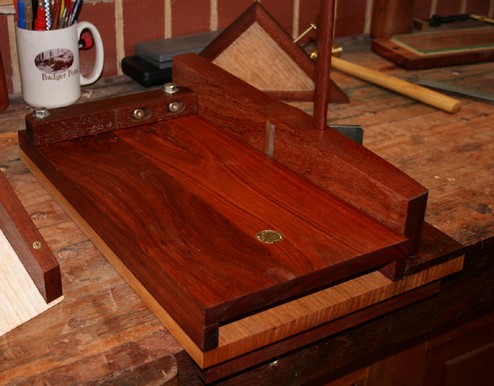
Yes I have used steeper bevels. I used to use a HNT Gordon Trying plane (60 degree bed). Here is a board I made for a client who specified using this very plane ..


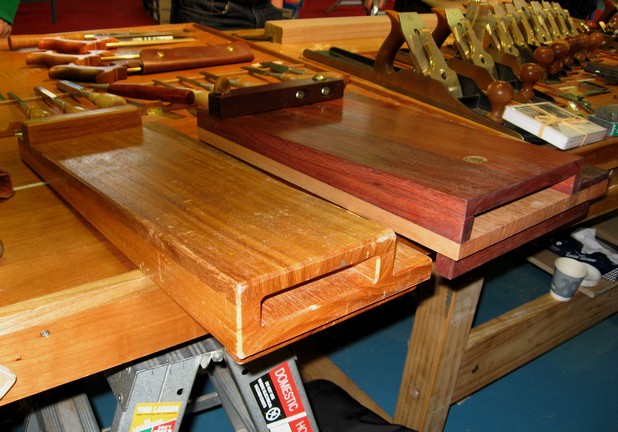
And here is Michael Connor's shooting board alongside a similar one for comparison (taken last year on the LN booth at the Perth Wood Show)...


The difference between a low cutting and high cutting angle is well known - the LA produces a smoother finish and is the action itself is softer and less effort. With a sharp blade, the HNT Gordon does an acceptable job. A LA Jack (with low cutting angle) is the preferred plane.

Regards from Perth

Derek

Re: Shooting board comparison for Bugbear

#4

Dumb Question, Perhaps

Hank Knight

>In my thinking about ramped shooting boards, it has occurred to me that the work might be more stable during the cut if the ramp was reversed, ascending to the fence rather than descending to it. With the fence at the bottom of the ramp, the plane blade (assuming a square blade) contacts the workpiece at the near bottom corner and tends to push it up, off the surface of the shooting board. If the slope of the ramp were reversed, the blade would contact the workpiece at the top near corner, pushing it down against the surface of the shooting board during the cut. This configuration would appear to give you a more stable workpiece. Does the at make sense? If so, why are ramped shooting boards built with the ramp sloping down from the near side to the fence?

BTW, I agree with you, Derek, about the slicing action afforded by the ramp. I think it is a worthwhile consideration in selecting a shooting board design.

Hank

Re: Shooting board comparison for Bugbear

#5

Re: Shooting board comparison for Bugbear

Wiley Horne--So. Calif.

>Derek,

Excellent post! Thank you.

Would you clarify the angles at play here? There is the angle of the skewed #51--that is, the skew relative to the edge of the plane sole. Call that angle A. Then there is the angle of the ramp, call that angle B. Now when the #51 is used with the #52 shooting board, then the wood is struck with the blade at A degrees off vertical. But when the #51 plane is used with the ramped shooting board, is the blade striking the work at A-B off vertical, with the two angles offsetting? Or A+B, with the angles additive? And what are the two angles, A and B?

It appears to me that A and B are offsetting, so that the skewed plane on the ramp is striking the work at A-B, and that that is the point of the test, but I may be seeing things backward. Also, if the physical setup were such that the skew was additive to the ramp angle, would that make for even better slicing?

Hank is asking a related question, so you may want to combine the answers. Also, if my characterization of the physical setup is not helpful, please use your own (<:).

Again, this is excellent!

Wiley

Re: Shooting board comparison for Bugbear

#6

and what about...

Bill Tindall, E.TN

>the coopered affair I spy to the side? What is that to be?

Re: Shooting board comparison for Bugbear

#7

Thanks Derek...

Scott Burr in Ben Lomond CA

>Do you have info on your website about bringing your 51 back to life?

I have one a lot like yours. I've got the frog welded back together. Re-Japanned her now I need a blade and maybe a chip breaker. Any tips from the wonder down under?

Thanks!

Re: Shooting board comparison for Bugbear

#8

Re: Dumb Question, Perhaps

Derek Cohen (in Perth, Australia)

>In my thinking about ramped shooting boards, it has occurred to me that the work might be more stable during the cut if the ramp was reversed, ascending to the fence rather than descending to it. With the fence at the bottom of the ramp, the plane blade (assuming a square blade) contacts the workpiece at the near bottom corner and tends to push it up, off the surface of the shooting board. If the slope of the ramp were reversed, the blade would contact the workpiece at the top near corner, pushing it down against the surface of the shooting board during the cut. This configuration would appear to give you a more stable workpiece. Does the at make sense? If so, why are ramped shooting boards built with the ramp sloping down from the near side to the fence?

Hi Hank

Not so dumb question. My answer is just based on my experience and logic (in opther words, a dumb answer).

One of the differences between a flat and a ramped shooting board is as I outlined, the ramped board is less jarring. The other difference is that a shooting board that captures the plane, such as the #52, is easier to wield as you are able to remove from the equation the effort required in holding the plane steady. With the average shooting board, the plane is steadied against the side of the runway. However, since the action of the other hand (the non-planning hand) is to feed/push the board into the plane, there is much effort expended on pushing the plane against the runway. All this is self-evident when you use a shooting board.

A downward facing ramp makes it easier to clamp the board to the fence. Holding work on a flat board requires a little more effort than when holding work on a ramped board.

When the plane strikes the work on a ramped shooting board it feels as if work is pushed against the fence; it does not feel as if the work was being lifted (as you imply). Perhaps the ease of holding the work down outweighs (pun intended) the benefit of a plane directed downward??

I think we need a mechanical engineer!

Regards from Perth

Derek

Re: Shooting board comparison for Bugbear

#9

Re: and what about...

Derek Cohen (in Perth, Australia)

>Hi Bill

A couple of months ago I made a coopered box as part of a birthday present for my brother (the remainder of the gift was a letter opener, which I also made). My wife, Lynndy, liked it so much that she put in an order for a box with a coopered top (but different to my brothers'). So there I am at it again, doing a bit here-and-there while I wait for glue to dry on panels for a cabinet.

My brother's box ..


http://www.finewoodworking.com/item/13415/letter-knife

http://www.finewoodworking.com/item/13200/coopering-a-box-lid

Regards from Perth

Derek

Re: Shooting board comparison for Bugbear

#11

wouldn't the angle of blade (skew) help?

Alan DuBoff

>Derek,

If you lift the trailing edge of the ramp, as you have it, the blade will be skewed at an angle which will be pushing the work downward, keeping it solid as the plane cuts.

Wouldn't reversing the ramp cause lift?

As you can see, your Stanley is skewed the same way and ramped board would skew a non-skewed plane. If you reversed the ramp as Hank suggested, wouldn't it skew the blade in the opposite way and cause the work to lift?

Just an observation.

Cheers,

Alan

Re: Shooting board comparison for Bugbear

#12

Re: Shooting board comparison for Bugbear

Derek Cohen (in Perth, Australia)

>Hi Wiley

I will try and respond directly.

Would you clarify the angles at play here? There is the angle of the skewed #51--that is, the skew relative to the edge of the plane sole. Call that angle A.

The #51 is angled at 20 degrees.

Then there is the angle of the ramp, call that angle B.

The angle of the ramp is 5 degrees.

Now when the #51 is used with the #52 shooting board, then the wood is struck with the blade at A degrees off vertical. But when the #51 plane is used with the ramped shooting board, is the blade striking the work at A-B off vertical, with the two angles offsetting? Or A+B, with the angles additive? And what are the two angles, A and B?

The ramped board (5 degrees) plus the #51 (20 degrees) has a combined skew of 25 degrees.

It appears to me that A and B are offsetting, so that the skewed plane on the ramp is striking the work at A-B, and that that is the point of the test, but I may be seeing things backward. Also, if the physical setup were such that the skew was additive to the ramp angle, would that make for even better slicing?

Keep in mind that I had already established that the ramped board with a straight LA blade (as in a LV LA Jack) has noticably smoother entry to the wood than a flat shooting board.

Here, the extra 5 degrees of the ramped board is not much in the total skew (of ramp plus #51), yet it feels significant in action.

I returned to the workshop to shoot a few edges with a straight blade (in the LAJ). This is how it appears ..

1. A ramped shooting board is smoother than a flat shooting board.

2. A skewed cut (#51) is smoother than a straight blade (LAJ).

3. This is additive: a ramped board plus skewed blade is the best of the lot!

Regards from Perth

Derek

Re: Shooting board comparison for Bugbear

#13

Re: wouldn't the angle of blade (skew) help?

Derek Cohen (in Perth, Australia)

>Hi Alan

That was my thought as well .... then my spatial difficulties kicked in and I became totally confused! :)

Regards from Perth

Derek

Re: Shooting board comparison for Bugbear

#15

thanks Derek

Ian (in Sydney, Australia)

>

Re: Shooting board comparison for Bugbear

#16

Not a dumb question

Marv

>If the plane iron is not skewed, it will tend to lift the work piece, but not much because the work piece is not lifted very much in the back and the non-skewed iron would have some slicing effect.

If the iron is skewed so the high corner touches the wood first and if the iron is skewed more than the work piece is lifted, it will tend to force the work piece downward but would have more slicing action if the work piece was not lifted.

If the iron is skewed so the bottom corner touches first, it will tend to lift the work piece but less so if the work piece was not lifted.

The main advantage to raising the work piece is to aid in holding it against the fence.

The shooting board could be improved with a positive clamping device that holds the work piece in place so both hands could control the plane.

Marv

Re: Shooting board comparison for Bugbear

#17

Re: wouldn't the angle of blade (skew) help?

Hank Knight

>Alan,

As I visualize it, the effective skew angle with a rear-high ramp would cause the blade to first strike the work at the bottom near corner, which would tend to push it up, off the ramp. It wouild be the same effect as shooting with a skewed blade on a horozontal ramp where the leading edge of the blade was at the bottom and the trailing edge at the top. The blade would strike the work at the near bottom corner, lifting it from the ramp. If the skew of the blade were reversed, with the leading edge on top, the blade would first strike the near top corner of the work, forcing it down onto the ramp. Marv got it right in the following post. Think of how the blades are configured on a Lion Miter Trimmer. They are skewed so the top corner of the work is struck first, forcing it down against the work surface and against the fence as it's cut.

As a practical matter, the lifting force is probably so slight one does not notice it, and it's an easy trade-off for the slicing action Derek spoke of. I wonder if reversing the slope of the ramp wouldn't give you the best of both worlds.

Hank

Re: Shooting board comparison for Bugbear

#18

Re: wouldn't the angle of blade (skew) help?

Alan DuBoff

>Hank said:

"As I visualize it, the effective skew angle with a rear-high ramp would cause the blade to first strike the work at the bottom near corner"

I don't see it like that at all, as I visualize it the top of the plane is being pivoted forward and hitting the top near corner, and in turn that force is being applied to the material and down into the bottom fence which is securing the piece???

Maybe I am picturing a different board. I thought the ones that Derek made were rear-high, so it would skew the blade in a similar fashion to how the Stanley 51/52.

By making the ramp rear-low (the opposite as to how Derek has his), the blade would skew the opposite direction, and catch the lower near corner, and more so because of the angle of the cut would apply force in the upward direction. If the board is secure, no problem, but if your holding it with your hands then all bets off as human factor comes into play, but it seems to me that the force could possibly pop the work out of the shooting board if it lifted over the lower fence/stop (not sure of the terminology for the shooting board at the moment, that is a fence on a miter AFAIK).

Am I visualizing something else?

Cheers,

Alan

Re: Shooting board comparison for Bugbear

#19

Re: wouldn't the angle of blade (skew) help?

Alan DuBoff

>Hank,

Maybe my bad, I see in another thread that the material may be lifted in the rear also, I thought only the plane/ramp was lifted.

Now I'm confused, I need to find a pic of Derek's shooting boards with the wegies on them...:-)

FWIW, my shooting board doesn't have wegies...;-)

Cheers,

Alan

Re: Shooting board comparison for Bugbear

#20

I have to say I agree completely with you Hank!

Alan DuBoff

>Hank,

I found the pic of Derek's shooting boards, here's one I found on his web site.


I don't understand how this could possible force the work into the stop either. This seems to be raised on the wrong end, I agree.

This is not to say it won't work, because Derek uses it all the time so it must work. It just doesn't seem to make sense, in regards to the angles and/or force that is being applied. Like I said, it must work...:-/

Cheers,

Alan

Re: Shooting board comparison for Bugbear

#21

Re: I have to say I agree completely with you Hank

Derek Cohen (in Perth, Australia)

>Fir reference, the shootong board on the left is by Michael Connor (who is well known and respected both as a furniture maker abd manufacturer of shooting boards), while the one one the right is one of mine (I made a few for customers last year).

The photo was taken at the Perth Wood Show in 2008 at the LN stand.


Both boards are identical in their slope for the top, at 4 degrees (my original board is 5 degrees).

Several years ago Michael's board was the inspiration for my own first efforts, having used Terry Gordon's. By comparison, mine is wider and the fence has fine adjustability. Michael's fence is fixed.

Regards from Perth

Derek

Re: Shooting board comparison for Bugbear

#23

Thanks a lot!

Wiley Horne--So. Calif.

>That covers all the bases.

An excellent experiment! Very heads-up by Bugbear also.

Wiley

Re: Shooting board comparison for Bugbear

#24

But I have to wonder...

Alan DuBoff

>Derek,

It makes me wonder, as I mentioned to Hank, I figure you use it all the time and it must work...but have you tried the ramp the opposite way? What are the results? It must be wrong, or others would do them that way, so what gives?

There is obviously not enough force in the upward direction to make a difference in the cut, but why does it make the cut perform better with the ramp? My guess is that it has to be the skew, is that part of it?

Cheers,

Alan