Infills verses LNs and LVs?
Derek Cohen (in Perth, Australia)
>Do you think there is something unique in the way an infill holds a plane iron that give it an advantage over a wooden plane or modern LV of LN planes?
Hi Tom
There is a disadvantage from the side of an infill because it has two different materials, steel and wood. In a new infill it is expected that the bed infill lines up with the steel mouth support. However over time the infill may shrink, or expand in a humid workshop. Of course, this is why it is important to choose your infill wood carefully.
Holtey has for some time been reinforcing the beds of his infills with brass rods that run through them to the sole. The blade actually rests on the rods, although it appears to rest on the wood of the infill.

Holtey states frankly that he considers infills less reliable than metal-bedded planes. Hence the reason for building his #98 and #982.
The new #982 ...
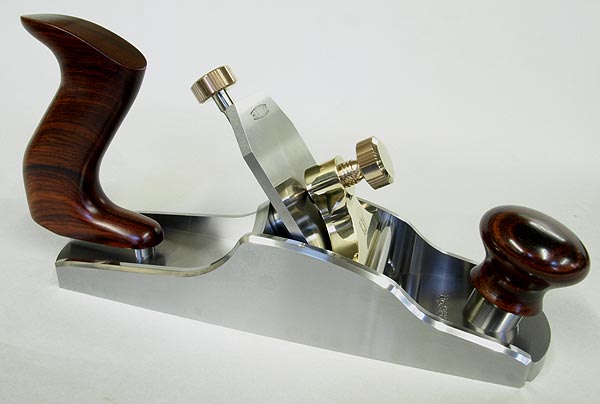
In my opinion the differences between well-made planes - be they infill, LV or LN - is not readily apparent under "average" conditions. Two factors are noted among the better planes - and again I do not see this due to the type of bedding (that is just one of several factors that determines the stability of the blade): the first is that more difficult woods (e.g. reversing grain, hardness) sorts the men from the boys; and secondly, the better planes cut better when the blades are blunt (as Joel at TFWW notes, "they just feel harder to push").
The latter factor is one why BU planes and selected BD planes do so well - the higher the cutting angle (e.g. around 60 degrees - hence my decision to go for this in the Brese Small Smoother), the better they perform on gnarly woods. Again this is not the only factor that determines performance, but it is easiest to demonstrate.
Regards from Perth
Derek


