We value your privacy.
We use cookies to enhance your browsing experience, analyse site traffic, and personalise content.
By clicking “Accept all”, you consent to our use of cookies. You can also choose
“Essential only” or learn more.
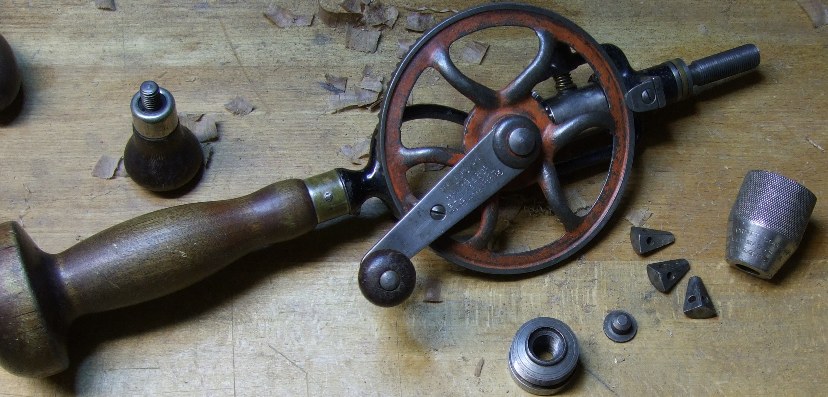
I got a Goodell-Pratt hand drill from CA, so far away the seller doesn't reply to my moanings. The problem is the missing spring of the chuck. I'm not sure if there isn't another missing part. Specifiations of the model are:
Goodell-Pratt 15" hand drill. The chuck has pat. date of Aug.13,1895 and the crank handle has pat. date of Mar.31,1896
So if someone has information on the spring(s), form and size or alike or can point me to a resource, maybe I could make it work again.
If I'm not mistaken, there are three small coil compression springs used in that chuck. The springs fit into the small holes on each side of each jaw. The hole will dictate the diameter of the spring. The length of the spring needs to be long enough to press the jaws against the inside wall of the shell that they slide up and down in, but not too long or the jaws won't close down tight to each other. If you want to make your own springs, you will need some piano wire. The wire gauge is important so you will get enough spring action but not so big that the springs won't compress enough, again, to close completely. It might require some trial and error to make what you need.
If you are lucky, you might find the diameter spring at your local hardware store and then just cut them to the proper length. You can also do some Googling and do a search on coil springs and hopefully get lucky there. I would try this first.
>If you've got some click-type ball point pens around (in the U.S., almost every household seems to have some in a cup near the telephone), you might take one apart. Occasionally, the little spring on the end of the ink cartridge that pushes the cartridge back will be the right size, though, often, even these are too big.
They're LITTLE springs. If you can find a business that repairs old mechanical office equipment, you might inquire there too - typewriters and all that used to use some very small springs, but, in the U.S., there are precious few places that still repair these machines.
The little round thing to the left of the chuck jaws goes under the jaws and serves as a buffer between the jaws and the spindle on which the chuck is threaded. You'll have to examine it and think about how it will work assembled to decide whether the "bump" on this piece faces the jaws or (more likely) the spindle.
Assembly is loads of fun - you're juggling three jaws, three little springs, the center piece, and the two outer parts of the chuck. I read somewhere a technique for the assembly, but can't now remember it...it wants three or four hands, with fingers about the size of monkey fingers.
>All that Bill says I found true except the part about reassembly. It was harder than he says!. But, I did finally get my favorite drill to work again. Again, the length and springyness of the springs is critical.
>There's an easy method to use to aid in assembling one of those little chucks....
Cut a 2 or 3 inch piece of cardboard, like what you find on the back of a note pad.
Assemble the three jaws with the springs in the holes onto the piece of cardboard.
Push the chuck housing down over the three jaws until it sets down onto the cardboard, then while holding the housing against the cardboard, pick the whole thing up and turn it over. Now remove the cardboard and the jaws and springs will not fall out.
>Ball point pen springs. There are also some on line sources. Beware they have minimum orders and such. This place is cool because they have several calculators to help with out destroying too many brain cells.
>I have that exact drill and mine came without the springs as well. Someone on Wood Central posted the solution that worked for me at the time. Ball point pen springs are too large. The perfect size are the ones in the cheap plastic mechanical pencils.
I found three of these in the supply cupboard at work and literally broke them in half to get at the springs. The springs were a perfect fit just as they were. These pencils sell for a dollar or two in low end retail stores.
>The holes are probably intersecting each other, but the springs won't go all the way through. The holes intersect because they were drilled to their maximum depth to facilitate as long a spring as possible.
Nonetheless the intersecting holes help to get the springs fixed. The springs are hooked by themselves.
The process is straightforward too. I measured the outside perimeter, divided by three and got the length of one spring. I tried that out, it didn't work, so I snapped off two coils on each spring and repeated the process until they fit snugly. A bit of multi purpose grease held the "little round thing with the bump" in situ as I screwed the chuck together again. The bump is directed toward the thread of the drill.