Home Articles Forums Gallery Marketplace Videos

WoodCentral Forums

Knowledge You Can Build On — Est. 1998

Precision you can feel — woodworking perfected with Lee Valley

Letting the benchtop settle in

Posts

Letting the benchtop settle in

#1

Letting the benchtop settle in

wilbur

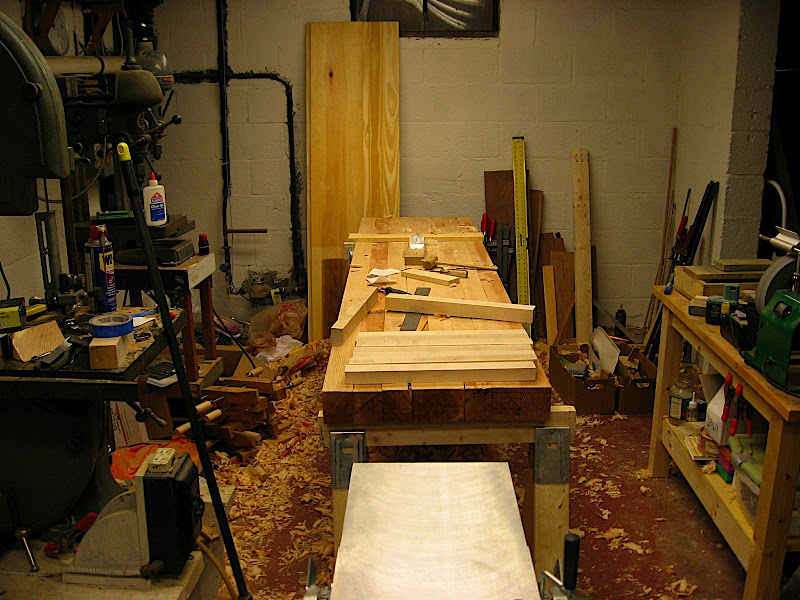
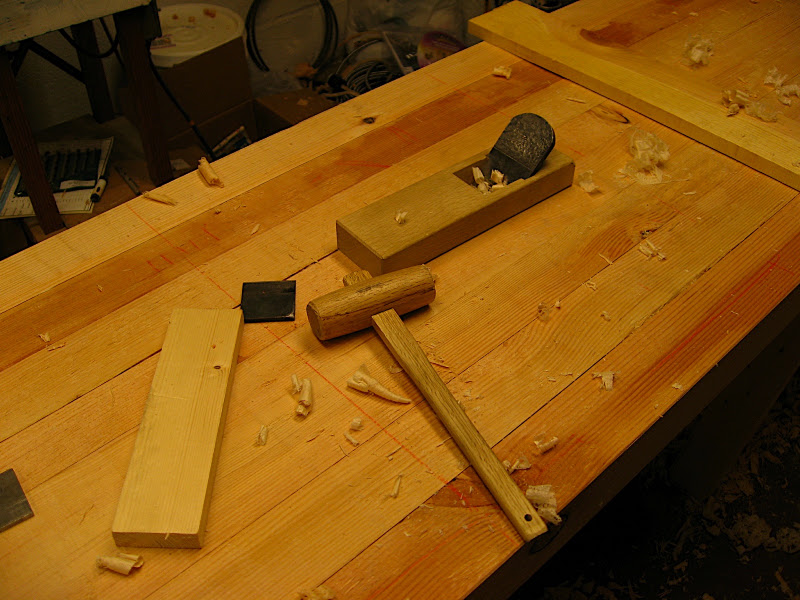
>Despite all the sage advice I've gotten here, :@) I finished flattening the bottom to the degree that I wanted to. Again, it went much more quickly than I expected. Only 30 minutes with a jointer plane, and the bottom of the benchtop was flattened to the point that I couldn't identify any twist or wind with winding sticks. (Actually, I used a four foot level at one end, and held up a yardstick at the other.)

So here's what it looks like relative to the rest of my workshop:

And a better view of the surface. Remember, this will be the bottom side of my bench:

I'm going to let this top sit like this for a little bit, while I figure out what to do about the final size and location. Originally, I wanted to have this bench up against the far wall in the first picture, but I would have to shorten it a fair amount. In its present position in the middle of the room, I lose space, but I could keep most of the length. I might trim about 6" off to make it easier to get around the bandsaw. Or I could reconfigure the base of the bandsaw to move it a little closer to the wall, which will give me more room around the bench. Another thing in favor of the bench's current position is that the lighting is really good here.

This will also give me a chance to see how much this top is going to move, left to its own devices. In the meantime, I can use this surface to make the legs and stretchers.

Thanks for reading along so far! I'll post more when I really get going on the base.

Re: Letting the benchtop settle in

#2

Re: Letting the benchtop settle in

Stephen Shepherd in the State of Deseret

>Wilbur,

Good work on the bottom, you will be able to reverse the top in the future if necessary. You should let it sit for at least a month before you put any finish on the bench, if you choose. Also if you finish the top, finish the bottom, again to maintain the balance.

I would flip the bench top over every other day to ensure equal exposure so it can adjust to its space.

Stephen

Re: Letting the benchtop settle in

#3

I second Stephen's advice...

Ellis Walentine, Host

>... to flip the top over on a regular basis to try to keep moisture transfer equal on both faces. Another trick that has worked for me is to suspend a piece of cardboard over the up face with an inch or so of air space between it and the bench surface. If you want, you can monitor some control pieces from the same board of flat-sawn lumber, one reversed daily, one covered by cardboard or plywood, and one left undisturbed and uncovered. Might be an enlightening experiment.

Ellis

Re: Letting the benchtop settle in

#4

Its on horses....

Bill Tindall, E.TN

>Why would it need to be turned every XX days? Sitting on horses it has equal air access to all parts? You will have Wilbur in the hospital with a hernia (it looks heavy)

Re: Letting the benchtop settle in

#5

Fuss Budgets

Greg B�tit, Vergennes VT

>I can't believe this thread is about a four inch thick work bench top. If this were a Queen Anne piecrust table, or even a regular 1" table top, OK. Four Inches of previously dried wood is what you're talking about here lads. Am I the only one who thinks this amount of concern about even treatment of top and bottom is ridiculous?

greg

Re: Letting the benchtop settle in

#6

Re: Fuss Budgets

Marv....... Northern California Lake Co.

>Hi Greg,

The main concern as I see it with a structure such as Wilbur's bench top is warpage in the form of twisting. Lots of time can be spent planing the top flat to a close tolerance, but all of that would be for naught if the top decides to turn into an airplane prop. This can also be a concern over time if the bench is setting on an uneven floor. Even a metal cutting lathe bed will warp if it isn't properly supported.

If I were Wilbur and if he hasn't already done it, I would make sure those two sawhorses are level.

Marv

Re: Letting the benchtop settle in

#7

Re: Fuss Budgets

Dave Anderson NH

>Hi Greg, I disagree with you. I think Wilbur is being prudent. I built a new bench last fall with a final top thickness of 3.125" from white ash dried to between 8-12% moisture content depending on where I measured. I only flattened the top to remove wind and twist (there was very little). Now 3 months later, the top has dried a bit more due to the woodstove and the 25-30% RH in my basement shop. At one end of the top there is a small check type crack, and it's not on a glue line either. I did put some finish on the top and bottom for temporary use, but I still haven't done the final super smooth finishing of the top. The final surfacing of the top will probably occur in a month or two. I do realize that no matter what I or anyone else does to their benchtop, it will always move around a bit .... it's wood. Still, I think a rest period for further aclimatization is a good idea.

Re: Letting the benchtop settle in

#8

Re: Fuss Budgets

ThomD

>I agree with Greg largely. Warpage isn't that big a deal, and it is more likely if the material isn't secured to anything than if it is. For instance if you are slow about getting a top attached to the base it may pottatoe chip on you over time where it would have been fine had it been secured. With large pieces there tends to be greater stability. If the top has good grain, it is very unlikely it will awarp there has to be internal stresses. Since it is laminated anyway, and should in agregate be like a big piece of quarter sawn wood it should be fine. Years and years of drying big pieces of wood, I normally saw it to 2-3" tells ne that unless it encloses the pith it rarely warps much.

If it is wet though it can split with uneven drying (though this was KD?) In that case I would store it on edge, as long as there aren't little children around it could crush. Put a handscrew over one edge and clamp that to your tressle or horse.

Lathe beds will twist as you say. I think I did not put enough care into positioning and leveling my bench in the past. Dealing with machines has taught me the eror of my ways. Most living areas are level, sure foundations shift and all that, but both garages and basements are often unlevel for drainage, and the floating of the cement floor tends to be higher around the edges we put our benches on. Some floor leveling thinset or shimming is a good idea. The edge of my garage looks perfectly flat but there is 1/2" of slope in the first 16" away from the wall. There is a company that makes a product that will float the floor dead level and chemical proof. It's too much for me, but it is accurate enough that one can make car frame repairs off the surface like a giant surface plate.

Re: Letting the benchtop settle in

#9

Most definitely

roninkokomo

>One could argue that in a handtool woodworkers shop. The most important tool is a dependably flat, and substantial workbench.

It really is very important to do it right now. It can be too late later.

I'd do whatever I could sanely do to maintain access to all sides of my bench. I find it most useful.

Re: Letting the benchtop settle in

#10

Re: Fuss Budgets

Warren in Lancaster, PA

>You are not the only one, Greg. Some of the responses in this topic gave me the chuckles. Some of the comments seem more likely based on folklore than science, more on imagination than experience. It would not hurt to do some flattening now. However it will be easiest when the top is nice and sturdy, held secure by the legs, etc.

Re: Letting the benchtop settle in

#11

Re: Most definitely

Dave Anderson NH

>Hi Ron,

My bench is out from the tool wall about 4 feet so that I have access on all 4 sides. I have the wooden twin screw face vise on the long side facing the tool wall and the opposite side has the Emmert K-1. I've had access to both sides of this 3 month old bench and its predecessor for over 10 years and have found all 4 side access invaluable both for working wood and for assembly of furniture.

Re: Letting the benchtop settle in

#12

Me Too!!

roninkokomo

>

Re: Letting the benchtop settle in

#13

Just to clarify a few things....

wilbur

>The main reason I'm going to let the benchtop sit is to see how I like having an 8 foot long top in my shop. As you might have noticed, my shop is a little cramped (isn't that always the case!) and I want to see if I can live with a bench this big with the space that I have before putting the legs on. I need to settle on the length of the bench before putting together the base since the positioning of the legs is going to be dependent on the length, as I'm planning to put them in about 15" in from the ends.

The benchtop is made from kiln-dried Douglas fir, and the wood has been sitting around in my basement for the past 6 months, and in my garage for about 6 months before that. I wish I had a moisture meter to see what the current moisture content is, just out of curiosity, but I bet it's pretty well acclimated already.

The top is essentially one big quartersawn piece of wood. I was careful to try to pick out 4x4s with that grain orientation for the top, so if there is any movement, it should be mostly horizontal.

The top is pretty level. I confirmed this when I was using my four foot level as a winding stick.

In any case, I did have a lot of fun putting this together! I already am enjoying teh added counter space that this benchtop has given me.

Re: Letting the benchtop settle in

#14

Insteresting...

Scott Burr in Ben Lomond, CA

>My bench (still in planing) will be set up the same way. All four vises too!

Re: Letting the benchtop settle in

#15

Can't spell so good so late. Goodnight!

Scott Burr in Ben Lomond, CA

>

Re: Letting the benchtop settle in

#16

Admittedly fussy

Ellis Walentine, Host

>Thanks for the reality check, Greg. Uneven moisture transfer would be definitely be more of an issue with a thinner piece. I shouldn't have made such an academic exercise out of this. Oh well.

Ellis

Re: Letting the benchtop settle in

#17

I agree, with a caveat or two...

John in NM

>I have seen some awfully thick wood warp, bow, or twist for no apparent reason, sometimes years after the piece is built. Almost always on pieces that somebody paid for (so you have to fix it!), and invariably for a client who lives about as far away from the shop as possible ;)

So with that in mind I wouldn't worry about it, Wilbur's got two aspects of Murphy's Law working in his favor - the bench top moving about will only inconvenience him in so far as he needs to spend another 30 minutes on it with a plane, and its right there in his shop.

The more conservative views of wood movement are certainly important to understand, and apply when it matters. But the bench is for work, it will need smoothing and flattening now and then anyway, and things like end checks won't affect its function.