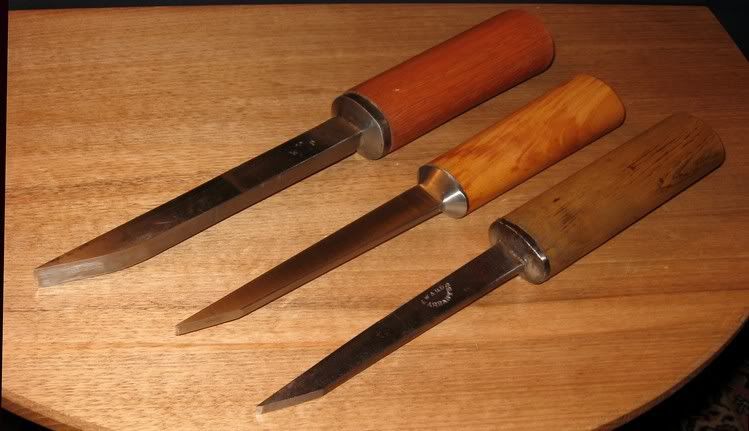
Coming in late, you don't need one.
Andrew F in Australia
>Hi Hamish
You asked:
Are mortice chisels a necessary part of a woodworkers kit?
No, they're not. They're a specialty chisel used for cutting deep mortices where you can't get working space to allow you to twist out the chip. Mortice chisels are a prying chisel.
On a cross-grain application such as a mortice, chisels are driven into the job with a mallet and then the waste removed by twisting the chisel, so that one corner of the chisel stays still and the other corner moves and breaks the timber out.
This is the other reason for the octagonal handles on the old Sorby chisels. The octagon gives you better grip for the twisting.
Would mortice chisels help in the cleaning up process
Not really help in the cleaning up process, just using a mortising chisel is quicker than digging a mortice with bench chisels.
... and if so, what size would be recommended.
The exact size if the mortice you're cutting. A 1/4" mortice needs a 1/4" mortising chisel, etc...
I have also seen swan neck ones advertised that are supposed to help clean up the bottoms. Are they effective?
Yes, they are effective, but not necessary for furniture work. They're a specialty tool where the bottom of the mortice has to be flat -> say, for a concealed lock such as the mortice lock used in drawers.
From the two replies I received, it seems that mortice chisels, although not compulsory, would help to clean up mortices.
When I was trained, the cabinetmakers used standard bench chisels for furniture mortices. They're just not as good at taking abuse as the mortising chisels, so they have to be used slowly. Mortising chisels were designed more for doors, etc... Where the mortice on the stile is 6" deep or so by 3/4" wide.
Does this mean that one should have a whole array of different sized mortice chisels or would a small selection suffice?
A small selection is fine - 8mm (5/16") or 6mm (1/4") is traditional on 3/4" stock. The 1/4" is how I was trained on 3/4" stock, but I can also see Richard Jones' point on using 8mm chisels.
Should your chisel be the same width as the mortice you are cleaning up or could a smaller one do just as well?
Yes.
The English tradition is to use the same width chisel as the width of the mortice. The European tradition is to hog out the waste with a smaller chisel while not touching the layout lines, leaving a ragged hole in the middle of the mortice. You then come back and pare down to the exact mortice width.
I was trained both ways. They both work. I'd venture to say that the German method gave a smooth mortice side which would give better adhesion with modern glues (poor gap filling ability), while the English tradition may have worked better with a glue that relied on mechanical keying as the side of the mortice was rough.
Which sizes would you recommend for carcass construction for house furniture? Finally, are the swan necked ones worth buying too?
If you had to buy one, buy the 1/4" or 5/16". No need for a swan neck chisel.
Just to reiterate, however, you don't need one. Standard bench chisels are fine for cutting furniture mortices, just you need to work slower and take smaller bites.
The mortising chisels are quicker, and in the age when time was money cutting mortices, they made perfect sense.
Cheers,
Andrew