Home Articles Forums Gallery Marketplace Videos

WoodCentral Forums

Knowledge You Can Build On — Est. 1998

A55 Smoothing Plane

Making a workbench top without a workbench - pics

Posts

Making a workbench top without a workbench - pics

#1

Making a workbench top without a workbench - pics

wilbur

>In a post below, Charlie mentioned how it is hard to make a workbench without a workbench. That is true, but I've come up with a little system for my bench top glue up I thought might be of interest.

The first step is to get two sawhorses where the tops are jointed and level. Then I laid several of the boards for my bench top on the sawhorses, and used a clamp at either end to clamp them together.
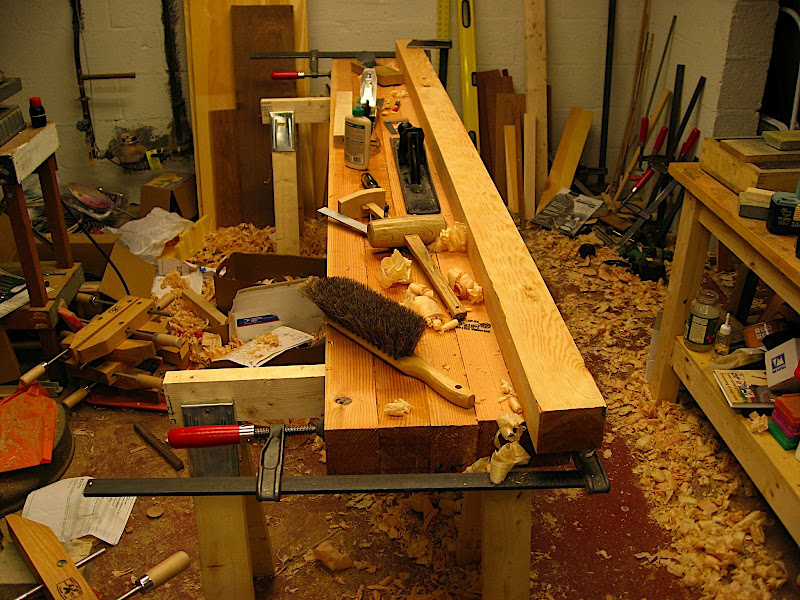

This essentially gives me a temporary bench top. It's not completely level, but it will be good enough for me to square up my boards and to start gluing them up.

At one end, I placed the bar of the clamp above the boards. This is a great plane stop.
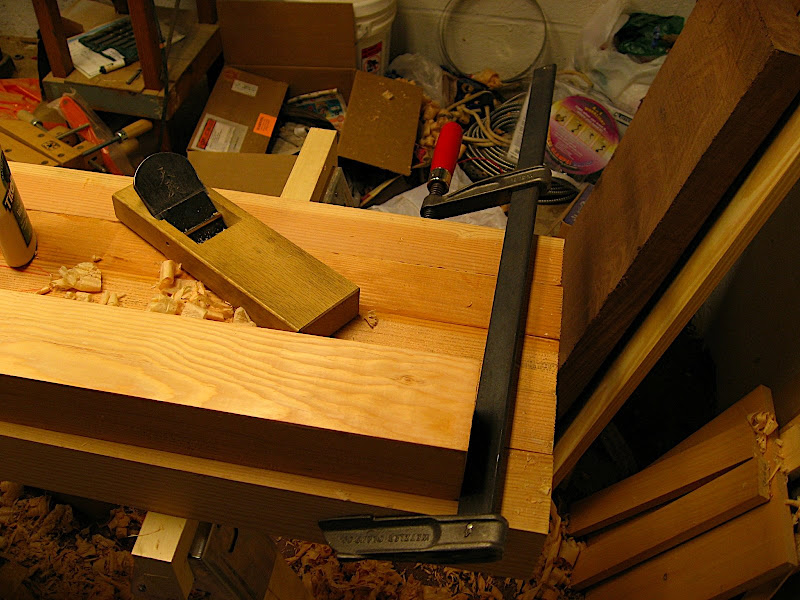

To square up the boards, I worked on them a section at a time. Besides my clamp bar planing stop, clamping the board to the temporary benchtop works really well too, for planing in the opposite direction.


After getting one beam squared up, I'll switch it with the beam that I'll be gluing it to and repeat the process. For the glue up, I took the end clamps off and pushed the beams over to give me space on the sawhorses to do the glue up.
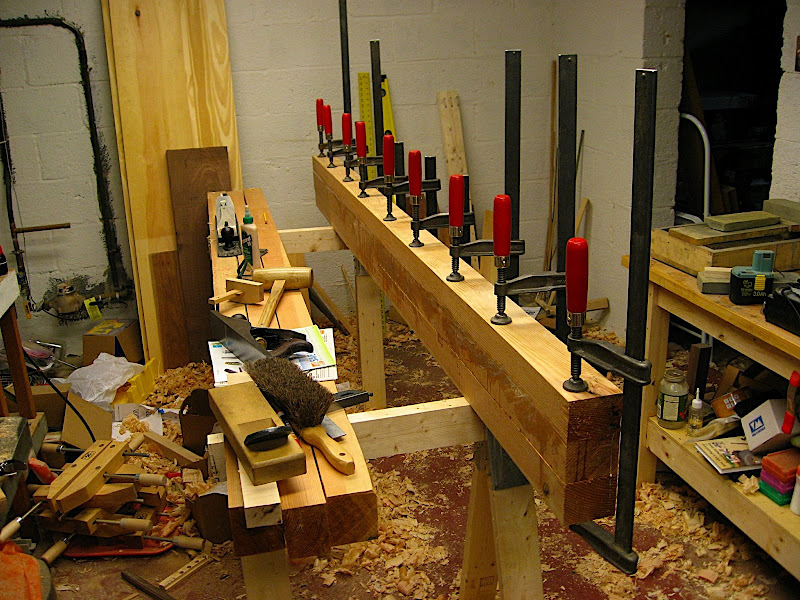

Keep repeating until done. This works surprisingly well.

Re: Making a workbench top without a workbench - pics

#2

Re: Making a workbench top without a workbench - p

Marv....... Northern California Lake Co.

>Thats some nice look'n fir you have there. Hard to find close grained fir anymore as I'm sure you already know. No old growth trees anymore. The trees now being run through the mills are the size we used to call "pecker poles". When Douglas Fir first started being logged here on the west coast the trees were as big as 10 ft. at the base and over 150 ft. tall with no limbs for 75 ft. from the ground. It's sad to see what they are sawing up for lumber these days. Mainly knots and sap wood.

Thats going to be one nice bench top.

I love your shop. Looks alot like mine. A clean shop only means noth'n git'n done.

Marv

Re: Making a workbench top without a workbench - pics

#3

Re: Making a workbench top without a workbench - p

Kevin Adams

>Hi Wilbur--

Looks like that Japanese plane was made for that fir--beautiful finish on it! Did you use that metal jointer I see in one of the photos first?

Please keep the pics coming.

Thanks.

Kevin

Re: Making a workbench top without a workbench - pics

#4

Re: Making a workbench top without a workbench - p

wilbur

>I had to pick through the 4x4 pile over the course of a year to get enough beams for this project. I specifically tried to find quartersawn beams with at least one clear side (or nearly so) for the top, and rift sawn beams for the legs and stretchers. The beams for the top have between 21-38 rings over the 3 1/2" width. I don't know if that is super tight grain, but it sure looks nice.

In what is probably grain match overkill, I'm arranging the beams so that they go up in the closeness of ring spacing as you go from the back to the front of the bench. That will look nice as well. I figure it will be worth it, as I plan on looking at this benchtop a lot as I use it.

Re: Making a workbench top without a workbench - pics

#5

Re: Making a workbench top without a workbench - p

wilbur

>Hi Kevin,

Yes, I put that Stanley #7 to work as well. I also have a #5 with a decently cambered blade that I used for really hogging off material. Once I get this bench done, one of the first things I'll do is to try to tune up this used Japanese plane with a really long dai that I have for use as a jointer type plane, and to take one of my poorer condition Japanese planes, aggressively camber the blade, and open up the mouth for heavier stock removal.

One interesting thing that I noticed in the past is that the #7 and my Japanese smoothing plane seem to joint an edge to the same degree of flatness, even though the Japanese plane is much shorter (22" vs. 11"). I think that this has something to do with the fact that with a #7, you are transitioning the downward force from front to back as you use it. With a Japanese plane you are keeping the downward force on the front of the plane for the entirety of the stroke. It may be that because of the transition, a #7 doesn't use all of the 22" of the sole as a reference at any given moment of the planing cut, whereas the Japanese plane uses the 7" or so of the front of the plane constantly.

Re: Making a workbench top without a workbench - pics

#6

Re: Making a workbench top without a workbench - p

ThomD

>If the assembly rocks at all while planing, just clamp a 2x4 a few feet longer and braced against the wall, that way the assembly would have to move the house, otherwise it is perfectly steady. Yet since the 2x4 projects off the end of the planks, there is plenty of room for the plane to come off them at the end of the stroke.

Re: Making a workbench top without a workbench - pics

#7

Re: Making a workbench top without a workbench - p

wilbur

>That's exactly what I did with my poplar-beam-on-sawhorses temporary workbench, except I used a 1x4 that was nailed into the underside of the sawhorse.

Re: Making a workbench top without a workbench - pics

#8

Lookin' mighty fine there Wilbur!

Scott Burr in Ben Lomond, CA

>It's shaping up to be a great bench. Just curious, where you gonna put that top as you work on the base?

I've been told it's better to do the base first so you have a place to do the top...

Not to say your doing anything wrong.

Re: Making a workbench top without a workbench - pics

#9

Re: Making a workbench top without a workbench - p

Stuart Hough

>Wilbur, that's a great start to your bench. I love the looks of the doug fir! Just wish I could find it here in SC. Keep up the good work, and keep them pics a'comin'!

Re: Making a workbench top without a workbench - pics

#10

my workshop

paul womack

>

If you clamped a simple 1x2 or similar to run from the far sawhorse to the nearby wall, the arrangement would be pretty much unmoveable under normal planing forces.

This would be quite analogous to some Japanese bench ideas, which I'm guessing you're aware of.

BugBear

Re: Making a workbench top without a workbench - pics

#11

Scott....I heard...

Marv....... Northern California Lake Co.

>that you do all your woodworking on your kitchen table. Is that really true or is it just a rumor going around?

Marv

Re: Making a workbench top without a workbench - pics

#12

Re: my workshop

wilbur

>Hi Paul,

That's exactly what I did with my poplar-beam-on-sawhorses setup that I was using as a temporary bench, except that I used a 1x4 instead of a 1x2, and I nailed it into the sawhorse instead of clamping it. :@)

You're right about such a setup being immovable. That's probably why making a "real" workbench dropped down on my priority list to the point that my "temporary" workbench lasted almost 8 months. It worked that well.

Re: Making a workbench top without a workbench - pics

#13

Marv....I heard...

Scott Burr in Ben Lomond, CA

>Ahhhh you don't want to know....

I'm still workin' on mine. Wanna come over for dinner?

Shaving lasagna? With a nice red...