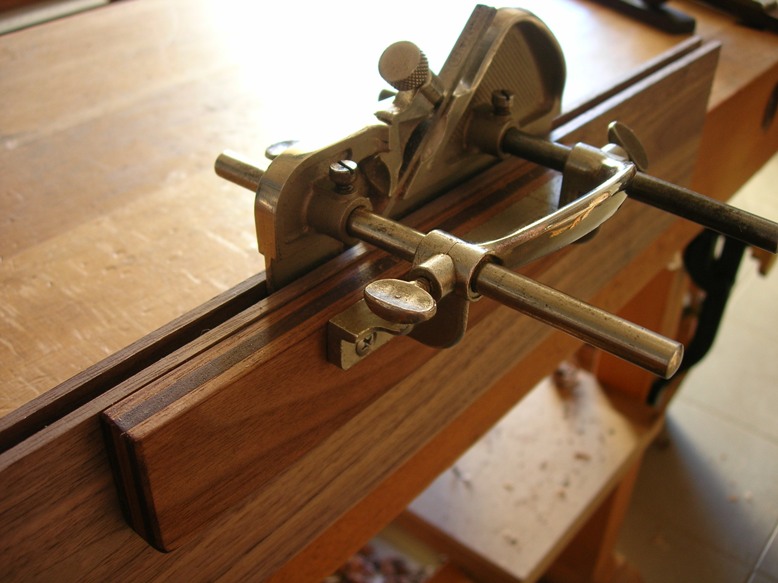
Re: Plough Planes..Well, I'LL BE!!!
Wiley Horne--So. Calif.
>Larry,
That's great news! Here's a couple things you can do......One, measure the gap between the fence and the near side of the cutter. Here's why. When you plough the groove in a drawer side, you want that groove to fall within a tail. That way, when you plough the drawer front, the groove will fall within an open tail socket, and you just make an end to end cut which does not foul the pins. So you want the gap to be large enough to clear the pin, but not so wide that it is taking up unnecessary space within the drawer. Speaking of ploughing all the way through--Derek's article refers to this--when you plough the groove on the drawer sides, if it's a half-lap drawer front, you can plough the drawer side end to end as well, right through the tail, since it will be covered by the lapped front. Anyway, a gap of around 1/2" is comfortable, and there is some leeway which depends on exactly how you lay out pins and tails. But whatever the gap turns out to be, you can adjust if need be, by adding an auxiliary fence, or by planing a little off the existing fence.
IMO, the first thing to do is just sharpen the iron and see how it works--that's the main diagnostic. If it passes that test, then one is cautious about how much 'fixin' it really needs.
For a general exam, tap out the wedge, making sure it's not frozen in the plane body. How does it mate with the iron? Note the V-groove on the bottom of the iron. This mates to the matching V on the skate--you want a solid connection there. Check the wedge: you want the bottom of the wedge (which touches the cutter) to be either straight or ever so slightly concave--I find the latter to be best. The match to the iron at the lower end is particularly important--doesn't have to be dead on at the top. If the fit at the bottom of the wedge is not tight, examine the wedge fit and consider scraping the middle so that it becomes ver-r-r-y slightly concave on the bottom, so that the wedge will be lightly 'sprung' when it's in position.
Sometimes the fence may be a little warped. If so, use judgment whether to plane it back flat. If the plane is working well, I'd go slow on the surgery. Also, if the plane is being moved to a new location, the wood may move over the next coupla three weeks to adapt. That's about it. Let us know how the plane works! It's a great story.
Wiley