Home Articles Forums Gallery Marketplace Videos

WoodCentral Forums

Knowledge You Can Build On — Est. 1998

Fast and affordable laser cutting – so you can make the parts you can’t find anywhere else

Mortise chisel size

Posts

Mortise chisel size

#1

Mortise chisel size

Larry_Wyatt(Cole's Dad)

>I got a bit of cash for Christmas and am going to buy a Ray Iles English mortising chisel. He has begun remaking the pig sticker style mortising chisels.

Here's my question. I can't decide between a 1/4" and a 3/8". Now to some of you this may seem obvious, but I've read many and varied opinion on which size to use. Many say that a 1/4" of tenon is plenty on 3/4 stock. Others disagree ans suggest 3/8 thick tenons. I see advantages and disadvantages to each and I understand them. I'd just like a sampling of opinions from the group.

Your opinions please.

Thanks!

Larry

Re: Mortise chisel size

#2

How's Cole doing?

Wiley Horne--So. Calif.

>Larry,

The following assumes actual 3/4" thickness....I suggest 1/4" if you use 1/4" grooves for the panel. Keeps the dimensions neat.

If you rebate for the panel (rather than groove), then 1/4" mortise allows for 1/4" mold and 1/4" sticks behind the panel to hold it in--which is about right.

Again, if the true dimension is 3/4", then a 3/8" mortise only leaves 3/16" on each side, which ain't much meat left, just looking at it.

Summary: I like 1/4" for 4/4 stock, with true finished dimension 3/4". Second choice 5/16". 3/8" too big.

If it were a big cabinet door, like for a big bookcase, and you were using 13/16" or 7/8" finished stock, I'd say 5/16". Just for the huskier tenon.

Great to hear from you!

Wiley

Wiley

Re: Mortise chisel size

#3

Jack Guzman from Maine

Re: Mortise chisel size

Jack Guzman from Maine

>Larry,I have both the 1/4" and the 5/16" inch sizes.I use the 1/4" for stuff slightly less than 3/4" thick. For most 3/4" stuff I use a 5/16". I like my mortise to be slightly larger than my panel groove. Like Wiley said ,the 3/8" leaves too little material for the mortise sides.I'll use that size for projects where the mortise is in thicker material than the tenon is,as in a table leg.

You'll enjoy your chisel.The more I use mine,the more I appreciate how well it does it's job.---Jack

Re: Mortise chisel size

#4

Re: How's Cole doing?

Larry_Wyatt(Cole's Dad)

>Hi Wiley! Great to see you still around and now the boss! LOL

Cole is doing great. He's 8 now and in the shop with me. This last week I let him burn some wood and use the scroll saw a bit. He was in heaven. Bought him "Woodworking for Kids" for Christmas, so he'll be building a tool box for himself this weekend.

Thanks for the reply. I'm of the same inclincation, but wanted to read some other opinions to see if I'd missed something.

It's curious to me whether the thickness of the walls of the mortise or the thickness of the tenon has more effect on joint strength.

Warm regards,

Larry

Re: Mortise chisel size

#5

Re: Mortise chisel size

Larry_Wyatt(Cole's Dad)

>Hi Jack!

Schwarz, et.al. suggest that the oval handle helps the user put the chisel in a naturally correct position. Have you found this to be true?

Warm regards,

Larry

Re: Mortise chisel size

#6

Re: Mortise chisel size

MikeW

>Hi Larry,

I have both round-handled sash mortise chisels and oval bolstered vintage ones. I have not found the oval handles to aid in lining up to the struck mortise lines.

I do find the oval handles much more comfortable in use, though. I can whack them longer without my hands feeling fatigued. Whether this is because of the larger diameter, or the oval shape (or both) I don't know.

Also, I use only the smaller sizes of the sash mortise chisels. So if I was using the larger sizes alignment issues might be more apparent.

One of the first things my grandfather helped me make that was all mine was also a toolbox. Wonderful memories that. When my granddaughter became interested in working in the shop, scroll sawing was what caught her eye at a local Woodcraft she tagged along with me to. So I bought a scroll saw, some pattern books and she used that thing to death. Also very, very found memories.

Take care, Mike

Re: Mortise chisel size

#7

Re: Mortise chisel size

ThomD

>I normally use the 1/4" chisel. There used to be a fad of making tenons 1/2 the size of the stock on the grounds that it was stronger. But it looks ugly, requires the removal of more material, and could only be stronger in certain situations. A case can be made for creating larger or smaller proportions, even un-ballanced proportions - should the frame of a door have the same tenon proportions as the frame in the seat of a canoe? But for general furniture work I use the 1/4" more than anything else.

Re: Mortise chisel size

#8

Agreed, The 5/16 is the way to go.

Scott Burr in Ben Lomond, CA

>If I was only to get 1 size this would be it. Works well with 3/4" and 4/4 stock.

Re: Mortise chisel size

#9

Mortise chisel handles

Derek Cohen (in Perth, Australia)

>Hi Larry

Long time no hear! I've missed the snippets about Cole.

The Ray Isles Oval (or English) Bolstered mortice chisels are excellent, and their D2 steel really does stay sharp longer than the HC steel of the vintage versions. They work the same and I cannot tell the difference other than longevity of edge.

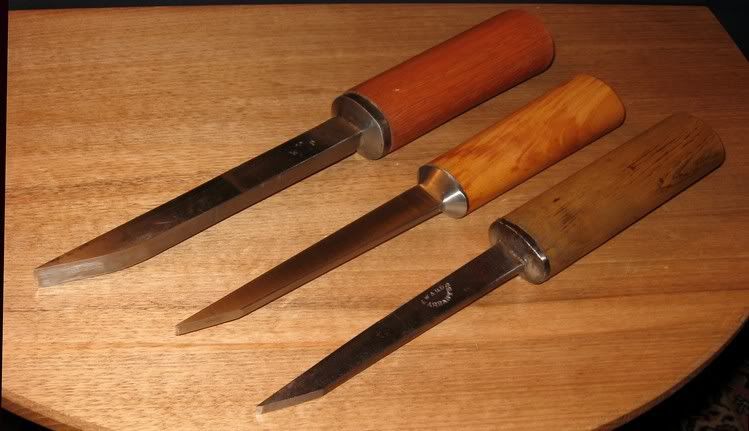
1/4" RI flanked by 1/4" and 1/2" Wards:


A couple of years ago I restored a few Ibbotson mortice chisles. I needed to make new handles and, being socket chisels (of a rather substantial size - they are not dinky in mass at all) I decided an oval type was not indicated. The ones I made were modelled on the Stanley/LN handle, but longer and thicker. They came out like this (1/4, 3/8, 1/2") ...


These turned out to be very powerful - they took a sharp edge and removed Jarrah like no one's business. However, they just did not feel as secure in the hand as the oval-handled type. It is this "security" of grip that improves tracking (other than the blade shape, which was the same trapezoid in both types). I kept wanting to return to those so, in the end, sold the Ibbotsons. Beautiful chisels that are much loved by the owner - I just hope that he does not get tempted to try oval bolstered types! :)

Regards from Perth

Derek

Re: Mortise chisel size

#10

A fantastic discussion

Larry_Wyatt(Cole's Dad)

>Thanks so much, gentlemen, for this discussion. I had narrowed down my choices to the RI 1/4" and the Lie-Nielsen 1/4 and wondered what the opinions would be on the handles, most of all.

I'm going to opt for the Iles 1/4, primarily because of the oval handle. I have two 3/8" sash mortise chisels now and the handles have not felt quite right.

Ooooops, Cole just got a boo-boo on his pinky from a squirrel tail plane. His first plane injury. I'm SOOOOO proud!!! "Suck it up, son. You're a woodworker now!" LOL Teaching him to round the edge of a board into a bullet nose profile. Gotta scoot.

Many gracious thanks to all and a Happy New Year!

Larry

Re: Mortise chisel size

#11

Better than laminated blades?

Scott Burr in Ben Lomond, CA

>All my pig stickers are laminated. You sure these can stand up to them Derek?

Re: Mortise chisel size

#12

Re: Better than laminated blades?

Derek Cohen (in Perth, Australia)

>Hi Scott

The vintage HCS (and, yes, laminated) get really sharp and I am impressed with the pounding they accept, but they still do not last as long as the RI D2. All my mortice chisels have a primary bevel of 20 degrees and a micro of approximately 35 degrees, so I am comparing apples with apples.

The lamination on a typical 7" long vintage runs to about 3" from the bolster. I would guess that it is a good bit thicker than on a Japanese chisel, possibly (from memory) about 1/4" thick at the bevel, about 1/8" thick in the middle until it tapers off at the bolster end. I can take pictures if anyone is interested.

If all I had were the vintage OBM chisels (mostly Wards), then I would still be as happy as a clam.

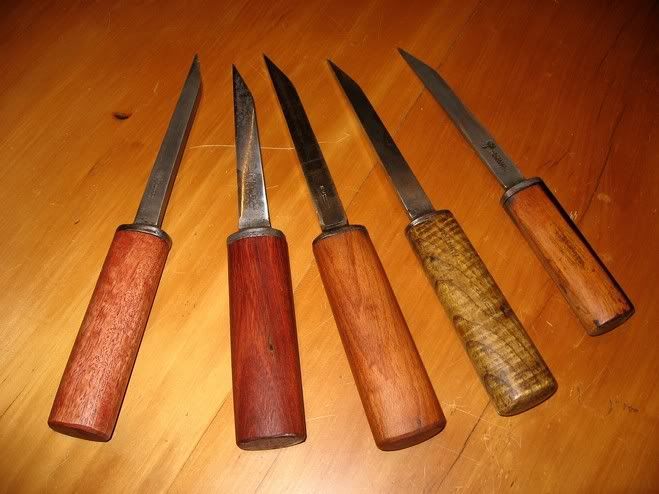
Here's a fun pic ... :)


Incidentally, I have a bunch because they were cheap steel at the time as each (bar one) required rehandling. I use the 1/4" most, the 5/16" next, I get a fair use from an 1/8, but have not used the others much, if at all.

In addition to a 1/4" and 3/8" Ray Iles, there are the following pretty vintage versions ...


Regards from Perth

Derek

Re: Mortise chisel size

#13

Thanks Derek,...

Scott Burr in Ben Lomond, CA

>Mine are old W. Butchers and I have a few Japanese ones as well. Thank you for taking the time to compare the two.

Re: Mortise chisel size

#14

Re: Mortise chisel handles

Pam Niedermayer, Austin, TX

>I must have missed something. Why didn't you make oval bolster handles for the Ibbotsons?

Pam

Re: Mortise chisel size

#15

Re: Mortise chisel handles

Derek Cohen (in Perth, Australia)

>Hi Pam

I kept the handles on the Ibbotsn's traditional partly for semi-historical reasons, and partly because these are socket chisels, not the tanged types as per OBM types. I had some doubts whether a oval handle would remain in position, that is, whether it would twist.

Also, I was curious about the differences with a OBM types of similar dimensions.

Regards from Perth

Derek

Re: Mortise chisel size

#16

I see, good points, of...

Pam Niedermayer, Austin, TX

>course you couldn't make oval handles for socket chisels.

Pam

Re: Mortise chisel size

#17

1/4" right choice

Andrew F in Australia

>Hi Larry,

I haven't read the responses, but when I read your post, the 1/4" is the right way to go.

I was taught by two master tradesmen. The one trained according to UK tradition had the mortising chisel match the width of the mortice. The one trained in the German tradition used a chisel smaller than the width of the mortice and then pared the cheeks down once the hole was cut.

Both were correct.

In your case, you can always cut a wider mortice, but it's a bit hard to cut a 1/4" mortice with a 3/8" chisel.

CHeers,

Andrew