Home Articles Forums Gallery Marketplace Videos

WoodCentral Forums

Knowledge You Can Build On — Est. 1998

Urban Salvaged Hardwood Slabs, Milled In-House from Rare Trees. Shop Unique Walnut Stock.

Scrapers revisited

Posts

Scrapers revisited

#1

Ellis Walentine

Scrapers revisited

Ellis Walentine

>I was doing some experimenting with scrapers and burnishers today and thought I'd share and solicit some opinions/experience from you folks. Notably, I identified several variables at play in the sharpening and use of scrapers. I'm sure there are more.

1. Hardness of the scraper.

2. Quality of the scraper steel.

3. Hardness of the burnisher relative to the metal.

4. Smoothness of the burnisher surface.

5. Quality of the edge of the scraper prior to burnishing.

6. Practicality of edge preparation.

If any of you would care to hold forth, I'd be interested in hearing your thoughts on these variables.

Ellis

Re: Scrapers revisited

#2

Jim in Burlington Ont.

One more

Jim in Burlington On

>Add to equation the thickness of the scraper. You can burnish a big hook and remove some serious curls with one.

Re: Scrapers revisited

#3

Re: One more

Wiley Horne--So. Calif.

>Agree with that. And then at the other extreme, LV sells some 'superthin' (0.010") scrapers that are fantastic for de-nibbing shellac and levelling finishes in general. They're hard (RC51-53) and come jointed and ready to take a burr. One of my very favorite tools, when you're getting down to final surface.

Wiley

Re: Scrapers revisited

#4

Re: Scrapers revisited *LINK*

Wiley Horne--So. Calif.

>Hi Ellis,

Another variable that is really useful, particularly on scraper planes, is the ability to vary the attack angle. Of course, with a card scraper used in your hand, one does this intuitively.

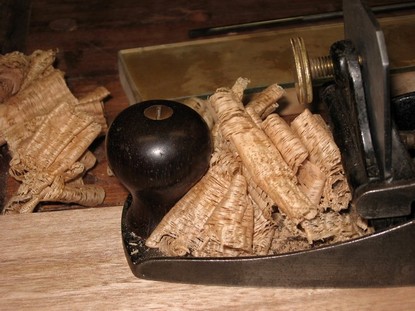
But scraper planes vary in their ability--and ease--of adjusting the attack angle. Where am I going with this? A really great guy I know made a gift to me of one of Paul Hamler's scraper inserts (see link below for photo). Paul himself sent along a graduated set of 1095 scraper blades that he made in various thicknesses. Paul simplified the Stanley 112, 212 mechanism so that the angle is varied by simply turning one knurled screw to dial in whatever angle works best with the hook you just put on the blade.

I mounted my scraper insert on a Bailey No. 6 shoe, using the plane's own frog screws.

Paul Hamler of course builds only to the highest quality standards.

Wiley


Adjustable angle scraper by Paul Hamler

Re: Scrapers revisited

#5

With one exception

Stephen Shepherd in the State of Deseret

>Ellis,

I don't think that No.1 the hardness of a scraper is important, No. 2 the quality of the scraper matters most. I don't think that scrapers are hardened nor do they need to be as the burnishing process work hardens the burr when it is turned on the edge.

Stephen

Re: Scrapers revisited

#8

scrapers

paul womack

>

1. Hardness of the scraper.

2. Quality of the scraper steel.

3. Hardness of the burnisher relative to the metal.

4. Smoothness of the burnisher surface.

5. Quality of the edge of the scraper prior to burnishing.

6. Practicality of edge preparation.


Some of these represent play offs and compromises.

However, I see no reason not to "max out" factors 3 and 4.

By the way, speaking as a member of the free world, I hope all Americans on this forum will vote - one way or the other. Democracy is

too precious to waste.

BugBear

Re: Scrapers revisited

#9

scrapers

paul womack

>I don't think that scrapers are hardened nor do they need

Well, all metals *have* a hardness.

AFAIK commercially available scrapers tend to be around 53 rockwell C, similar to handsaws.

BugBear

Re: Scrapers revisited

#10

Re: Scrapers revisited

MikeW

>Just some random thoughts, Ellis.

I have and use thick and thin, harder and softer scrapers. I prefer softer steel for the hand-held scrapers and harder/thicker scrapers for when I had a scraper plane.

I like the softer steel ones for hand use mainly for speed of renewing the hook, which of course needs to be done more often I suppose due to the softer steel. The trade-off for me is that it is quicker/easier to renew.

I do have a bit of saw steel laying around, which is what the harder ones available from anyone are made from. So I do have a bit of a choice. But I buy softer strip just for hand-held scrapers.

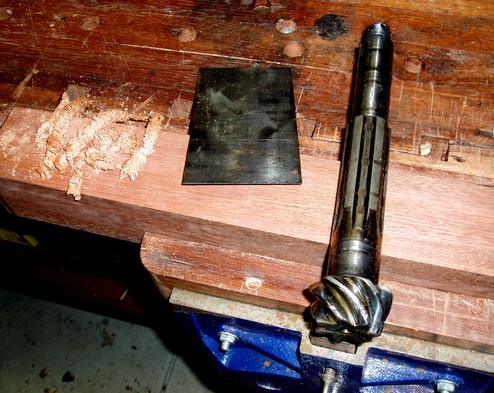
For burnishers, I was given a piece of carbide rod. Nothing has beat that rod for preparing a hook. So I now fall into the hard/smooth is good for a burnisher camp and have given up my chisel shanking ways.

I have long been convinced the better one preps a scraper, the easier it is to create the hook and it is longer lasting. However, I do not see a better surface left behind on the wood. So I no longer go from a smooth file to the burnisher, taking the scraper to the edge of an oil stone prior to using the burnisher.

Take care, Mike

Re: Scrapers revisited

#11

A formidable experiment if done right

Bill Tindall, E.TN

>It will take a lot of work to explore the effects of 6 variables, even if each variable is explored at only two levels. But, if you want to tackle it, I can send you a plan for the experiments that will yield statistically valid conclusions provided you have a response that can be reliably measured. The results will make a great article in some magazine and you will become famous for having reported the only statistically valid experiment ever done in woodworking.

The inclination is to do such an experiment by varying one thing at a time, holding others constant. This approach is not efficient and it will mask the interaction of variables. So for example, on a soft plate, the hardness or the burnisher may not be significant, where as with a harder plate it could be the most significant variable. Now this interaction is easy to imagine. Others might not be and will be found only by a properly designed experiment.

Re: Scrapers revisited

#12

amen on the carbide rod. LV opportunity

Bill Tindall, E.TN

>I don't see why this idea has not become universal. Don't know where to get one?

Any tooling supply house has them cheap as tooling blanks, MSC for example. Would be a great product for LV to sell.

Or, turn around a Formica trim bit, the kind that are solid carbide with a cutting slot milled on one end. Mount it backwards in a stick and you have the best burnisher there can be. When you need to trim Formica take it out and put in trim router. I like multitasking devises.

Re: Scrapers revisited

#13

maybe most important variable

roninkokomo

>The skill of the sharpener honer.

Most of us use way too much pressure to turn the edge

Re: Scrapers revisited

#14

Re: amen on the carbide rod. LV opportunity

Tony Z

>Bill and others,

Regarding burnishers, I would suggest a combination of hardness and polish being a necessity. The carbide Derek and Mike W. speak of have both attributes, and exceeds by several miles the polished drill rod sold by MSC.

In this, I am speaking from experience as I was the guy who sent out spent carbide rods from my manufacturing plant. I (rather, my employees!) manufacturer parts out of powder metal and the carbide rods are used as core pins for the molding dies. In the past we have tried many materials including drill rod, but the high polish and hardness of carbide cannot be surpassed. Further, this particular grade of carbide has a natural lubricity that aids in turning a burr.

Unfortunately, at this time I only have a few pieces in my stock! I would ask Ellis (as the Chief Goose Looney of this site) to email me his mailing address, and I'll "scrape" up a special piece for him. Anyone else that will actually use a piece, also email me and I'll put your name on a list. It may be six months or more, but sooner or later, my guys will create some more scrap carbide that I can send out!

T.Z.

Re: Scrapers revisited

#15

Re: amen on the carbide rod. LV opportunity

Alexander Grigoriev

>LV is actually selling:

1. Open-rod style (freehand) carbide burnisher. http://www.leevalley.com/wood/page.aspx?c=2&p=32643&cat=1,310,41070&ap=1

2. Carbide burnisher contraption with adjustable angle. http://www.leevalley.com/wood/page.aspx?c=2&p=32633&cat=1,310,41070&ap=1

I have #2. Works pretty well, but for standard size and straight edge. For small and curved, use a freehand burnisher. AND, the carbide rod was pretty coarse, I took pains to polish it a bit, but it's still not ideal.

Modern card scrapers are pretty hard. If you try to use Nicholson mill file on them, the file dulls at once. The no-brandname file, though, that LV sells for scrapers, holds OK.

Re: Scrapers revisited

#16

Re: A formidable experiment if done right

Ron In Sterling CT

>Bill

I agree that a controlled experiment with 6 variables when properly executed would provide a vast amount of statistical evidence that would be hard to refute. Having said that, I am going to pass on this experiment as I did enough of that kind of work in my career, and I am enjoying retirement to much now.

Ron

Re: Scrapers revisited

#17

Re:

ThomD

>Burnishing technique makes a big difference, lubricated surface vs not, concaving the edge by flexing it brings up a much more agressive edge, or allows one to go back to the well several times more than normal.

Since I have two metal cutitng belt sanders in the shop with belts from anything from Big Dog to super fine finishing, I tend to maximize my efficiency by just touching the edge to the belt to square and sharpen it, and then raise the burr with an LV burnisher. The edge is great and long lasting but not as good as it would be if properly prepared, but it takes about 1% of the time, and there is not discernable difference in the finish quality. I only use scrapers with stuff I am finishing, normally, and the finish is perfectly happy with less fine finish not more.

I suspect some hardness is necesarry to form the burr. 51-53 is pretty hard. resistance to the burnisher is probably what allows the correct thickness of burr to form.

Re: Scrapers revisited

#18

Re: A formidable experiment if done right

Bill Houghton, sunny Sebastopol, CA again

>I am reminded of my first exposure to social science experimentation, as a class assignment in a political science course. As I remember, I chose something to do with voting.

By the time I had refined the experiment to the point that the instructor was willing to give it a passing grade, the original (and quite significant, as I recall now - though don't ask me to go back 40 years and retrieve what it was!) question had long since become unanswerable within the confines of the experiment.

Some experiments are worth doing. For others, better just to go out and play.

Re: Scrapers revisited

#19

Re: A formidable experiment if done right

Paul Kierstead

>Naw, a zillion people would still post madly about how the test was "limited" and ignored their pet issue or the phase of the moon or some sort. Plus, of course, what would we argue about if we actually had factually based answers? There is always methodology to argue it is more fun to present a collection of anecdotes, hearsay and tradition as fact.

Re: Scrapers revisited

#20

Re: Scrapers revisited

Moses Yoder in White Pigeon, MI

>I didn't read through every response, but a few more variables would be the size of the hook that is turned and the angle the burnisher is held against the scraper. I have learned to prefer a hard scraper medium thick which was purchased in a set from Lee Valley, using a carbide rod for a burnisher and turn a very small hook at about a 10� angle. This I think lasts longer than a large hook and the harder the steel in my opinion would equal longer time between sharpenings. A hard steel takes a nice small hook that is easy to control and lasts a long time.

Re: Scrapers revisited

#21

steel properties

Bill Tindall, E.TN

>The burr can fail by bending or breaking. Several have spoken about the hardness of the steel. A steel property of great importance is toughness. This property is determined by the steel composition and hardness. (toughness usually gets less as the steel is made harder) If the steel is not adequately tough the hook will break/fracture either in preparation or in use. In this regard the carbon steels are good. Just like for a chisel, the most important steel properties will be maximum toughness at optimum hardness. The hardness with resist burr deflection.

If it was made in thin enough stock I would like to have a scraper made of the CPM 3V. It is of exceptional toughness. Where as the burr on carbon steel fractures away early in the edge refining process of a plane or chisel, the burr on 3V can tenaciously hang on through to the end. I often examine the final edge with a glass to ensure the burr is gone or the edge may perform like it is dull.

Re: Scrapers revisited

#22

scrapers

paul womack

>The burr can fail by bending or breaking.

And abrasion, surely?

BugBear

Re: Scrapers revisited

#23

good question!

Bill Tindall, E.TN

>I never examined a "dead edge" under magnification to see. There has been work done on chisels (bending or braking failure predominates) and plane irons (abrasion failure), but nothing I have seen on scrapers. Good project for when I get some other things finally finished.

If the hook can be successfully reformed without resharpening would that imply the failure was from deformation(lack of hardness)? Alternatively if metal is missing after use it would imply abrasion or fracture of the burr tip. Maybe scrapers are the most complex case where all three failure modes are significant in dulling.

Re: Scrapers revisited

#24

Re: steel properties

Tony Z

>Excellent question Bill! Surely there is a tool steel out there that could give us the properties needed for a scraper, especially if the supplier took a look at the "whole" picture when looking for a combination of taking a high polish, with the need to flex (card scraper) and to retain the burr.

In my use of card scrapers with a highly polished carbide burnisher, I get great burr retention and easy set-up with a run of the mill LV card scraper. However, going to Bahco/Sandvik card, I do not get the same results! Thickness of the cards is virtually identical, with the major difference is the LV card has been used for years and the Bahco has hardly been used at all.

My point is, although the burnisher plays a large part in success with the scraper (as does card preparation), I feel the steel used in the card itself has as large a role, and for any experiments to be valid, the exact steel (as well as preparation of the steel) needs quantified (as well as using cards with equal mileage--either all brand new, or all with equal years of use!).

T.Z.

Re: Scrapers revisited

#25

Ellis Walentine

Thank you for all the good input

Ellis Walentine

>I am planning to do a bit more experimenting with burnishers and edge preparation as time permits. I will let you know if I stumble upon any new revelations. My objective, having spent a lot of time sharpening scrapers in my cabinetmaking days, is to find the combination of steel, files, burnishers and techniques that will take the least time and effort, and result in the longest-lasting and most easily maintained edge. Fastest, easiest and best works for me.

Thanks again for the enlightening discussion.

Ellis