Setting up a Woodie on Glass
Derek Cohen (in Perth, Australia)
>Setting up a Woodie with a Glass Blade Setting Block
All those who use wooden and steel planes without adjusters are familiar with the routine of setting up the plane with a freshly honed blade. Typically, this involves placing the plane on a flat service, such as the bench top or a flat board, inserting the blade through the mouth, tapping the wedge into position � or tightening the lever cap � and then adjusting the blade projection in-or-out with a mallet. A rap on the heel will raise the plane, and a tap on the blade will lower it, as will a rap on the toe of the body.
This method has been around for as long as planes have been around. Indeed, Terry Gordon (of HNT Gordon planes) supplies a short hardwood block for this very purpose. He also has a nice tutorial on his website.
For several years I dedicated a hardwood board for setting planes. This was a flat piece of hard Jarrah. It did a decent job and would get close to the setting needed for a fine shaving on a smoother, but I�d still finding I would have to spend time tuning it until it was where I wanted it. Setting up a jack is not critical since one generally wanted a thickish shaving, but a too-thick shaving at the end can destroy all the hard work that preceded it.
There are a few reasons why a plane does not set up well with this method.
The first is that the sole of the plane is not flat or coplanar in the toe-mouth-heel area. A sole with a low mouth will allow the blade to extend further than is wanted for a fine shaving.
Another reason is that the plane is not held firmly against a flat surface when the blade is dropped through the mouth.
And a third is that the setting surface is either too soft or not flat to limit blade projection.
For the past year or so I have been using a sheet of glass to set plane blades. I have mentioned this in an off-the-cuff way before now, but now I will spell it out. I suppose that the thought of dropping a freshly honed blade onto a hard glass surface sounds crazy, but I have never damaged an edge in all the time I have been using this method.
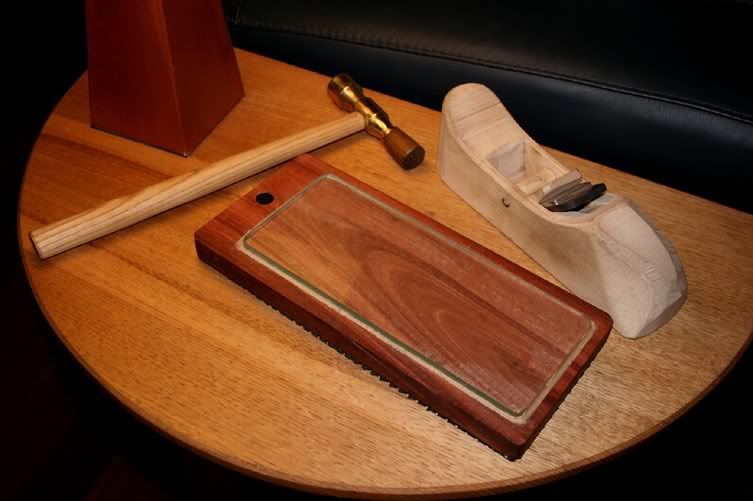
The dimensions for the glass are: 5mm thick and 230mm (9�) x 100mm (4�). This is secured to the wood with silicon at its edge.
Incidentally, that nice plane hammer is one of Dave Anderson�s (Chester Tool Works).
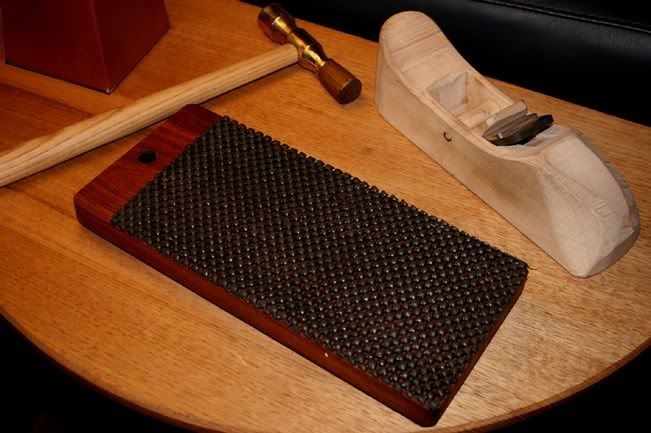
The underside of the setting block has rubber non-slip ..
Place the plane sans wedge and blade on the glass surface. Now slide in the blade and set it down (gently) on the glass so that the blade sits flat along its full length. Continue to press the plane body down very firmly. Insert the wedge and push it in as hard as you can. Use the hammer to secure the wedge (while it lies on the glass) � again, gently!
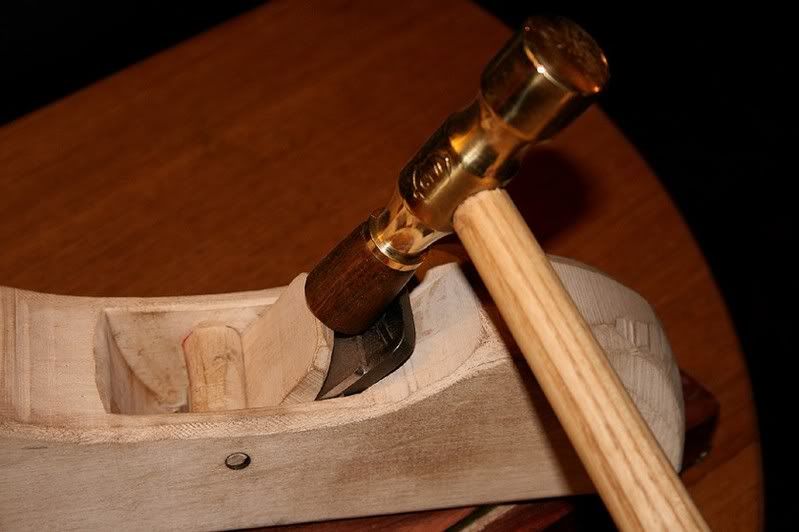
This should be as much as you need to do. The blade should be square to the sole if you have pushed it through the mouth until it registered with the glass.. It should also have minimal projection � enough for the finest of shavings. It is much easier to tap the blade/rap the toe for increased projection than raise the blade if there is too much projection. The reason is simply because raising the blade also loosens the wedge. And this increases the probability of losing blade squareness.
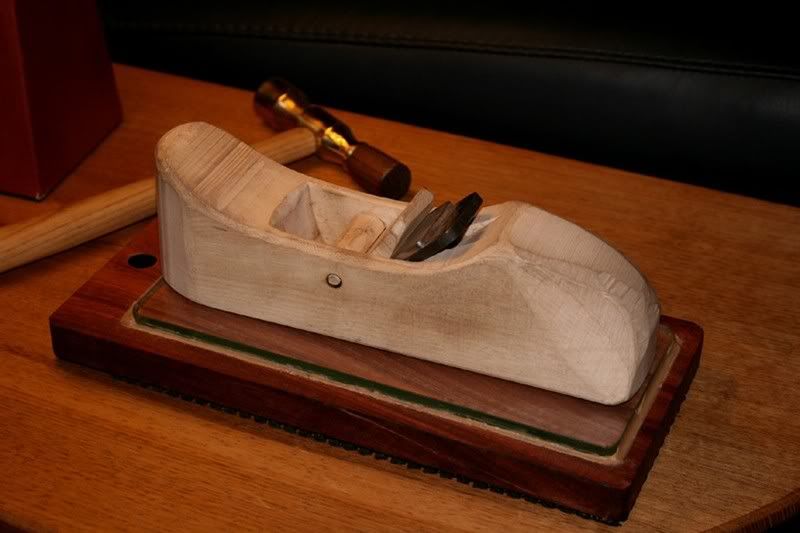
Set to go.
Regards from Perth
Derek
Re: Setting up a Woodie on Glass
#2Re: Setting up a Woodie on Glass
Stephen Shepherd in the State of Deseret
>Derek,
You wrote:' A rap on the heel will raise the plane, and a tap on the blade will lower it, as will a rap on the toe of the body. '
You mean tapping on the end of the toe to lower the plane iron, right? Tapping on the toe in front of the blade opening (on the top of the plane) will raise the blade.
Stephen
Re: Setting up a Woodie on Glass
#3Re: Setting up a Woodie on Glass
Derek Cohen (in Perth, Australia)
>You mean tapping on the end of the toe to lower the plane iron, right? Tapping on the toe in front of the blade opening (on the top of the plane) will raise the blade.
Hi Stephen
I mean tapping the toe at the end of the plane to lower the blade. And tapping at the heel to raise the blade.
Here is the toe ...

The other end is the heel.
Regards from Perth
Derek
Re: Setting up a Woodie on Glass
#4Re: Setting up a Woodie on Glass
ThomD
>That's a new one to me. I adjust in my hand with two fingers over the mouth. Basically as a mater of touch develop a feel for how high the blade is sitting. so that when I tighten the wedge it will not be lower than required, or much higher either. This does not seem to take any particular talent.
In the case of Japanese planes just clunk the blade in since it is depth limited anyway.
Re: Setting up a Woodie on Glass
#5Umm, who made that plane?
Ray Gardiner
>Hi Derek,
Just curious, would I be correct in thinking that, what you have
there is "genuine Krenov" made by the man himself?
Regards
Ray
Re: Setting up a Woodie on Glass
#6Re: Umm, who made that plane? *LINK*
Derek Cohen (in Perth, Australia)
>Hi Ray
I assume that you are referring to the first post - then yes, that is a smoother made by Jim Krenov. Sweet working plane. And this is one that benefits from setting a fine shaving. While I love having one of JK's planes, I love more using it whenever the right project is available.
I did a review of it last year - link below.
Regards from Perth
Re: Setting up a Woodie on Glass
#7Re:Tool Aesthetics
Ray Gardiner
>Hi Derek,
I first looked at it and thought, wow! Derek's standards are slipping, maybe he was in a hurry and didn't have time to finish it.
Not up to the usual beautifully crafted jarrah and she-oak standards we have come to expect.
On refelection, it seemed that perhaps it was something special, now, knowing more about it and the maker,
it suddenly becomes a thing of beauty in it's purity of functionality.
The lack of any attempt at finishing touches serves to emphasize it's purpose.
Funny how a bit of knowledge changes our perception of beauty.
Regards
Ray
PS You have to be JK to get away with it...
Re: Setting up a Woodie on Glass
#8Re:Tool Aesthetics
Victor Parisian
>Yep, my furniture attempts look more like his planes than his furniture. Hopefully that will improve.
Victor - still feeling my oats in Houston
Re: Setting up a Woodie on Glass
#9Re:Tool Aesthetics
ThomD
>"On reflection, it seemed that perhaps it was something special, now, knowing more about it and the maker,
it suddenly becomes a thing of beauty in it's purity of functionality."
That goes to show how subjective and brand conscious we all are.
Not meant in a catty way, but wouldn't that be a Krenov plane from his brutalist period? Not in fact subject to the same design rules/process as his furniture and earlier planes? His reaction to people spending too much time idolizing tools, rather than using them. Which I take to be a sincere statement on his part, but could also be a further upping of the ante on the spiral of definitional one-upmanship. A further example was his concern when these planes were sold for high prices which played heavily into either side of the argument. I think I remember defending his intent on this board, but people took it either way.


