We value your privacy.
We use cookies to enhance your browsing experience, analyse site traffic, and personalise content.
By clicking “Accept all”, you consent to our use of cookies. You can also choose
“Essential only” or learn more.
>I'm in the market for a #4 smooth plane. I'm not sure if I should spend the extra money for a LN or go with the LV. Or for that matter has a completely different suggestion. Has anyone here tried both? If so do you have an opinion? Price is a concern but, I do like to buy quality tools that will last as long as I do.
I own a LN #4 and in my HO it is worth every penny I paid for it !! I have not used the LV. I am sure, however, it is every bit the tool you read it is.
I do own several older Stanley #4's that have been tuned and sharpened. I find myself reaching for, and enjoying using them as much as the LN. You can find very good Stanley #4's on the auction sites for 30-40 bucks, put a good aftermarket blade and, perhaps a aftermarket chip breaker in it and have an extremely good working plane.
I also have L-N planes, side by side with my stanleys. (some with SW blades, some with aftermarket Hock irons, and cap irons) That said, to justify the cost of the bronze, I make sure to buy something I can't find in antique iron... so I went for the high angle 50 degree frog. No regrets, and in use it is clearly a different animal than the normal pitch planes. I haven't managed to justify a 55 degree just yet. Working on it, but not yet. I have a low angle jack, and that takes care of a lot of things.
Personally, I'm a member of the cult of the plane redeemer. We regularly hold our meetings at the Temple of St. Bogus the Mistaken, and we regularly put our noses (and anything else we can find, for that matter) to the grindstone on a regualar basis. Part of the gospel is that the old, good Stanleys have already outlasted whatever generation has died most recently by about 10 years or so... the pre-depression era planes were, quite simply, poetic. But they do take some initial attention to clean them off, re-seat a few things, and flatten them. But they're really wonderful things, given new life, and I think it's kind of an honor to be the guy who will renew their useful existence. My all time fave is a Stanley #3 that's stamped "Imperfect."
Funny how even the old factory seconds cast a long shadow over anything current.
That said, I do understand that there's a large market for an out of the box experience, and L-N and LV are both good for that, though I think their blades, while servicable out of the box, could still use some tuning. Canadian costs less than American. But the steel is more or less equal, at least as far as the A2 goes.
James,
Who's thinking that he should start touching up and reselling old Stanleys, a la Kuc.
>Both planes are excellent, you can't go wrong with either.
However, I think you should really try the Veritas Low Angle Jack before making a decision. Wonderful plane, and immensely versatile. No it's not in the #4 size range (rather like a 5 1/2), but you will be thrilled by the way it works, trust me!
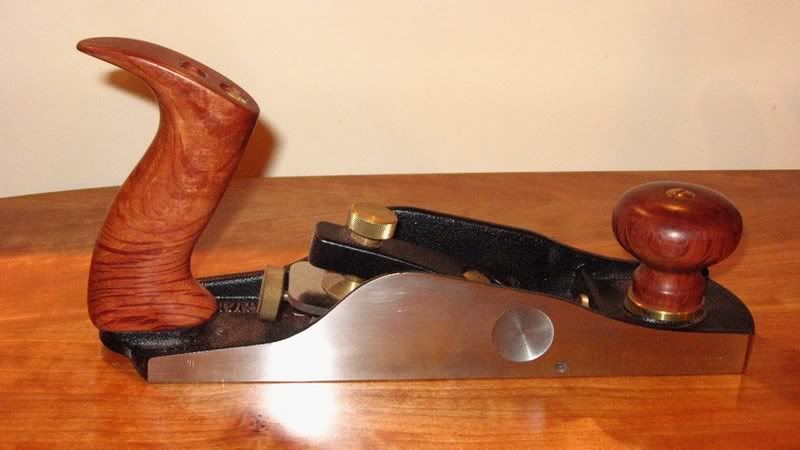
I have the LN #4, and have used a LV #4 on a few occasions. My preferance for BD planes is LN, for BU LV. This really has nothing to do with performance, but more with the feel in my hand, I just prefer the LN rear tote on BD planes. You won't go wrong performance wise no matter which you choose, but I would definately, as Denis said, check out the LV Bu Jack, it's one of my go to planes also.
>I recently took a class in the shop of Mack Headley and Sons (class under the name of "Woodworking Workshops of the Shenandoah Valley"). The shop makes incredible reproduction furniture. I saw 3 planes in the shop, an old No 5 Stanley, a block plane and a shoulder plane. We were asked to bring a No. 5 to the class. The point is that one can build awesome furniture from mahogany, walnut and cherry with just these planes, should that be your objective.
The more I use planes for what I do, the less I see the need to have spent the money for a new LN. But at the time I wanted something to work right out of the box.
>We still live Brother! I too am a member (or wish to convert) to the "Cult of the plane redeemer." We regularly hold our meetings at the Temple of St. Bogus the Mistaken or the Shrine of soon to be unrusted.
Cheers, Scott who wonders how that 605 works so well with a sole that looks like H$ll...
>Well, you asked if anyone had a different suggestion, so I might as well toss one out there.
Are you satisfied with your ability to sharpen a plane blade? And have you seen in person what a tuned plane can do?
If the answer to the above questions is "No", then before getting either a LN or LV plane, I'd look into taking a sharpening or hand tool class of some sort. Or go to your local woodworking club, and find the hand tool maniac. (All woodworking clubs have one, and believe it or not, I'm not the one in ours.) You'll need to sharpen that blade eventually, and if you get that part down, you may find that you'll be able to get a used Stanley with excellent results.
But between the two, I like Lie-Nielsen, mainly for looks, and because I like bevel down planes, but that's just me. This preference has nothing to do with objective data.
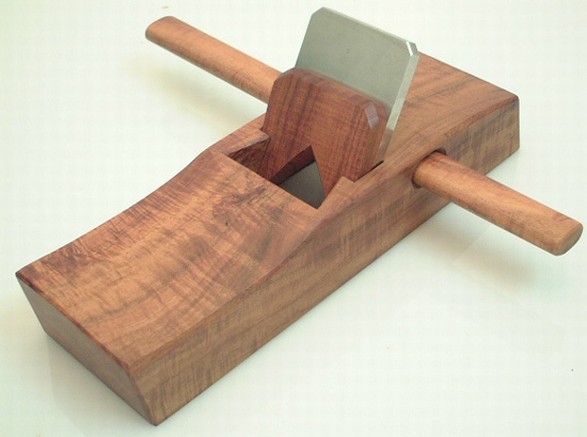
>I like the LN planes better. It's more of a proven design. The LVs can be excellent and also a little gimmicky. I;m not sure this is the example where I would choose the LV. The handle attachement seems a little weak among a number of things. I would choose a wooden bodied plane for real work though.
I think that you need to say what you hope to do with the plane in question. I know that a #4 type plane is intended for smoothing, but there are many variations of this possible, and they may each suit better or worse a different wood or planing style.
If you enjoy using Stanley planes, then I would say that a LN #4 may very well be the natural extension of this. After all, LN are in the business of reproducing these planes and building them to a quality level that Stanley never could. If you get this far, then you have to answer the question about the wood. Straight grained softwoods and medium hard woods are no test at all - most planes can handle them in their sleep. A standard 45 degree frog may be all you require. If you plan to work more complex, figured grains, then the frog angle need to be steeper to increase the angle of cut. LN also provide a 50 degree frog. Personally, I do not find a lot of difference between the 45- and 50 degree frogs, but that may be because the wood I use requires a much steeper cutting angle. I am waiting for LN to make a 60 degree frog for my Anniversary #4 1/2 (which has a 50 degree York pitch). That will be a Killer plane!
There are other 50 degree planes around that are BD and different. One worth trying out is the Blum Smoother. This has a different blade system, so you need to look at it carefully. Nevertheless it works extremely well, and it is one of the best balanced planes I have used - it feels incredibly light (although it is actually not).
I have a review at: http://www.inthewoodshop.com/ToolReviews/Blumplanereview-SmootherandForePlanes.html
The other #4-sized BD plane I can recommend, this time for complex grains, is the HNT Gordon smoother. I have mainly used the original Malaysian-inspired design, and only have praise for the quality of its performance. Again, you need to know that this one uses a hammer to adjust the blade rather than mechanical means. But this is a quick and easy learning experience.
I compared the Blum and Gordon smoothers in the same review, but there is one dedicated to the Gordon on my website as well (see Link below).
The other HNT Gordon plane worth considering is the A55 smoother, which is bedded at 55 degrees and has a mechanical adjuster. It is a light, excellent performer.
Both HNT Gordon planes may also be used as scraper planes by reversing the blades.
One of the reasons that the Veritas LA Smoother is so well liked is that it may be configured for any wood that you choose simply by using a blade with the appropriate bevel angle. A 25 degree bevel angle will give you a great plane for end grain on a shooting board, while a high angle (such as 50 degrees) will plane the most complex, interlinked face grain you can throw at it. Another aspect I like is that this low-centre-of-gravity plane is so comfortable to use. Here is mine ..
Hope this gives you an idea of some of the options.
>I'd like to thank everyone who took the time to respond. I do own a LN low angle block, and I love it. It is my first real plane and the reason I want another. I work mostly figured cherry and have problems with tear out with the low angle. I do keep the blade very sharp, and that helps. But I'm hoping that going to something with a higher angle will work even better. I'm also not sure if I should smack or hug the guy at Woodcraft who talked me into buying a hand plane. I was all power all the time until I got the block plane. And now I can feel myself falling down the slippery slope.
You need planes, lots of planes, the more the merrier.
After all you wouldnt want us to feel silly now dont you?
Jokes asides, I do own a 'few', mostly vintage refurbed Stanleys, Sargents, MF etc but I also have a growing collection of new LN and LV. Its quite a treat to have a plane that work out of the box. Yes a quick honing on the blade doesnt hurt, but they will make nice shavings as is. Never happened to me with a plane from EBay :-)
Bob, who says : you are getting sleepy, buy more planes...
>Clifton planes. They're well made. Also, I'd suggest trying a 4 1/2 size as well. My MF #10 is usually my goto plane. If you can wait until this fall, Stanley is bringing out a new line of premium planes.