Home Articles Forums Gallery Marketplace Videos

WoodCentral Forums

Knowledge You Can Build On — Est. 1998

THE WOODRAT IS BACK!

dovetail angles

Posts

dovetail angles

#1

dovetail angles

Tom Sontag - St. Louis

>By my reckoning it has been almost a full 24 hours since we had a dovetail thread, so I wanted to make sure someone picked up the slack.

A while back I noted that Christopher Schwarz mentioned that his favorite angle for dovetail layout was something like 14 degrees (=1:4). And I see that Veritas has added a 14 degree layout marker to their stable of 7 degree (1:8) and 8 degree (1:6) markers. The ad copy talks about a bigger angle for thinner pieces, which makes some sense.

Before I dive into 5 drawers worth of DTs, which angle do you use for drawers and why? I am using soft maple and the stock is about 3/8" thick. For the carcass (13/16" material), I used the hardwood standard of 1:8, which looks fine. But I am not entirely happy with the way the larger sliding bevel gauge rests on smaller pieces, so am thinking of making or buying a marking gauge. I realize that Frank Klausz just eyeballs and cuts and I could do the same, but taking a little time to get a more consistent result is okay by me. I like the look of lower angles, but function comes first. Maybe the softwood 1:6 is the answer since drawers often have a softwood for the secondary wood. 14 degrees seems, I don't know, kinda ugly.

Re: dovetail angles

#2

I'm making 2 drawers now...

Scott Burr in Ben Lomond, CA

>Cherry fronts and 3/8" poplar sides and backs. I went with 8:1 DT, no problems. The LV gauges work well for DT layout but you can't mark down the edge of the board because of the length of the gauge.

Re: dovetail angles

#3

Re: dovetail angles

Bill Tindall, E.TN

>Lots of people like 14 degrees but I think 7 or 8 looks better. 14 seems too fat to me. I was cutting 7 degrees but have settled on 8 and I think that is where I will stay.

Re: dovetail angles

#4

It all depends.....

Wiley Horne--So. Calif.

>Hi Tom and all,

First off, congratulations on being so far along on your project!

It's an interesting question. About ratios and angles for drawer dovetails. I would say it's an aesthetic choice, rather than the old hardwood/softwood bromide, because the dovetail provides a megastrong drawer join, no matter the ratio.

Aesthetically, what I've noticed is that a given ratio pin--say, 1:7 (~8 degrees)--will look dramatically different depending on whether it is a thin pin entry or not, whether it is a longish pin or not, and how many pins will be used.

I encourage anyone to draw up their pin patterns, either on paper or right on the wood, and see what looks best in the situation. To me, 1:8 or 1:7 tend to look better when you have very thin pin entries and longer pins (like a good 3/4" of pin length in a fat drawer front), and a number of pins. On the other hand, where one is going to use a little heavier pin, or shorter pins (say 5/8"), or only 1 or 2 whole pins, 1:6 or 1:5 begins to appeal more. Because it takes more rake on a shorter pin or a heavier pin to give it some snap.

How many pins per drawer is important too. To take a specific example, I was researching the pin layout used by Thomas and John Seymour of Boston, circa 1790-1810) in their small tables, and they used 1:5. I seriously doubt they said, 'we're going to use 1:5'--they probably figured out what looked best and what would be most functional in the situation, and it just happened to be 1:5. Having been indoctrinated in 1:8 and 1:7 like everyone else, I questioned it. But when it came to actually making the drawer, it became obvious that the Seymours had nailed it. Because these were shallow drawers, with only the two half-pins and a single interior pin in drawers with sides less than 3" high. And they did use saw-kerf width pin entries. In this situation, the 1:5 ratio gave the pins enough meat that they looked right, and looked strong enough to grip the sides well. 1:7 would have looked skimpy in this particular situation.

All this is just to say that 1:7 will look best on some drawers, and 1:5 will look better on others. It all depends. I encourage folks to make these decisions case by case, based on what it's really going to look like in the case at hand, rather than going by a formula.

Wiley

Re: dovetail angles

#5

Re: It all depends.....

Derek Cohen (in Perth, Australia)

>I will reinforce everything that Wiley has written. I began writing the same, then was diverted (work!). So I shall not repeat his clear thoughts.

The hardwood-softwood dichotomy is no longer relevant with todays glues. These create a very strong joint. So dovetails have become a design feature for many, a mark of handcraft for others, and a construction joint for some.

It helps to try and visualise the dovetail shape and its overall impact. Short, long, skinny, wide, spaced, irregular, patterned, etc.

A drawer at 1:7 on a 3/4" thick face .


Below - I wished I had made these pins skinnier at the apex. The 1:8 slope does not work well here in my opinion. The boards are 3/8" thick and the box is small. Perhaps 1:5 would have been better with this width apex, or otherwise it really needed a skinnier tip ...


Dovetail guides help here. Keep a selection on hand. Make your own - this is both fun and cheap.

From left to right: LN (1:6 AND 1:7), WoodJoy (1:6 AND 1:8), and two of my own (1:7 and 1:8)..


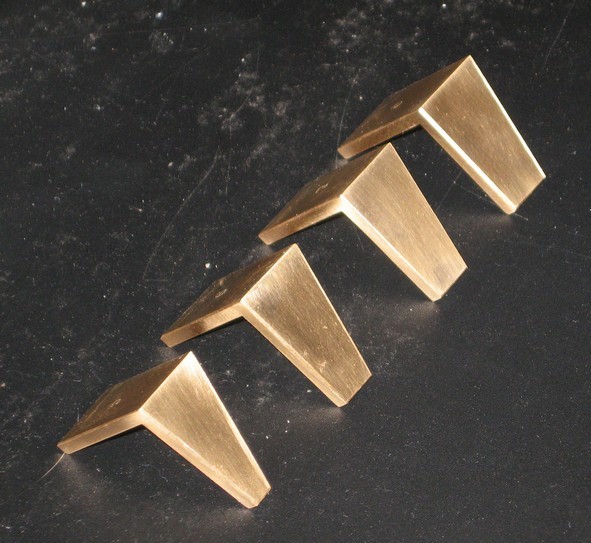
Here is a set I put together in brass for the forum members of WoodNet ... 1:5, 1:6, 1:7, and 1:8


Regards from Perth

Derek

Re: dovetail angles

#6

Derek, can you explain...

Stephen Shepherd in the State of Deseret

>"The hardwood-softwood dichotomy is no longer relevant with todays glues."

Stephen

Re: dovetail angles

#7

Re: Derek, can you explain...

Derek Cohen (in Perth, Australia)

>Hi Stephen

Heh .. I was half expecting your question. :) You call on my great powers of reasoning! :)

I think that the answer is more theoretical than real world. Still ...

My take is that wide tails with ratios such as 1:4 and 1:5 have greater holding strength than ratios such as 1.7 and 1.8. The former have traditionally been chosen for softwoods and the latter for hardwoods. I assume that the reduced compressibility of hardwood allows them to work as well as the softwood angles.

The thing is, as one progresses toward the highest ratio, the side of the tail begins to approach being parallel. Keep going and you will have created a box joint. The strength of a box joint lies in its high glue area. However, the trend towards decorative dovetails (such as the half blind ones in the drawer in my example above), where there are few tails and skinny profiles (= less holding strength), means that these are weaker constructions. So, ergo, greater glue strength means that one may do with less glue area.

Regards from Perth

Derek

Re: dovetail angles

#8

Re: Derek, can you explain...

Warren in Lancaster, PA

>"the former [angles] have been traditionally been chosen for softwoods and the latter for hardwoods." I'm not sure what you mean by traditional. I was under the impression that the two angle system was a 20th century idea. And many times dovetail joints in period furniture have softwood and hardwood together.

Frankly the worst problem in dovetail repair is when delicate pins break. It is a lot of trouble to put in new pins. If you look at 18th and 19th century furniture there is not a problem with glue failure when the dovetail angle is small; usually if the joint comes apart it is sloppy work, and often a sloppy worker uses larger angles.

Re: dovetail angles

#9

Re: Derek, can you explain... *LINK*

Derek Cohen (in Perth, Australia)

>I was under the impression that the two angle system was a 20th century idea. And many times dovetail joints in period furniture have softwood and hardwood together.

Hi Warren

On reflection, and a little Warren-inspired research, I believe that you are quite correct.

The "modern" writers, such as Charles Haywood recommend the two angle system (e.g. 1:5 and 1:8). I also came across a blog of Christopher Schwarz (link below)in which he notes a similar opinion. Extrapolating from his references (which are obviously not exhaustive), the two angle system probably started after 1900.

Regards from Perth

Derek


Dogmatic about Dovetail Angles