Home Articles Forums Gallery Marketplace Videos

WoodCentral Forums

Knowledge You Can Build On — Est. 1998

Exotic Hardwood, Personally Sourced Worldwide. Inspected at Origin. Shop Rare Stock.

Surprise tool

Posts

Surprise tool

#1

Surprise tool

Stephen Shepherd in the State of Deseret

>At the local swap today, I picked up a few nice old tools from a fellow I have bought stuff from in the past. He wanted $5.00 for a socket chisel, rosewood handle putty knife, tapered square reamer (nice long old one) and a folding corkscrew (nice old one).

Then I noticed the box that had the old tools and inquired. He said $30.00, empty. I got the box a diminutive reinforced tool box made mostly of poplar, in the mid nineteenth century, cut nails, nice old green paint on the outside. He threw in the other tools and I got it all for thirty dollars.

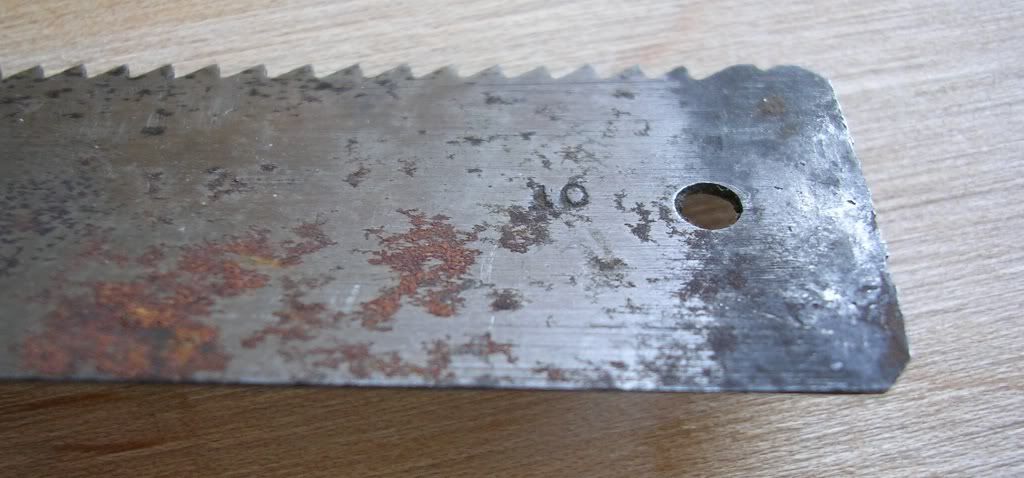
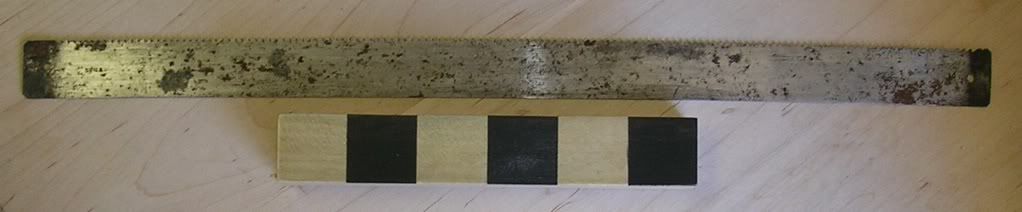
When I got home, I noticed something under the inside edge of the bottom and removed the blade shown below. It is a 10 tpi, 14" (between holes) 7/8" wide rip web blade made by PS Stubs. It has no set, is ground tapered (not on each end) and has never been used and it appears it has never been sharpened other than at the factory. It has a belly to the saw but it is uniform, the back side is concave and the tooth side is convex.

I am not sure what to do with it nor exactly how old it is. If it is an older blade in original condition, perhaps it should be preserved. I am tempted sharpen it up a bit an use it but maybe I shouldn't. There is also what might be remnants of a paper lable on one side.

I think this blade slipped under the side of the tool box and remained hidden until today.

What do you think I should do with it?

Stephen


img

Re: Surprise tool

#2

Small floor saw possibly?

Alan DuBoff

>Stephen,

Nice find. The fact that it has a belly would suggest it be used for some type of floor saw and/or saw that could start a cut in the middle of a board. Although it looks that the belly is slight, I think it would work possibly.

It could be they didn't use that blade as it did have a belly, and their intention was straight blades when this one resulted, so possibly it was tossed to the side, picked up by a worker and eventually ended up with you. Who knows...always nice to fantasize about old tools creating the stories we want...;-)

Re: Surprise tool

#3

Re: Small floor saw possibly?

Stephen Shepherd in the State of Deseret

>Alan,

The belly is 1/16th inch in the middle. Under a small amount of pressure it flexed to slightly less. Under tension in a saw frame I think it would still have a belly. I am wondering if it is put in intentionally? I have a thin blade on a small frame saw and it has a reverse belly, from use, but goes flat or straight when the frame is put under tension.

Stephen

Re: Surprise tool

#4

Re: Surprise tool

Peter Evans

>Interesting find, PS Stubs is not known as a hand saw maker, ie no reference to Stubs in the McConnell/Schaffer book on British hand saw makers.

However Stubs was a maker of hack saws and blades, see http://findarticles.com/p/articles/mi_qa3983/is_200212/ai_n9164354. The brand name was around for a long time, starting in 1777; the company itself taken over before 1970 by James Neill).

Re: Surprise tool

#5

I can think of a couple things... *LINK*

Alan DuBoff

>Stephen,

It is possible that it was done intentionally, Foley made a carrier that would accommodate an arched blade as used on floor saws. But I believe the intention is to be able to start the cut in the middle of a section, so there are a few things that it could work for in that regard, however one would involve putting a (gasp) back on it.

That would be to use it like a stair saw to start a cut in the middle of a board, might be handy for repair work in that regard also, if one needed to start cutting in the middle so they can preserve the edge. Once an edge is broken it weakens a piece severely...*wink*

So, one way is to use it as a "gents stair saw" (tm).

Maybe another way to approach the task, without a back would be to create a saw the used a pull stroke, like a Japanese style saw. Small joinery pull saw could work.

I was thinking about a two man saw, but a small version that would be used by a worker with a handle on one end, and a smaller handle on the other, using like a hand plane or stair saw in function. I would still put a back, because I don't think you would have the precision which seems desirable to me with Joinery.

What advantage would it have over a stock rip or xcut saw? I don't know...to me working wood is just a removal process, not matter how it is done. You can chop it, slice it, cut it, tear it, and even beat or break it apart by the fibers...wood is fascinating...

The old saying, "When you have a hammer, everything starts looking like a nail" could be fitting. A smith uses heat and a hammer to solves problems, a sawyer uses a saw, a chisler (no jokes please;-) uses a chisel, a planer uses a plane...etc...

To me a real craftsman is able to use all of his tools, in all types of ways, some that have never been used before possibly...and have a good command of those tools to use them effectively (and safely;-).

I have also been thinking of small chisel type devices with saw teeth on them to use for cutting slots in wood for inlay possibly, and some do exist, but I have to lastly tell you that I recently saw in an old South Bend catalog, a device that was sold to undercut commutators, isn't Mica the plastic stuff they used? It's called a Mica Undercutting Attachment.

It's interesting as this same concept seems to be used for broaching on metalwork, to create square holes essentially. A file is really only a stiff saw when we think about it, and we can change the pattern even by texturing the surface.

To bring this back to sawing, there are many things that can be done with small saws, by using them in non-conventional ways. Devices one uses with an arm motion to cut/remove wood in that way is such a device. There is nothing that probably hasn't done by folks for ages most likely, a real galoot uses the tools at hand and often one is used for a purpose not that it was intended. As long as it works, I think it's all good.:-)


What is Mica, from page 17 (Mica Undercut Atatch)?
Re: Surprise tool

#6

And of course mini bow saw is the most obvious!

Alan DuBoff

>

Re: Surprise tool

#7

REALLY long stair saw ?

steve mackay

>

Re: Surprise tool

#8

Maker's Mark 

Stephen Shepherd in the State of Deseret

>


img

Re: Surprise tool

#9

Tooth Mark, note taper on back of blade 

Stephen Shepherd in the State of Deseret

>


img

Re: Surprise tool

#11

Re: Stubs saws

Stephen Shepherd in the State of Deseret

>Paul,

I saw that article when I did a search, but I think you have to be a member to see any pictures.

The company was in business for a long time, and I was hoping the mark would provide some idea as to when the blade was made.

Stephen

Re: Surprise tool

#12

Hacksaw blade?

Stephen Shepherd in the State of Deseret

>Peter,

This saw has 10 tpi, stamped on the blade and confirmed by measurement. By the way the blade is .032 at the teeth and .020 on the back. But doesn't that sound course for a hacksaw? Most hacksaw blades have finer teeth.

And according to what I could get from the internet was that the blades were sold unpunched, broken to length and punched. This one is factory punched.

The tooth pattern also doesn't quite line up with the ends of the saw, which are not tapered. The color change in the photograph indicates where the taper grinding starts and stops. Also the back edge is slightly irregular, looks to be hand ground.

Stephen

Re: Surprise tool

#13

Meat Saw Blade

Todd Hughes

>I sort of collect Meat saws, hang them in the kitchen, and I am about 100% positive this is a Meat Saw blade.

Don't know if I ever saw one marked Stubs though I have seen a good many other tools so marked esp. Hand Vises. I have come across more then a few old meat saw blades just like this and in the same condition or even better some being still in their cardbord sleeve.When new I don't think often they had holes in the end because butchers would fit them to thier saws and punch the holes in the distance they needed.

.... I cut some up to make blades for a Stanley 66 beader and they worked very well....If you don't want to make some beader or scraper blades out of it I would pick up an old meat saw and put it in.No reason you have to just cut meat with it, I used to use a nice old meat saw to cut wood with too and worked fine .....Todd