Home Articles Forums Gallery Marketplace Videos

WoodCentral Forums

Knowledge You Can Build On — Est. 1998

Have a question? Ask Woody!

Talk to me about dado planes

Posts

Talk to me about dado planes

#1

Talk to me about dado planes

Dominic Greco in Richboro PA

>

Hi Everyone,

A recent email conversation about carcass saws with Wiley started me thinking (which is ALWAYS a dangerous thing).

He asked why I was using a router plane and not a DADO plane to cut dados. I told him that I was cutting a bunch of stopped dados and that a router plane seemed perfect for the task (and that my LV large router plane worked very well). I also admitted to him (as I do to you here), that I know next to NOTHING about this type of plane.

He mentioned how easy some of the woody dado planes are to use and some points to look for when shopping around (like the nickers needing to be sharp and the blades well honed). (and corect me if I'm wrong here Wiley) I asked him about the Stanley #39 series and he replied that he hadn't much data on them. So off to ebay I went and was sort of amazed to see not too many of them selling (or more realistically, not too many with all the parts and in somewhat good shape)

So, talk to me about dado planes.


  1. Do you have any and how useful are they?


  2. How often during a project do you use them?


  3. Do you prefer wooden ones or something like the Stanley No 39?


  4. I imagine a router plane is more suited for stopped dados, correct?


Thanks!

See ya around,

Dominic
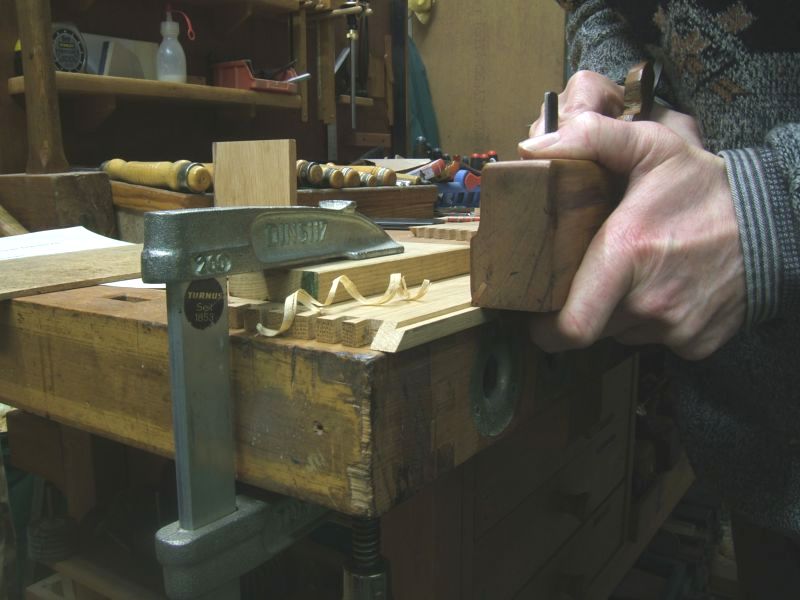
Re: Talk to me about dado planes

#2

Re: Talk to me about dado planes

Dean J in MN

>

# Do you have any and how useful are they?


Yes, I have 5 in various widths. Depending on your typical usage you may find 7/8, 3/4 and 1/2 to be very handy. How useful? I can think of no faster way to cut a dado.


# How often during a project do you use them?


Every case piece I build with drawers have dados to accept the drawer blades and dust boards. And, by butting the case sides together and cutting the dados at once, they always line up! :)


# Do you prefer wooden ones or something like the Stanley No 39?


Woodies. To be honest, I've never seen a 39, nor used a metal dado plane.


# I imagine a router plane is more suited for stopped dados, correct?


I try to avoid designs which require a stopped dado. But if you can not, you can get close to a stopped dado with a dado plane by working from the far side of the board to the near. You'll end up with a "ramp" of sorts you either 1) cover up with mating piece, or 2) finish with a chisel.

-Dean

Re: Talk to me about dado planes

#3

Re: Talk to me about dado planes

Warren in Lancaster, PA

>Dean has given a nice outline. One other option you might enjoy, Dominic, is the Stanley 45 plane. Besides plowing grooves in about 9 widths, it can make dados in about seven different widths. You can also adjust the skates to make exact or intermediate widths like 9/32 if you care to. If you find yourself using the same size over and over, a wooden dado plane or a 39 plane is nice because it is always set up. I have seen 39 planes, but it seems there are not enough around for the collectors.

A lot of energy has been spent describing how to make stopped dadoes by hand. I made them myself when I was a beginner, but not for about 30 years. You rarely see a stopped dado on 18th century work. The reason is that they are too much work and there are lots of other options. If you design around your tools and methods you can avoid having to make a stopped dado.

Re: Talk to me about dado planes

#4

Re: Talk to me about dado planes

wilbur

>I have a wooden Japanese dado plane (actually, it's usually called a Japanese groove plane for some reason) that cuts a 1/4" groove, with double nickers. It's a great plane. I've found that with these planes there's a fine line between them working well, and hardly working at all. The key is to make sure that the main blade is not taking too heavy of a cut, and that the tips of the nickers are just below the level of the main blade.

Once I got mine tuned up, I found that I used it a lot more than I thought I would. Even though it's a 1/4" plane, you can use it to cut wider grooves by shifting the plane over after completing the first groove.

I haven't used a metal dado plane, but I have used metal plow planes, which are very similar. I like the wooden plane better, but it's not a huge preference so far.

I wouldn't worry about the sharpness of the blade or nickers if you are looking for a used plane. After all, you'll have to sharpen the blade and nickers eventually.

I do use a router plane for stopped dados. You can't really use a dado plane for this task because the nickers ride ahead of the main blade.

There's some good pictures of what a Japanese groove plane looks like on this site: http://store.wvtools.com/jagrpl9in.html

Re: Talk to me about dado planes

#5

Okay, I give up

wilbur

>How do you put the drawer bottom in without a stopped dado?

Re: Talk to me about dado planes

#6

Re: Okay, I give up

Dean J in MN

>??? Now I'm confused? Dado's for a drawer bottom?

I just plow a groove in the drawer sides and front. Or cut rabbets if you are setting them in a rabbet and using runner strips like some 18th C work.

-Dean

Re: Talk to me about dado planes

#7

A No 45 for dados?

Dominic Greco in Richboro PA

>Warren,

You wrote:

"...One other option you might enjoy, Dominic, is the Stanley 45 plane. Besides plowing grooves in about 9 widths, it can make dados in about seven different widths."

This is good news because I just finished restoring a No 45 and have used it to just drawer grooves and rabbits. But always close to the edge of the work piece (within 1/2").

I didn't think that a No 45 would sork in this situation. The reason I thought that a dado plane would be more useful was that the dados I just made (and plan to make in an upcoming bookcase project) were across the width of (somewhat) wider boards and further away from the edges. I assumed that with a dado plane you would use a wooden straight edge or batten clamped in place so that you can ride the dado plane against it when first forming the joint. Can you do this with a No 45?

Thanks,

Dominic

Re: Talk to me about dado planes

#8

Re: A No 45 for dados?

Warren in Lancaster, PA

>For casework, I usually nail a temporary batten to the inside of the case. You have to remove the fence and turn down the nickers. Adjust the width between the nickers for your dado width. The cutter should be slightly narrower than the nickers so the nickers are doing the edges, not the edges of the cutter. You cannot dado with the 1/8 or 3/16 cutters because they use only one skate.

Re: Talk to me about dado planes

#9

Re: Okay, I give up

wilbur

>That I understand. What I am being dense about is how you keep the groove from being seen on the outside of the drawer without making a stopped groove.

Re: Talk to me about dado planes

#10

Don't, I give up

Pedder Broockmann

>If I undestand the question correctly, there are two ways:

mitred boards or half blind dovetails.

Re: Talk to me about dado planes

#11

Re: Okay, I give up

Pedder Broockmann

>Wilbur, a picture might help, although it's not a groove but a rabbet

(not me but a german forum member)


img

Re: Talk to me about dado planes

#12

Re: Okay, I give up

Dean J in MN

>Are you asking how the groove in the drawer sides is hidden from the front? The drawer front is half blind dovetailed to the sides.

Or am I reading your question wrong?

-Dean

Re: Talk to me about dado planes

#13

Re: Okay, I give up

Wiley Horne -- So. Calif.

>Wilbur,

It's a half blind drawer. The drawer front terminates in half pins top and bottom. You run the groove in the bottom tail of the drawer sides. The continuation of the groove on the drawer front is between pins, so not visible there. The termination at the front of the drawer sides is hidden by the lap of the drawer front. At the rear of the drawer, you can see the grooves, because you're looking at the insertion of the drawer bottom--it's all exposed. So there are three full length grooves, which cannot be seen.

Wiley

Re: Talk to me about dado planes

#14

Re: Talk to me about dado planes

Wiley Horne -- So. Calif.

>Hi All,

I did have a nice email exchange with Dominic regarding saws and planes for cutting dados. I have had good luck obtaining dados on line. Here are the guidelines that I use, that I sent to Dominic:

Things to look for,

1. Decent appearance.....a few hammer tracks are OK, but I want to see the maker's mark, and want to see nice wood, and wedges that aren't beat to crap. If it's a stylish escapement, that's a pretty good indicator of overall quality. Plus the name brand makers in both UK and US did fine work. Appearance is a good tipoff as to overall condition. If it's a beater, forget it, something else will be wrong. Body warped, who knows?

2. Both wedges present....for main blade and nicker.

3. Nicker blade present.....sometimes it ain't.

4. I'd look for a dealer who knows what he's selling. They're usually pretty honest about faults.

______

What I've found is that the wooden dado plane is simple enough, that if it was made well in the first place, it'll still be good 100-150 years later. As I mentioned to Dominic, the main thing you have to detail is to make sure the nickers line up with the edges of the main blade. On the half dozen dados I've bought sight unseen, the nicker and main blade lined up pretty well, but in a couple cases, the nicker did not terminate in sharp knives, and needed a little file work. Other than that, sharpness goes without saying, same as any cutting tool.

Wiley

Re: Talk to me about dado planes

#15

Thanks!

wilbur

>Thanks, everyone. I knew it was something obvious that I was overlooking.

Re: Talk to me about dado planes

#16

Wooden dado planes problem??

Jim in VA

>On many of the old wooden dado planes I have seen (and the few that I have) the nickers line up with the main iron, but the "nicker iron" is quite a bit wider than the plane body is thick. Now I realize that the nicker iron has to be somewhat wider so that the body will clear the dado, but it sticks out from the body on each side to such and extent that it would appear to difficult to run along a batten.

I've always wondered if the wooden bodies had shruck a bit over the last 130 years or if there were made that way. Any thoughts?

Re: Talk to me about dado planes

#17

OK, you asked for it Dom...

Scott Burr in Ben Lomond CA

>Do you have any and how useful are they?

Yes, I have 6 of them.

How often during a project do you use them?

Anytime I need to cut a groove, rabbit or dado.

Do you prefer wooden ones or something like the Stanley No 39?

I've never used a wooden one. I'm currently on the hunt for one.

I use metal ones all the time. I can't recommend the NO. 39 series.

They only cut one width and there a bit uncomfortable to hold.

My personal favorite is the NO. 46. I have a fond spot for my Miller Patent. Pictured

I imagine a router plane is more suited for stopped dados, correct?

Not necessarily. If you and run one end of the dado out to the edge, say out the back of casework their very easy to cut with a plow plane.


img

Re: Talk to me about dado planes

#18

Re: Drawer bottoms

Moses Yoder in White Pigeon, MI

>Next week sometime I should be ready to make the drawer boxes. 9 if I remember correctly. I plan on sharpening my saw and chisels first. So I have been thinking about drawer boxes. I have found that I intensely dislike putting stopped dados in drawer sides. The reason is because box sides are normally pretty thin and the little bit of end grain left in the stopped dado pops out very easily. It can be fixed, but things should be designed in such a way that the required work is pleasant. The drawer fronts on the sideboard I am working on are going to be separate from the box and screwed onto the front after the box is assembled. I have decided to run a groove for the bottom all the way through the sides and then simply dovetail the drawer ends above the bottom, attaching the bottom to the ends with screws. I thought about using slips to install the bottom but they will not work very well in the piece I am working on. The slip either takes some interior drawer space or has a groove that is impossible to clean out, which is fine in more traditional work but not as popular with modern housewives.

Re: Talk to me about dado planes

#19

Re: OK, you asked for it Dom...

Moses Yoder in White Pigeon, MI

>Is that the reproduction made by Paul Hamler (if I remember correctly) ? I found my type 4 #41 Miller's Patent plane was not worth a hoot for grooving. It doesn't have the nickers, and there is nothing to really lock the iron into place. I plan on actually using my #46 sometime soon and seeing how that works. I think if you plan on doing this for a while and need a variety of sizes the #46 is a good plane to have. If I remember right this has nickers on both sides of the iron and is skewed so it should work well for dados. The wooden dado planes would be less initial investment and if you need only 2 or three sizes to play with they would be a better deal. I think the #39 works well for dados but is limited to specific sizes which has been mentioned. If you do buy them from the bog of eternal stench try to make sure they have the nickers and all the misc. parts as the parts can cost more than the plane.

Re: Talk to me about dado planes

#20

Moses is wise man...

Scott Burr in Ben Lomond, CA

>Yes, that�s my Hamler copy. Your right it's nickerless (sorry couldn't help myself with the spelling 8^). If you knife the grooves before hand it works fine.

I think the 46 is the best all around plane for this type of work. Yes, they have knickers in all the appropriate places for grooving.

Yes, their are expensive if you get a "real full blown with all the blades" If you find a nice complete one with out blades, you can always get a set (or individual ones) blades from our very own Jim Reed.

Hey Jim, where are you BTW!?!

This should bring the cost down to a reasonable level.

Your are correct in making sure these planes have all their pieces.

Re: Talk to me about dado planes

#21

Re: Wooden dado planes problem??

Wiley Horne -- So. Calif.

>Hi Jim,

I can only offer my amateur observations. Which go like this....As you point out, both edges of the nicker blade and the main blade have to clear the "runner" section of the dado plane. For the same reason that a plough blade has to clear its skate. There is surely a correct technical term for the runner section of a dado plane--I'll just call it the 'runner' for right now, til someone shows up with the correct term.

The 5 dado planes I have vary among themselves as to how far the nicker cutters and main blade extend beyond the runner. Three of them are pretty tight (like 1/64" or a bit less of overage), while two of them I would say are a full 1/32" outside the runner. I don't think it makes a difference, so long as the main blade edges and the nicker cutters line up.

Here's why. The dado plane is going to be fenced on the right side, which is flat from top to bottom--the right side of the runner is simply the right side of the plane. And no matter the width of the cutter, the cutter is skewed so that it will line up on the right side of the plane, at cutting depth. [Did I say dados were 'simple'? They're not that simple--the skewed blade is really a slick trick.] Anyway, when you get ready to make the cut, set the fence right on the mark you've made. Then 'right justify' the nicker and main blade--press them up against the fence til they're about flush, or tap them with a mallet or any likely stick of wood you can reach, and make them about flush with the right side of the plane. At this point, they may stand out on the left side of the runner by 1/16"--so what? As long as they line up, you're still good. They're gonna cut the channel properly.

Now if the right side nicker cutter will not flush up to the right side of the plane, the problem likely is that the cutter has no flare. Generally the nicker cutters are flared a bit beyond the nicker body on either side. If it is not so, my opinion is that you want to fettle the nicker so that the cutter edge is the rightmost element. I have found this simple to do, but it takes about a 1000 words to describe all the possibilities and remedies, so I'll quit here and see if the above makes any sense to you.

Wiley

Re: Talk to me about dado planes

#22

Now for the errata.....

Wiley Horne -- So. Calif.

>1. One of my dado planes, a 3/4" Malloch & Sons, of Perth (Scotland), is left handed. Fence it to the left side.

2. Two of my right-handed dados are _not_ flush on the right side, as I stated above. A 1/2" Wetherell, Chatham and a 1/4" A. J. Wilkinson & Co., Boston. They have shallow rebates for the lower inch and a half on the right side, but would still be flush to the fence on that side.

Wiley....feeling kinda stoopid.

Re: Talk to me about dado planes

#23

Re: Moses is wise man...

jim reed @ tallahassee

>I'm still making shavings AND cutters. Gotta admit that the #46 is my favorite dado plane. I hate nickers, so I use a boxcutter instead--not very traditional, but works like a charm.