WoodCentral Forums

Est. 1998 — 27 years of woodworking knowledge

VERITAS Low Angle Spokeshave

Posts

VERITAS Low Angle Spokeshave

#1

VERITAS Low Angle Spokeshave

Marc in Luxembourg

>Hi all,

We recently had a brainstorming over there in the German forum on how to plane a concave curve of radius 4inches on a board. There were many ideas and I followed the one of the spokeshave. So I ordered a low angle model by Veritas. It worked not as bad as a scraper blade but I couldn't avoid chatter. First trials ended up like this:

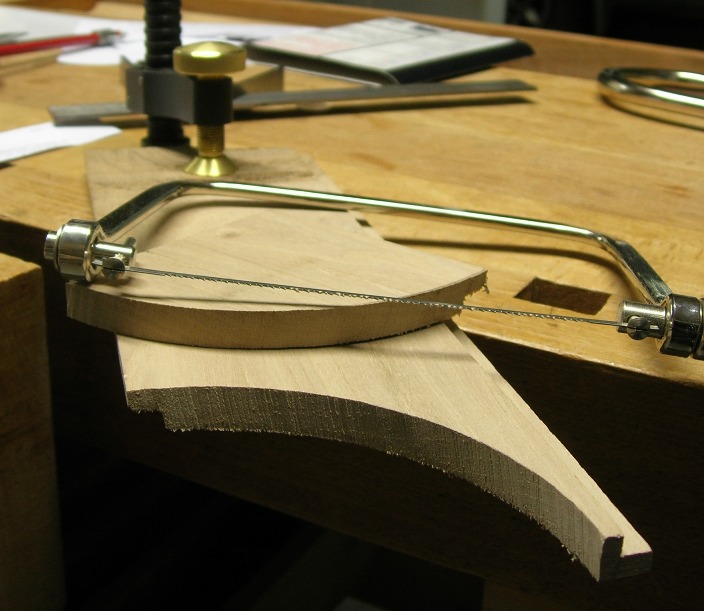
1. I sawed with a coping saw.

2. Results of a first attempt. Chatter on the curve.
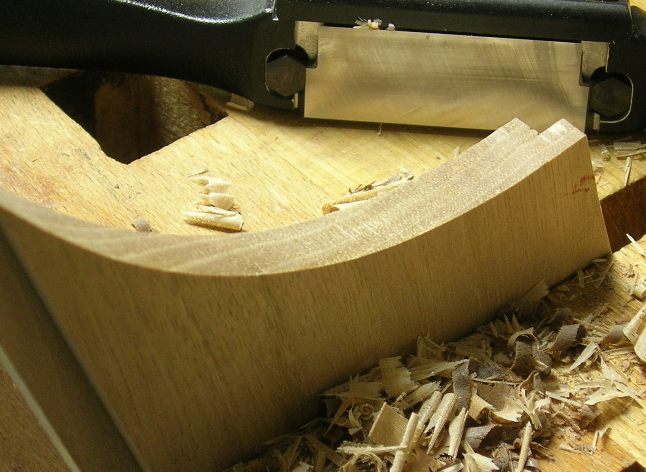

I came to the conclusion, that the toe piece was to short to make a stable rest and this could cause the chatter. So I built a new wider aluminum toe piece with a slightly smaller radius than the 4 inches of the board's curve.
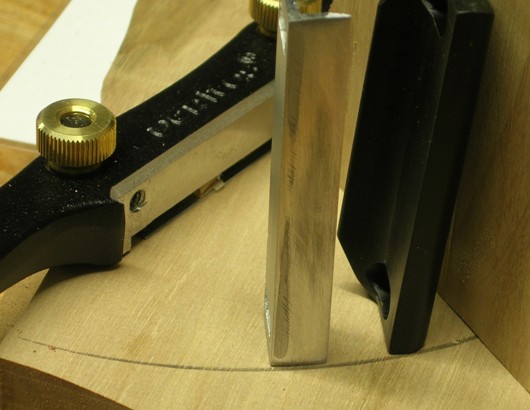

But the heel of the blade touched the workpiece in the curve. The spokeshave only took off shavings on the start and the end of the curve.
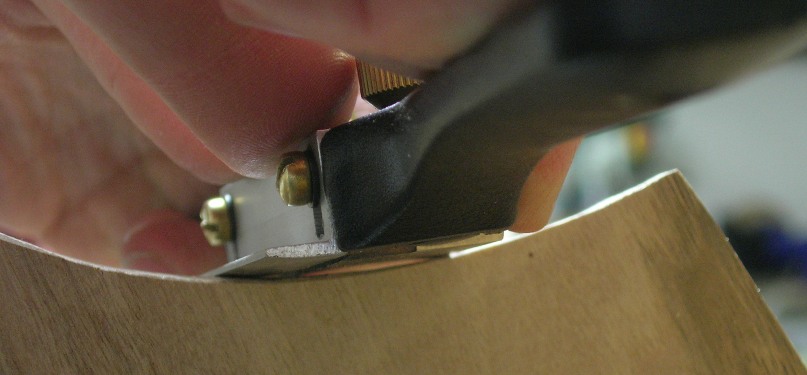

A second filing session gave the toe piece a smaller radius. And see now it worked okay. Planing first one edge long like I would chamfer, then the other edge always skipping the blade a tad more towards the centre. Finally two or three strokes shave the center. The result is fine ... for me. What do you think? And what did you do?
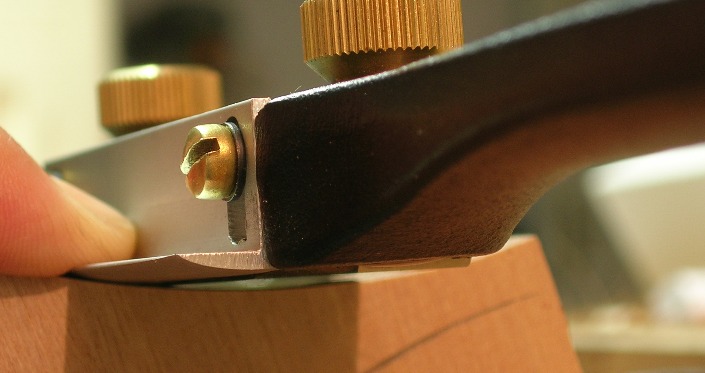

Thanks for looking and sharing,

Marc

Re: VERITAS Low Angle Spokeshave

#2

Re: VERITAS Low Angle Spokeshave

dave brown

>I'd use a spokeshave and skew the shave heavily. Or, combine skewing w/ moving the spokeshave laterally as you move it forwards.

Alternately, if I had my no20 tuned up (compass plane), I'd use that.

Re: VERITAS Low Angle Spokeshave

#3

Re: VERITAS Low Angle Spokeshave

Wiley Horne

>Marc,

Finding a shave for a particular curve is an interesting problem, and you've made a excellent solution. Veritas could offer alternate toe pieces, and extend the range of their shave, within some limits.

I had a similar problem, involving finding a shave to get into a very tight curve (the bottom curve of what is called a 'therm foot'). I obtained a cigar shave, but could only get it to chatter, as the tightest part of the curve was essentially end grain, and the cutter did not have direct bedding under it.

I wrote to Thomas Lie Nielsen, who offered to machine a tighter curve onto the LN 'small bronze shave'. We agreed, and Thomas reduced the radius of a small shave from the factory version of 1-1/2" down to about 1-3/16". This solved my problem. I was very appreciative, as Thomas did not even charge for the custom machining--just the stock price of the shave.

Anyway, you have produced an elegant solution to the problem, and it seems like it would be worth a note to Lee Valley.

Wiley

Re: VERITAS Low Angle Spokeshave

#4

Re: VERITAS Low Angle Spokeshave

Moses Yoder in White Pigeon, MI

>If I get chatter marks with the spoke shave I usually just remove them with a scraper. The spoke shave is probably the best tool for fairing smaller radius curves. For large radius long curves I use a #113 adjustable radius plane.

Re: VERITAS Low Angle Spokeshave

#5

Re: VERITAS Low Angle Spokeshave

Marc in Luxembourg

>Dave,

You mean skewing the way you do with a plane in order to narrow the blade's width and the effective pitch angle? Hm, it is not possible because of a tight radius of 4 inches. The low angle spokeshave had only slight clearance at the heel of the blade. For the compass plane, it is not built for those tight concave curves.

Thanks for your appreciation,

Marc

Re: VERITAS Low Angle Spokeshave

#6

Re: VERITAS Low Angle Spokeshave

Marc in Luxembourg

>Wiley,

Two other toe pieces of different radii would certainly be helpful. It would make the low angle spokeshave a sophisticated allrounder avoiding chatter on variable concave curves. Some machining on the flat edge of the existing toe piece could do the job.

I never used a cigar shave. It is a learning curve I reported to the future, but I guess, it is a bit like using an old Stanley or new Kunz spokeshave with a rounded sole. Please tell me if I'm wrong. The rounding is too pronounced and the shave lacks a stable rest on the workpiece. Derek reported on another forum from Terry Gordon, that the shave tends to roll at the point where the blade touches the workpiece. I concluded of this and of my small practice, that the toe of the tool has to be as long as possible in order to avoid chatter.

I don't know what is a "therm foot", a google image search provided only footwear photos...

The purpose-made tool for the task is to machine or file a sole adequately to the desired radius as you did by asking Thomas Lie-Nielsen to make you a custom made shave. I now wonder how much radii are necessary to dispose of.

Thank you for your appreciation, Wiley, I will make a note to Lee Valley.

Marc

Re: VERITAS Low Angle Spokeshave

#7

Re: VERITAS Low Angle Spokeshave

Marc in Luxembourg

>Moses,

Thank you for your comment. I had negative results with a scraper blade. It hooked easily on the curve and those marks were tedious to get rid of later. So after encountering the chatter marks with the original low angle spokeshave I thought of using a purpose made scraper shave with a rounded sole. I didn't put into practice this idea as I had acceptable results with the new toe piece. But the idea isn't lost and as soon as I will have some spare time I will try...

Marc

Re: VERITAS Low Angle Spokeshave

#8

I would have used one of these... *LINK*

Scott Burr in Ben Lomond CA

>Or one of these:

http://www.leevalley.com/wood/page.aspx?c=1&p=49710&cat=1,50230&ap=1

Just ditch the brass wear plate and radius the front.

Then there are always files and sandpaper.


The round one...

Re: VERITAS Low Angle Spokeshave

#9

Re: I would have used one of these...

Marc in Luxembourg

>Hi Scott,

You're right, many roads lead to Rome and we just had an abstract discussion over here. The woodworker who asked, finally drawed on a sanding block but wasn't quite happy about it. Some people, me included, dislike wet and dry... For what is the spokeshave kit of old, one can install a rounded front piece that fits the purpose. One convenience is the depth of merely half an inch. I didn't give it a try because I would have to wait a week and then yet to start tool work.

For what is the Veritas rounded spokeshave I could not find an information of the radius. So it would have been guesswork. Maybe I should have given Canada a call, but... The LNs Boggs rounded spokeshave has a radius bigger than that of 4 inches. The Preston model has a 1 1/2 inch radius which I think is not adequate. All this is unlucky because the euro rates that good now.

Marc

👍 This page answered my questions

Your vote helps other woodworkers quickly find the answers and techniques that actually work in the shop.