WoodCentral Forums

Est. 1998 — 27 years of woodworking knowledge

glue in the endgrain

Posts

glue in the endgrain

#1

glue in the endgrain

les winter

>I'm building some small boxes and using through dovetails. I have the dovetails set 1/32 below the surface and I plane the entire face level after glueup.

I got glue into the endgrain of the pins and tails, and it looks awful under a coat of shellac. For the next go-around, I sealed the endgrain with shellac before glue up. Didn't help much.

The glue gets in pretty deep.

Has anybody here a better proceedure?

thanks

Les
Re: glue in the endgrain

#2

Re: glue in the endgrain

Pam Niedermayer - Austin, TX

>Why use glue at all? The nice thing about dovetails is they are mechanically strong.

Or, why not peg them rather that glue?

Or, why do you want through dovetails?

Pam

Re: glue in the endgrain

#3

Re: glue in the endgrain

Pam Niedermayer - Austin, TX

>Or, make them proud?

Pam

Re: glue in the endgrain

#4

Re: glue in the endgrain

Robin Corell, in Atascadero CA

>Or use hot hide glue.

Robin

Re: glue in the endgrain

#5

Re: glue in the endgrain

Hank Knight

>Les,

Everybody has their favorite method, so I'm sure you will get lots of suggestions. Rather than planing the sides, I leave my pins and tails a little proud, maybe 1/32", and plane them flush when the glue dries. This leaves a fresh face on the end grain. I find an added benefit with this method: the planing tends to crush or spread the end grain fibers ever so slightly, even with a sharp plane. This "mushrooming" will close or fill small (emphasis on "small") gaps in the joint. Go light when you apply the glue, you don't need much. The joint should go together with very little squeeze-out. My $.02.

Hank

Re: glue in the endgrain

#6

Re: glue in the endgrain

MikeW

>Hi Les,

I leave my pins proud, mainly put glue on end-half of the pins (though I often put a light amount near the outside of the tails), usually use hide glue (liquid, not hot) and trim the pins flush after the glue sets.

If it is a box with little room inside, I either shellac the inside before assembly or use blue painter's tape on the inside before assembly to minimize how much squeeze-out has to be cleaned up.

Take care, Mike

Re: glue in the endgrain

#7

Hide glue

Warren in Lancaster, PA

>As Robin suggests, you would not have this problem with hide glue, which is much kinder to finishes and especially to water stains.

If you must use the low class yellow stuff, here are some suggestions. Use a brush about the same width as the thickness of the boards and spread glue lightly and carefully on the surfaces so as to reduce the chance for squeeze out. When you put the pieces together avoid touching the squeeze out beads. Remove them later with an awl or a pick when they are partly dried.

If things are going well, you could probably reduce your finish planing by going to a 1/64 differential.

Re: glue in the endgrain

#8

Interestingly Enough

Jim Shaver - Oakville, Ontario

>Hi Pam,

To support your point about the mechanical strength of a dove tail, an example of my own.

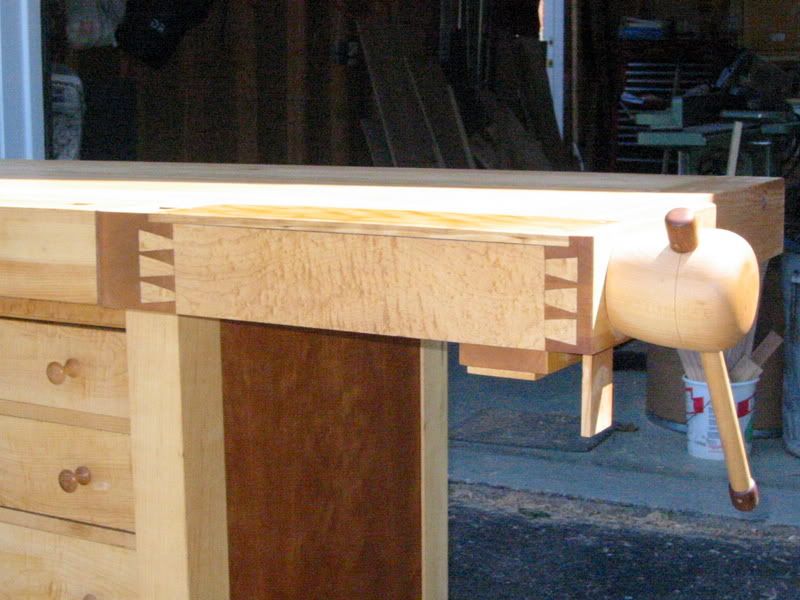
I built a work bench in a Shaker style a few years ago, one of the features was the tail vise. I cut and dove tailed the side board into the all wood design. I set and tapped the dove tails in for a "Dry Fit" (oh how I work differently now). Well I never went back to it to remove and glue it in.

Photo Sharing and Video Hosting at Photobucket

I have been using this vise as my main holding vise now for almost 5 years, and not once have I felt that I needed to pull that side board off and attach it with glue. It was just an omission that I forgot to glue it in, but even now I still see no need to change a thing.

Just thought I'd share that.

Take care,

Jim

Re: glue in the endgrain

#10

Re: I'm in the same camp as Hank...

les winter

>Thanks everybody.

Proud it would be.

Pam, I use dovetails because I like them. No other reason.

I use glue because with a 1/4" thick or so wall, the mechanical clamping is not too strong.

Perhaps hide glue (not the hot stuff) is a good idea and I'll try that.

regards

Les

Re: glue in the endgrain

#11

Interesting Hide Glue is always the best choice

Stephen Shepherd in the State of Deseret

>

Re: glue in the endgrain

#12

puzzled that this is a problem

Bill Tindall, E.TN

>I just finished 7 drawers and glue on the end grain was not an issue. I suppose not because the end grain needs to be sanded, or planed if one insists, or it will not suit my expectations for attractiveness. I fit the assembly so that the sides are proud of the pins a slight bit, plane to the pin ends(which removes scribe marks) and sand the pin ends till smooth and non porous, which removes yellow glue just fine. In this state the pin end grain does not absorb excessive stain and it all turns out looking just fine.

If the end grain of the pins is not sanded (or planed) it is going to look rough from how ever it was sawed and over absorb stain and finish. In my hands removing the torn grain from sawing (by sanding in my case) removes any glue squeeze out on the pins.

Re: glue in the endgrain

#13

Re: Interesting Hide Glue is always the best choic

Tom Colligan

>Let's get going on that book, Stephen, ya hear! :) Tom

Re: glue in the endgrain

#14

Re: puzzled that this is a problem

les winter

>Well, you have an inteesting point. I had been planing down the faces to the end grain and just enough beyond to plane the end grain smooth. Maybe a few more strokes would have done it.

👍 This page answered my questions

Your vote helps other woodworkers quickly find the answers and techniques that actually work in the shop.